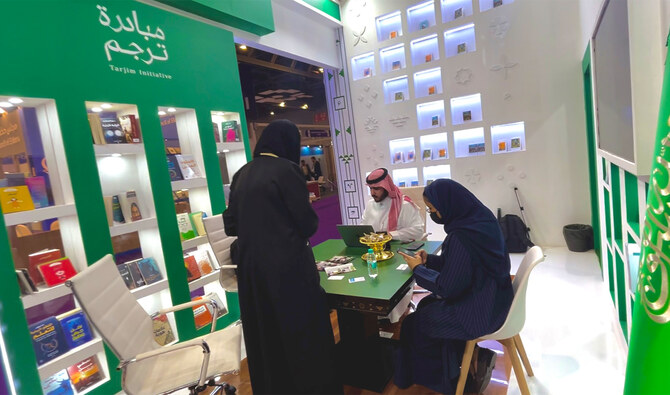
Saudi pavilion at Delhi book fair showcases English translations of Kingdom’s literature

The Tarjuma initiative corner of the Saudi pavilion at the New Delhi World Book Fair, New Delhi, India, Feb. 4, 2025. (AN Photo)
Short Url
Updated 07 February 2025
Follow

Saudi pavilion at Delhi book fair showcases English translations of Kingdom’s literature

  • India’s second-oldest book fair is attended by 2,000 exhibitors from 40 countries
  • Saudi Arabia was guest of honor of the New Delhi World Book Fair in 2024

NEW DELHI: Saudi Arabia’s exhibition at the New Delhi World Book Fair is bringing the Kingdom’s literature closer to the Indian audience by showcasing its English-language translations under the flagship Tarjim initiative.

Inaugurated in 1972, the fair in the Indian capital is the country’s second oldest after the Kolkata Book Fair.

Organized by the National Book Trust of India, the event started on Feb. 1 at the Pragati Maidan convention center and will run through Feb. 9. It is attended by 2,000 exhibitors from some 40 countries.

Saudi Arabia — which in 2024 was guest of honor of the book fair — this year is represented by the Literature, Publishing and Translation Commission, a government agency regulating and managing the literature, publishing and translation sectors in the Kingdom.

The part of the exhibition that has drawn significant interest among Indians comprises English translations of Arabic works published under the Tarjim program, which was launched in 2020 to promote international cultural outreach under the Kingdom’s Vision 2030.

The books displayed at the New Delhi fair included classics, fiction, and short stories.

Mona Lisa, a Delhi-based lawyer who came to the venue to visit the Saudi pavilion, appreciated the exhibition as a way to remove linguistic barriers and help Indians grasp the Kingdom’s culture.

“It’s nice to know that Saudi Arabia is trying to bridge the gap in terms of language,” she told Arab News.

“It’s a nice move by Saudi Arabia ... by the way of literature we’ll be able to know the culture, the people better. It’s always good to know something that you didn’t know before. It’s good to know the culture as well. And I’m looking forward to seeing much more.”
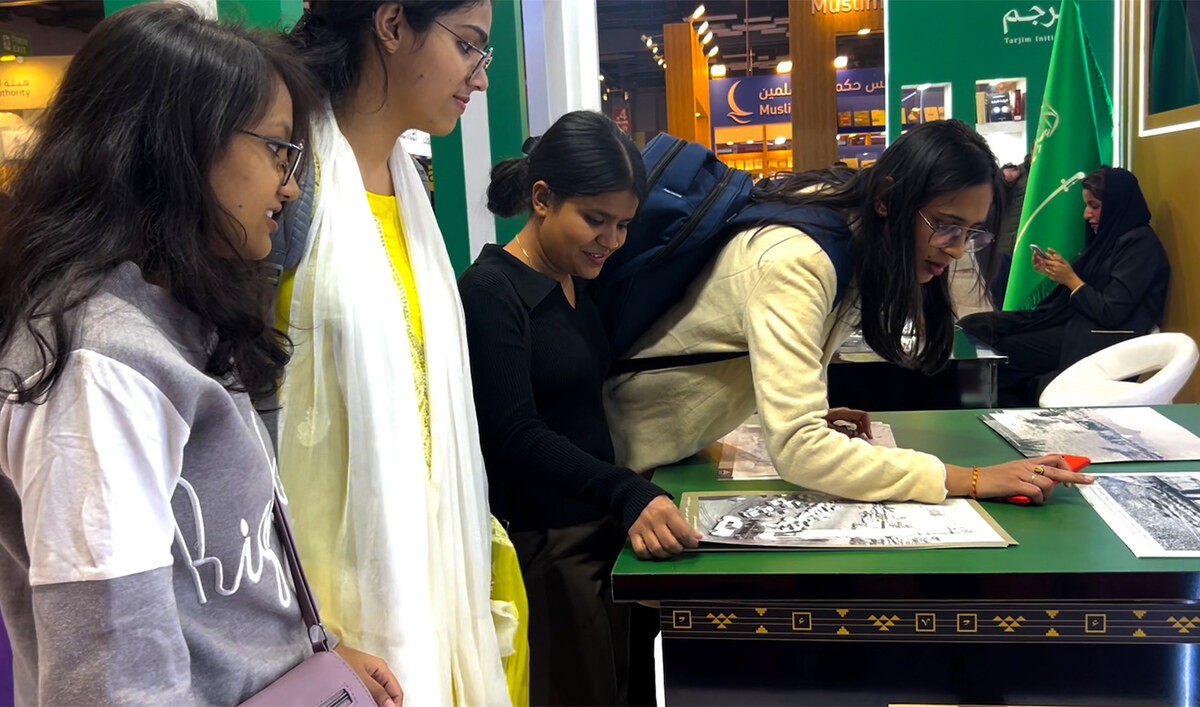


Visitors look at archival photos displayed at the Saudi pavilion at the New Delhi World Book Fair, New Delhi, India, Feb. 4, 2025. (AN Photo) 

Another visitor, Zohra Fatima, was drawn especially to short fiction stories as a means to imagine and understand life in Saudi Arabia.

“It seems very interesting ... To know deep inside their culture, one has to read this kind of tales,” she said.

Besides the translations, Saudi Arabia’s pavilion has also presented the country’s national bibliography — a catalog of all publications, including books, articles, and reports, produced within the Kingdom.

“National bibliography is basically a list of books published in a particular country,” said Dr. Prathasari Das, library information officer at the National Library of India, who was studying the works displayed at the exhibition.

“It is very nice to see this bibliography here to introduce the print culture — the print output in Saudi Arabia — to India ... Books are those mediums which connect different cultures around the world, so it’s like a window. I think that it will be a great help or great opportunity for Indians to see and mingle with this culture.”

For some like Shivani Nagar, a French linguistics student in New Delhi, visiting the pavilion was not only about literature, but also the Arabic language.

“I met the employees here and they taught me some words in Arabic, and I found it really interesting and, in my mind, I’m really hoping to learn more,” she said.

“It’s very good that they are putting English books so that I can learn about Arab culture in English, in my language ... (and) I can know about the culture, and (then) I can turn my goal to learning Arabic.”


Uganda partially restores internet after president wins 7th term

Supporters of President Yoweri Museveni celebrate his winning the polls. (AFP)
Updated 9 sec ago
Follow

Uganda partially restores internet after president wins 7th term

  • “The internet shutdown implemented two days before the elections limited access to information, freedom ‌of association, curtailed economic activities ... it also created suspicion and mistrust on the ‍electoral process,” the team said in ‍their report

KAMPALA: Ugandan authorities have partially restored internet services late after 81-year-old President Yoweri Museveni won a seventh term to extend his rule into a fifth decade with a landslide ​victory rejected by 
the opposition.
Users reported being able to reconnect to the internet and some internet service providers sent out a message to customers saying the regulator had ordered them to restore services excluding social media.
“We have restored internet so that businesses that rely on internet can resume work,” David Birungi, spokesperson for Airtel Uganda, one of the country’s biggest telecom companies said. He added that the state communications regulator had ordered that social media remain shut down.
The state-run Uganda Communications Commission said it had cut off internet to ‌curb “misinformation, disinformation, ‌electoral fraud and related risks.” The opposition, however, criticized the move saying ‌it was ​to ‌cement control over the electoral process and guarantee a win for the incumbent.
The electoral body in the East African country on Saturday declared Museveni the winner of Thursday’s poll with 71.6 percent of the vote, while his rival pop star-turned-politician Bobi Wine was credited with 24 percent 
of the vote.
A joint report from an election observer team from the African Union and other regional blocs criticized the involvement of the military in the election and the authorities’ decision to cut 
off internet.
“The internet shutdown implemented two days before the elections limited access to information, freedom ‌of association, curtailed economic activities ... it also created suspicion and mistrust on the ‍electoral process,” the team said in ‍their report.

In power since 1986 and currently Africa’s third longest-ruling head of state, ‍Museveni’s latest win means he will have been in power for nearly half a century when his new term ends in 2031.

He is widely thought to be preparing his son, Muhoozi Kainerugaba, to take over from him. Kainerugaba is currently head of the military and has expressed presidential ambitions.
Wine, who was taking on ​Museveni for a second time, has rejected the results of the latest vote and alleged mass fraud during the election.
Scattered opposition protests broke out late on Saturday after results were announced, according to a witness and police.
In Magere, a suburb in Kampala’s north where Wine lives, a group of youths burned tires and erected barricades in the road prompting police to respond with tear gas.
Police spokesperson Racheal Kawala said the protests had been quashed and that arrests were made but said the number of those detained would be released later.
Wine’s whereabouts were unknown early on Sunday after he said in a post on X he had escaped a raid by the military on his home. People close to him said he remained at an undisclosed location in Uganda. Wine was briefly held under house arrest following the previous election in 2021.
Wine has said hundreds of his supporters were detained during the months leading up ‌to the vote and that others have been tortured.
Government officials have denied those allegations and say those who have been detained have violated the law and will be put through due process.