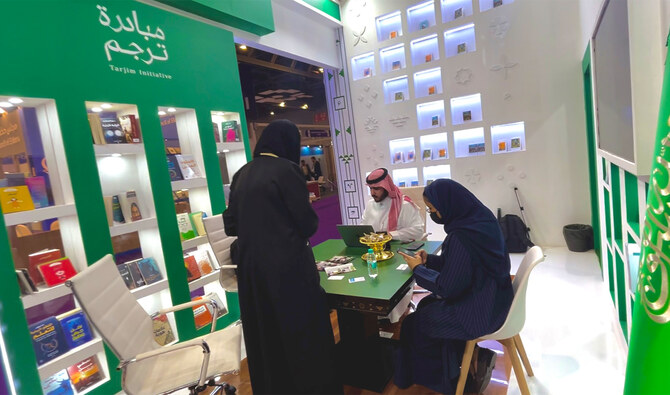

NEW DELHI: Saudi Arabia’s exhibition at the New Delhi World Book Fair is bringing the Kingdom’s literature closer to the Indian audience by showcasing its English-language translations under the flagship Tarjim initiative.
Inaugurated in 1972, the fair in the Indian capital is the country’s second oldest after the Kolkata Book Fair.
Organized by the National Book Trust of India, the event started on Feb. 1 at the Pragati Maidan convention center and will run through Feb. 9. It is attended by 2,000 exhibitors from some 40 countries.
Saudi Arabia — which in 2024 was guest of honor of the book fair — this year is represented by the Literature, Publishing and Translation Commission, a government agency regulating and managing the literature, publishing and translation sectors in the Kingdom.
The part of the exhibition that has drawn significant interest among Indians comprises English translations of Arabic works published under the Tarjim program, which was launched in 2020 to promote international cultural outreach under the Kingdom’s Vision 2030.
The books displayed at the New Delhi fair included classics, fiction, and short stories.
Mona Lisa, a Delhi-based lawyer who came to the venue to visit the Saudi pavilion, appreciated the exhibition as a way to remove linguistic barriers and help Indians grasp the Kingdom’s culture.
“It’s nice to know that Saudi Arabia is trying to bridge the gap in terms of language,” she told Arab News.
“It’s a nice move by Saudi Arabia ... by the way of literature we’ll be able to know the culture, the people better. It’s always good to know something that you didn’t know before. It’s good to know the culture as well. And I’m looking forward to seeing much more.”
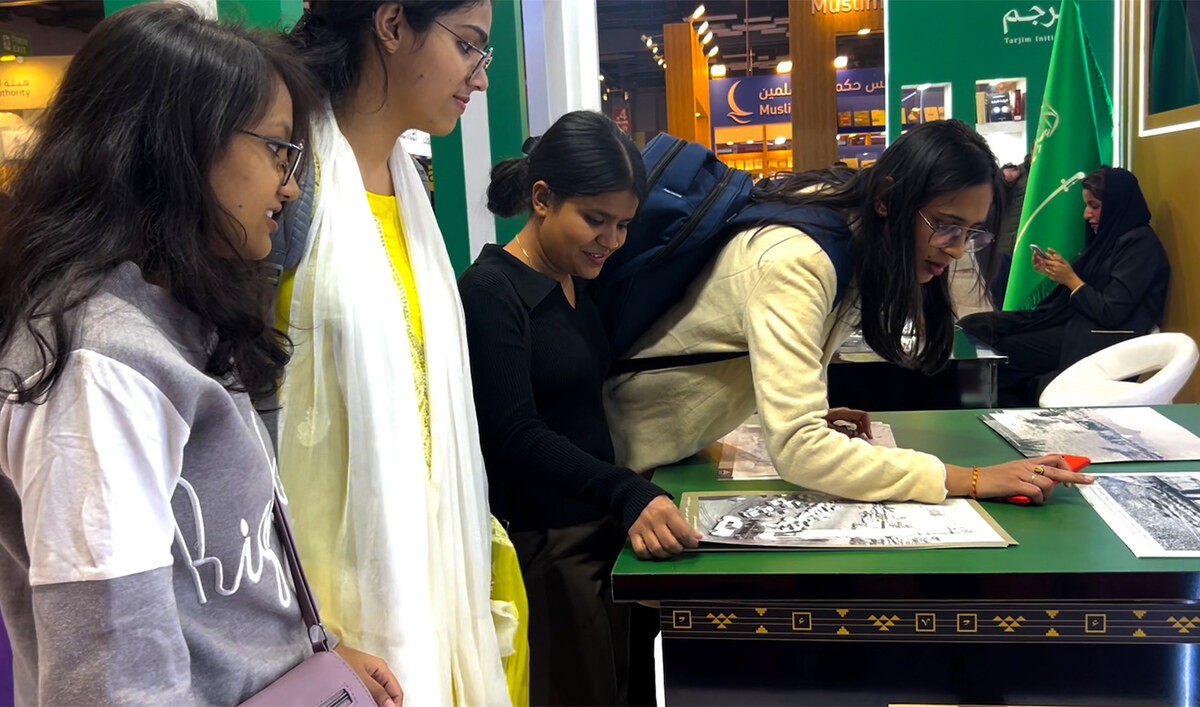
Visitors look at archival photos displayed at the Saudi pavilion at the New Delhi World Book Fair, New Delhi, India, Feb. 4, 2025. (AN Photo)
Another visitor, Zohra Fatima, was drawn especially to short fiction stories as a means to imagine and understand life in Saudi Arabia.
“It seems very interesting ... To know deep inside their culture, one has to read this kind of tales,” she said.
Besides the translations, Saudi Arabia’s pavilion has also presented the country’s national bibliography — a catalog of all publications, including books, articles, and reports, produced within the Kingdom.
“National bibliography is basically a list of books published in a particular country,” said Dr. Prathasari Das, library information officer at the National Library of India, who was studying the works displayed at the exhibition.
“It is very nice to see this bibliography here to introduce the print culture — the print output in Saudi Arabia — to India ... Books are those mediums which connect different cultures around the world, so it’s like a window. I think that it will be a great help or great opportunity for Indians to see and mingle with this culture.”
For some like Shivani Nagar, a French linguistics student in New Delhi, visiting the pavilion was not only about literature, but also the Arabic language.
“I met the employees here and they taught me some words in Arabic, and I found it really interesting and, in my mind, I’m really hoping to learn more,” she said.
“It’s very good that they are putting English books so that I can learn about Arab culture in English, in my language ... (and) I can know about the culture, and (then) I can turn my goal to learning Arabic.”