



WASHINGTON: A federal judge on Thursday temporarily blocked President Donald Trump’s plan to push out federal workers by offering them financial incentives, the latest tumult for government employees already wrestling with upheaval from the new administration.
The ruling came hours before the midnight deadline to apply for the deferred resignation program, which was orchestrated by Trump adviser Elon Musk.
Labor unions said the plan was illegal, and US District Judge George O’Toole Jr. in Boston paused its implementation until after he could hear arguments from both sides at a court hearing scheduled for Monday afternoon. He directed the administration to extend the deadline until then.
White House press secretary Karoline Leavitt said 40,000 workers have already signed up to leave their jobs while being paid until Sept. 30. She described federal employees who have been working remotely as lazy, saying “they don’t want to come into the office” and “if they want to rip the American people off, then they’re welcome to take this buyout.”
A federal worker in Colorado, who spoke on condition of anonymity out of fear of retribution, said the insults directed at the government workforce by members of the Trump administration have been demoralizing for those who provide public services.
She said the judge’s decision bolstered suspicions, echoed by people who work across various departments and agencies, that the deferred resignation program was legally questionable.
Democrats and unions warn that workers could be stiffed
On Wednesday, the administration ramped up its pressure on employees to leave, sending a reminder that layoffs or furloughs could come next.
“The majority of federal agencies are likely to be downsized through restructurings, realignments, and reductions in force,” said the message from the Office of Personnel Management, which has been a nexus of Musk’s efforts to downsize the government.
The email said anyone who remains will be expected to be “loyal” and “will be subject to enhanced standards of suitability and conduct as we move forward.” Some employees could be reclassified to limit civil service protections as well.
“Employees who engage in unlawful behavior or other misconduct will be prioritized for appropriate investigation and discipline, including termination,” the email said.
Democrats and union leaders have said workers shouldn’t accept the deferred resignation program because it wasn’t authorized by Congress, raising the risk they won’t get paid.
“It’s a scam and not a buyout,” said Everett Kelley, president of the American Federation of Government Employees.
An employee at the Department of Education, who also spoke on condition of anonymity out of fear of retaliation, said the administration appeared desperate to get people to sign the agreement. However, she said there were too many red flags, such as a clause waiving the right to sue if the government failed to honor its side of the deal.
The deal is ‘exactly what it looks like,’ says Trump official
Trump put Musk, the world’s richest man, in charge of the so-called Department of Government Efficiency, or DOGE, which is a sweeping initiative to reduce the size and scope of the federal government. The original email offering the deferred resignation program was titled “Fork in the road,” echoing a similar message that Musk sent Twitter employees two years ago after he bought the social media platform.
Trump administration officials organized question-and-answer sessions with employees as the Thursday deadline approached.
“I know there’s been a lot of questions out there about whether it’s real and whether it’s a trick,” said Rachel Oglesby, the chief of staff at the Department of Education. “And it’s exactly what it looks like. It’s one of the many tools that he’s using to try to achieve the campaign promise to bring reform to the civil service and changes to D.C.”
The Associated Press obtained a recording of the meeting, as well as a separate one held for Department of Agriculture employees.
Marlon Taubenheim, a human resources official with the Agriculture Department, acknowledged that “these are very trying times” and “there’s a lot of stress.”
“Unfortunately, we don’t have all the answers,” he said.
Jacqueline Ponti-Lazaruk, another agency leader, said employees “probably didn’t have the runway of time that you might have liked to make a life-changing decision.”
For those who remain, she said, “we’ll just keep plugging along.”
Assurances from administration officials have not alleviated concerns. Some federal workers said they did not trust the validity of the offers, doubting that Trump has the authority to disburse money. Others point to his record of stiffing contractors as a New York real estate mogul.
Musk’s plans spark demonstrations in Washington
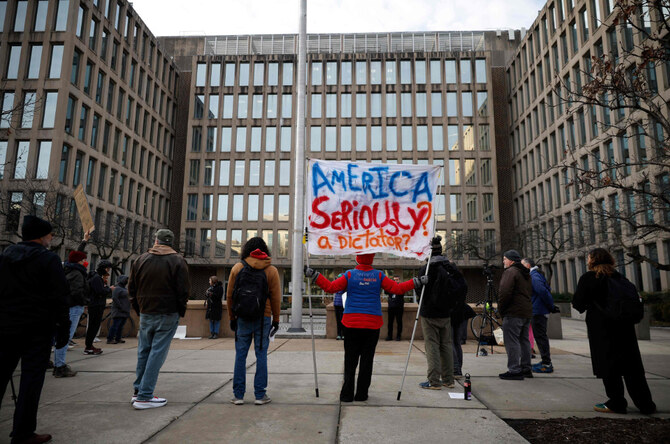
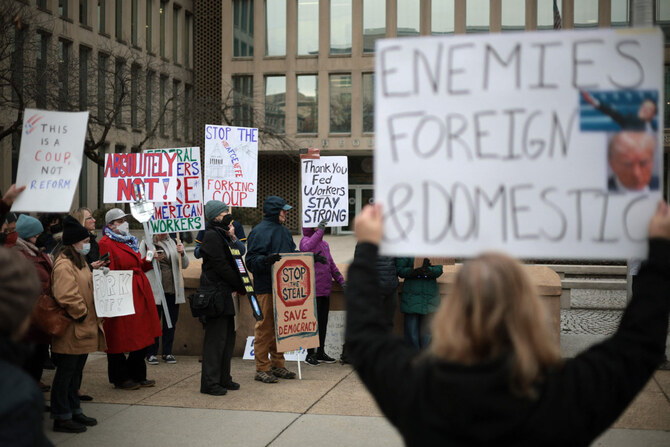
Scattered protests have sprung up outside federal buildings, including on Tuesday at the Office of Personnel Management.
Dante O’Hara, who works for the government, said if more people don’t speak up, “we’re all going to lose our jobs and they’re going to put all these loyalists or people that will be their shock troops.”
Government jobs have often been considered secure positions, but O’Hara said there’s fear in the workforce. The sense from his colleagues is “I don’t know if I’m going to be here tomorrow because, like, we don’t know what’s going to happen.’”
Dan Smith, a Maryland resident whose father was a research scientist at the Department of Agriculture, said federal workers are “so underappreciated and so taken for granted.”
“It’s one thing to downsize the government. It’s one thing to try to obliterate it,” Smith said. “And that’s what’s going on.”
Mary-Jean Burke, a physical therapist for the Department of Veterans Affairs in Indianapolis, said she’s worried that too many people will leave, jeopardizing health care services.
Burke, who also serves as a union official, said doubts have also been growing over whether to take the offer.
“Originally, I think people were like, ‘I’m out of here,’” she said. But then they saw a social media post from DOGE, which said employees can “take the vacation you always wanted, or just watch movies and chill, while receiving your full government pay and benefits.”
The message backfired because “that kind of thing sounded a little bit too good to be true and people were hesitant,” Burke said.
Either way, she said, Trump has achieved his apparent goal of shaking up the federal workforce.
“Every day, it’s something,” Burke said. “If he signed up to be a disrupter, he’s doing it.”


