Man charged in 2020 killing of rapper Pop Smoke pleads guilty to manslaughter to avoid trial

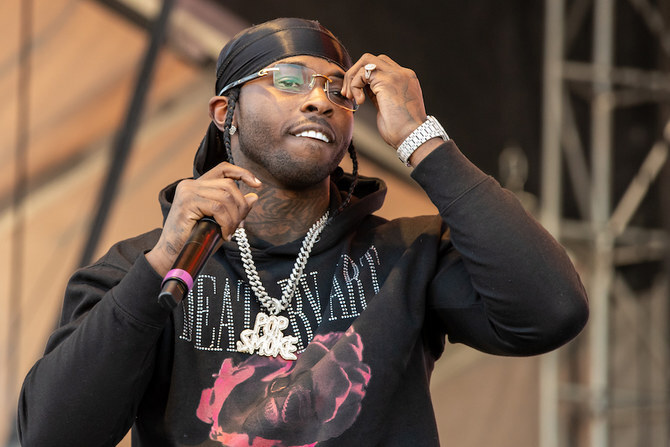
Pop Smoke was killed during a Los Angeles home-invasion robbery on Feb. 19, 2020. (AFP/File)
Short Url
Updated 06 February 2025
Follow

Man charged in 2020 killing of rapper Pop Smoke pleads guilty to manslaughter to avoid trial

  • Corey Walker, 24, pleaded guilty Wednesday to voluntary manslaughter
  • He was accused of leading the group to the rented mansion where the 20-year-old New York rapper Pop Smoke was killed

LOS ANGELES: A man charged in the 2020 killing of rapper Pop Smoke during a robbery at a Hollywood Hills mansion accepted a plea deal, averting a trial on a murder charge that was to have started Thursday.
Corey Walker, 24, pleaded guilty Wednesday to voluntary manslaughter and two counts of robbery in exchange for a sentence of 29 years in prison, which he will receive at a later hearing.
He was the only adult charged in the case along with three who were juveniles at the time of the crime, including a then-15-year-old gunman. All have already reached separate deals.
An email sent to Walker’s lawyers seeking comment was not immediately answered.
He was accused of leading the group to the rented mansion where the 20-year-old New York rapper Pop Smoke, whose legal name was Bashar Barakah Jackson, was killed on Feb. 19, 2020, during what was to be a four-day trip to Los Angeles. A 911 call from a friend of someone in the house reported armed intruders inside, police said.
The robbers knew the address because a day earlier, Pop Smoke had posted a photograph on social media of a gift bag he had received and the address was on a label, authorities said.
The rapper was in the shower when masked robbers confronted him. During a struggle, the 15-year-old, pistol-whipped him and shot him three times in the back, according to court testimony.
The attackers stole his diamond-studded Rolex watch and sold it for $2,000, a detective testified.
Born and raised in Brooklyn, Pop Smoke arrived on the hip-hop scene in 2018 and broke out with “Welcome to the Party” an anthem with boasts about shootings, killings and drugs that became a huge sensation, and prompted Nicki Minaj to drop a verse on a remix.
He had several other hits, including the album “Shoot for the Stars Aim for the Moon,” which was released posthumously.


BMW Art Cars mark 50 years at inaugural Art Basel Qatar

Updated 09 February 2026
Follow

BMW Art Cars mark 50 years at inaugural Art Basel Qatar

DOHA: BMW’s long-running Art Car initiative took center stage at the inaugural Art Basel Qatar, with Thomas Girst, BMW Group’s head of cultural engagement, reflecting on five decades of collaboration between artists, engineers and the automobile.

Speaking at the fair, Girst situated the Art Car program within BMW’s broader cultural engagement, which he said spanned “over 50 years and hundreds of initiatives,” ranging from museums and orchestras to long-term partnerships with major art platforms.

“Every time Art Basel moves — from Miami to Hong Kong to Qatar — we move along with them,” he said. “That’s why we’re here.”


A post shared by Art Basel (@artbasel)

The occasion also marked the 50th anniversary of the BMW Art Car series, which began in 1975 with Alexander Calder’s painted BMW 3.0 CSL. Since then, the project has grown into a global collection that brings together motorsport, engineering, design and contemporary art. “Those Art Cars speak to a lot of people at the intersection of motorsports, technology, racing engineering, arts, lifestyle and design,” Girst said.

For Girst, the relationship between art and the automobile has deep historical roots. He pointed to early modernist fascination with cars, noting that “since the inception of the automobile,” artists have seen it as both a subject and a symbol of modernity. “There’s a reason for arts and culture and cars to mix and mingle,” he said.

At Art Basel Qatar, visitors were invited to view David Hockney’s BMW Art Car — Art Car No. 14 — displayed nearby. Girst described the work as emblematic of the program’s ethos, highlighting how Hockney painted not just the exterior of the vehicle but also visualized its inner life. The result, he suggested, is a car that reflects both movement and perception, turning the act of driving into an artistic experience.

Central to BMW’s approach, Girst stressed, is the principle of absolute artistic freedom. “Whenever we work with artists, it’s so important that they have absolute creative freedom to do whatever it is they want to do,” he said. That freedom, he added, mirrors the conditions BMW’s own engineers and designers need “to come up with the greatest answers of mobility for today and tomorrow.”

The Art Car World Tour, which accompanies the anniversary celebrations, has already traveled to 40 countries, underscoring the project’s global reach. For Girst, however, the enduring value of the initiative lies less in scale than in its spirit of collaboration. Art, design and technology, he said, offer a way to connect across disciplines and borders.

“That’s what makes us human. We can do better things than just bash our heads in — we can create great things together,” he said.