

China, Pakistan urge Afghanistan to act against militants as Zardari seeks stronger economic ties

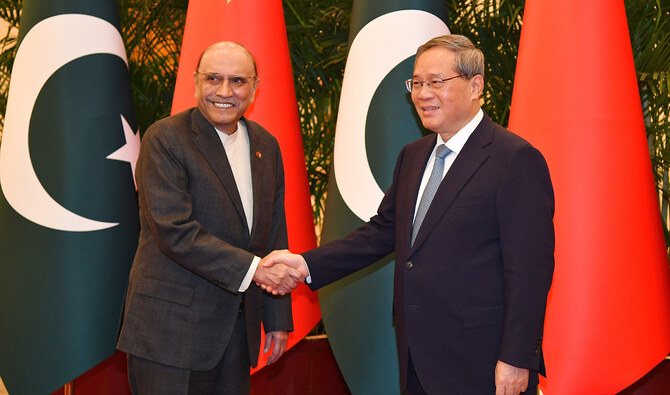
Pakistani President Asif Ali Zardari (left) meets Chinese Premier Li Qiang in Beijing, China, on February 5, 2025. (AP)
Short Url
Updated 06 February 2025
Follow

China, Pakistan urge Afghanistan to act against militants as Zardari seeks stronger economic ties

  • Pakistan recognizes commitment to ensuring safety of Chinese workers, calls it ‘foremost responsibility’
  • President Zardari meets Chinese Premier Li Qiang, seeks enhanced people-to-people exchanges

ISLAMABAD: China and Pakistan on Thursday called on Afghanistan’s administration to take “visible and verifiable” steps to address militant threat, according to a joint statement, as President Asif Ali Zardari discussed enhanced economic collaboration and people-to-people ties during a meeting with Chinese Premier Li Qiang.

Zardari is on a five-day visit to Beijing, where he also met Chinese President Xi Jinping a day earlier and invited him to visit Pakistan. His engagements with Chinese officials come amid Beijing’s growing concerns over the security of its nationals working in Pakistan, many of whom are involved in China-Pakistan Economic Corridor (CPEC) projects and have been targeted in a series of attacks in recent years.

During his meeting with Xi, Zardari acknowledged that Pakistan’s relationship with China had “gone through ups and downs” but said it would not be undermined by militant violence.

Most of the attacks against the Chinese workers have been attributed to groups such as Tehreek-e-Taliban Pakistan (TTP) and Balochistan Liberation Army (BLA), which Pakistan says operate from neighboring Afghanistan. Kabul denies the allegation.

“The two sides [Pakistan and China] agreed to maintain close communication and coordination on the issue of Afghanistan, and play a constructive role in helping Afghanistan achieve stable development and integrate into the international community,” said the joint statement released by Pakistan’s foreign office.

“They called on the Interim Afghan Government to take visible and verifiable actions to dismantle and eliminate all terrorist groups based in Afghanistan which continue to pose a serious threat to regional and global security, and to prevent the use of Afghan territory against other countries,” it added.

The statement also highlighted Pakistan’s commitment to ensuring the safety of Chinese workers, calling it the country’s “foremost responsibility.”

“The Pakistani side reiterated its strongest condemnation of the terrorist attacks in Pakistan involving Chinese personnel,” it said, adding that the government would continue to investigate these incidents and bring the perpetrators to justice.

“It will also further increase input into security, and take targeted and enhanced measures to effectively ensure the safety and security of Chinese personnel, projects and institutions in Pakistan,” the statement said.

Separately, the Pakistani president met with Chinese Premier Li at the Great Hall of the People, reaffirming Islamabad’s commitment to deepening its “All-Weather Strategic Cooperative Partnership” with Beijing.

“The President highlighted the pivotal role of the China-Pakistan Economic Corridor (CPEC) in promoting regional connectivity and economic growth and expressed appreciation for China’s continued support toward Pakistan’s development agenda,” a statement from Pakistan’s presidency said.

Discussions between the two leaders focused on the expansion of cooperation under “CPEC 2.0,” with an emphasis on renewable energy, science and technology, infrastructure and agriculture.

They also explored ways to enhance trade and investment through business-to-business linkages.

Both sides underscored the importance of strengthening people-to-people and cultural exchanges to build a “China-Pakistan Community of Shared Future in the New Era,” the statement added.


Pakistan, global crypto exchange discuss modernizing digital payments, creating job prospects 

Updated 05 December 2025
Follow

Pakistan, global crypto exchange discuss modernizing digital payments, creating job prospects 

  • Pakistani officials, Binance team discuss coordination between Islamabad, local banks and global exchanges
  • Pakistan has attempted to tap into growing crypto market to curb illicit transactions, improve oversight

ISLAMABAD: Pakistan’s finance officials and the team of a global cryptocurrency exchange on Friday held discussions aimed at modernizing the country’s digital payments system and building local talent pipelines to meet rising demand for blockchain and Web3 skills, the finance ministry said.

The development took place during a high-level meeting between Finance Minister Muhammad Aurangzeb, Pakistan Virtual Assets Regulatory Authority (PVARA) Chairman Bilal bin Saqib, domestic bank presidents and a Binance team led by Global CEO Richard Teng. The meeting was held to advance work on Pakistan’s National Digital Asset Framework, a regulatory setup to govern Pakistan’s digital assets.

Pakistan has been moving to regulate its fast-growing crypto and digital assets market by bringing virtual asset service providers (VASPs) under a formal licensing regime. Officials say the push is aimed at curbing illicit transactions, improving oversight, and encouraging innovation in blockchain-based financial services.

“Participants reviewed opportunities to modernize Pakistan’s digital payments landscape, noting that blockchain-based systems could significantly reduce costs from the country’s $38 billion annual remittance flows,” the finance ministry said in a statement. 

“Discussions also emphasized building local talent pipelines to meet rising global demand for blockchain and Web3 skills, creating high-value employment prospects for Pakistani youth.”

Blockchain is a type of digital database that is shared, transparent and tamper-resistant. Instead of being stored on one computer, the data is kept on a distributed network of computers, making it very hard to alter or hack.

Web3 refers to the next generation of the Internet built using blockchain, focusing on giving users more control over their data, identity and digital assets rather than big tech companies controlling it.

Participants of the meeting also discussed sovereign debt tokenization, which is the process of converting a country’s debt such as government bonds, into digital tokens on a blockchain, the ministry said. 

Aurangzeb called for close coordination between the government, domestic banks and global exchanges to modernize Pakistan’s payment landscape.

Participants of the meeting also discussed considering a “time-bound amnesty” to encourage users to move assets onto regulated platforms, stressing the need for stronger verifications and a risk-mitigation system.

Pakistan has attempted in recent months to tap into the country’s growing crypto market, crack down on money laundering and terror financing, and promote responsible innovation — a move analysts say could bring an estimated $25 billion in virtual assets into the tax net.

In September, Islamabad invited international crypto exchanges and other VASPs to apply for licenses to operate in the country, a step aimed at formalizing and regulating its fast-growing digital market.