

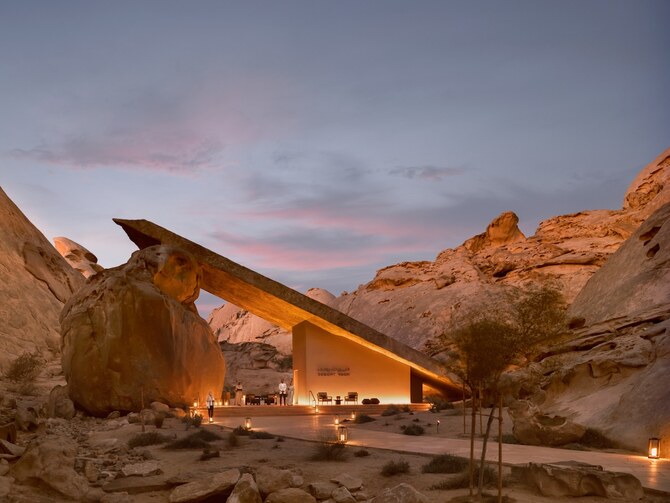
Inside Red Sea Global’s newly opened Desert Rock Resort 

Desert Rock Resort. (Supplied)
Short Url
Updated 07 February 2025
Follow

Inside Red Sea Global’s newly opened Desert Rock Resort 

RED SEA: As Saudi Arabia expands its portfolio of luxury hotel offerings, the newly opened Desert Rock Resort stands out for its otherworldly terrain and exceptional service. 

There will be no quibbling about the benefits of Saudi Arabia versus the Maldives here — an issue that has crept up when potential visitors discuss Red Sea Global’s other outposts, such as the futuristic overwater resort Shebara. When it comes to Desert Rock there is simply nowhere else like it and the resort has leaned in heavily to make use of the spectacular landscape. 

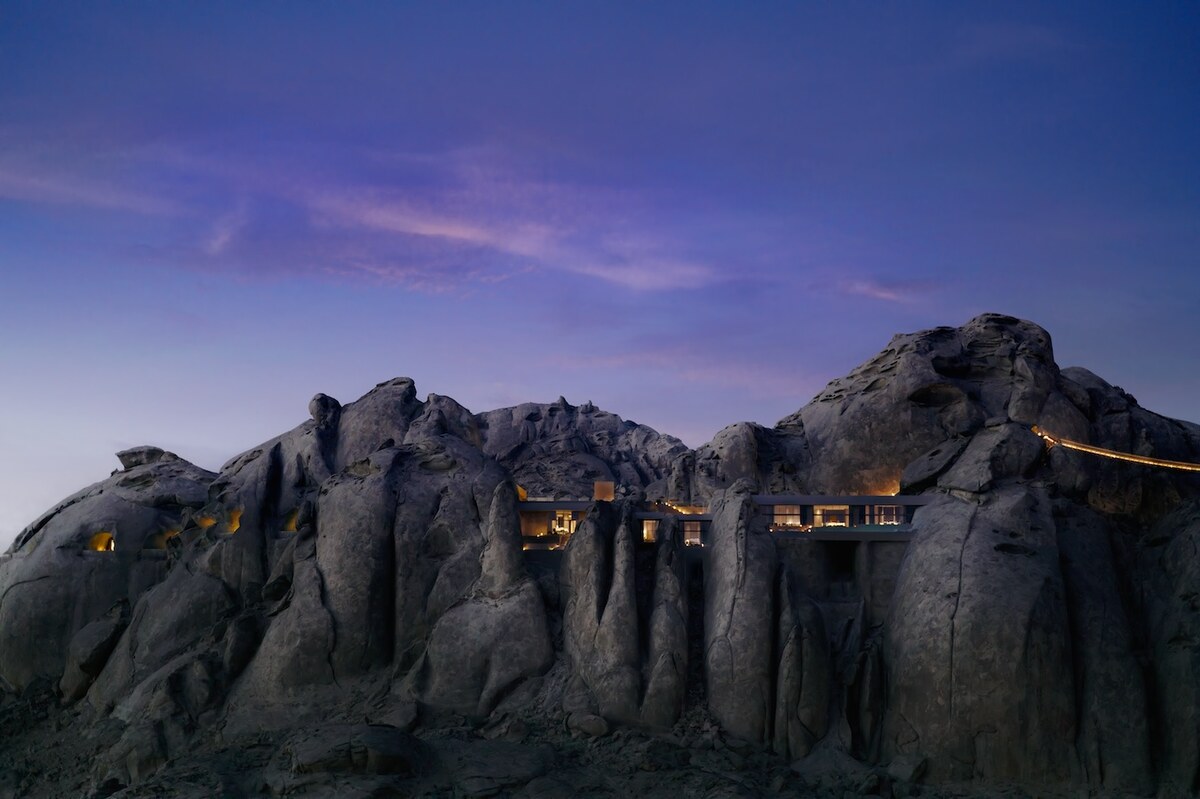
Set amid humbling mountains pockmarked with caves, the resort is a 20-minute drive from Red Sea International airport. 


Desert Rock Resort. (Supplied)

Home to 32 Wadi Villas on the valley floor, 17 Cliff Hanging Villas, four Mountain Crevice Villas, one Royal Villa and 10 Mountain Cave Suites carved into the rockface itself — yes, it’s as mind-boggling as it sounds — the hotel boasts private, temperature-controlled pools in every room and amenities that go a long way to helping guests understand the eye-watering price tag — Dyson hairdryers, Frette sheets and an array of luxe poolside accessories — while an assigned “Villa Host” takes care of your every need via WhatsApp. 

While the mountain-top Cave Suites and their views of endless rolling deserts and soaring rust-colored mountains are an influencer’s ticket to viral fame, the two-bedroom Mountain Crevice Skyline Villa is ideal for a larger group — with a conversation-starting bathtub (it fit at least five giddy, fully-clothed adults on our press tour) and glass-ringed fire pit. 


Desert Rock Resort. (Supplied)

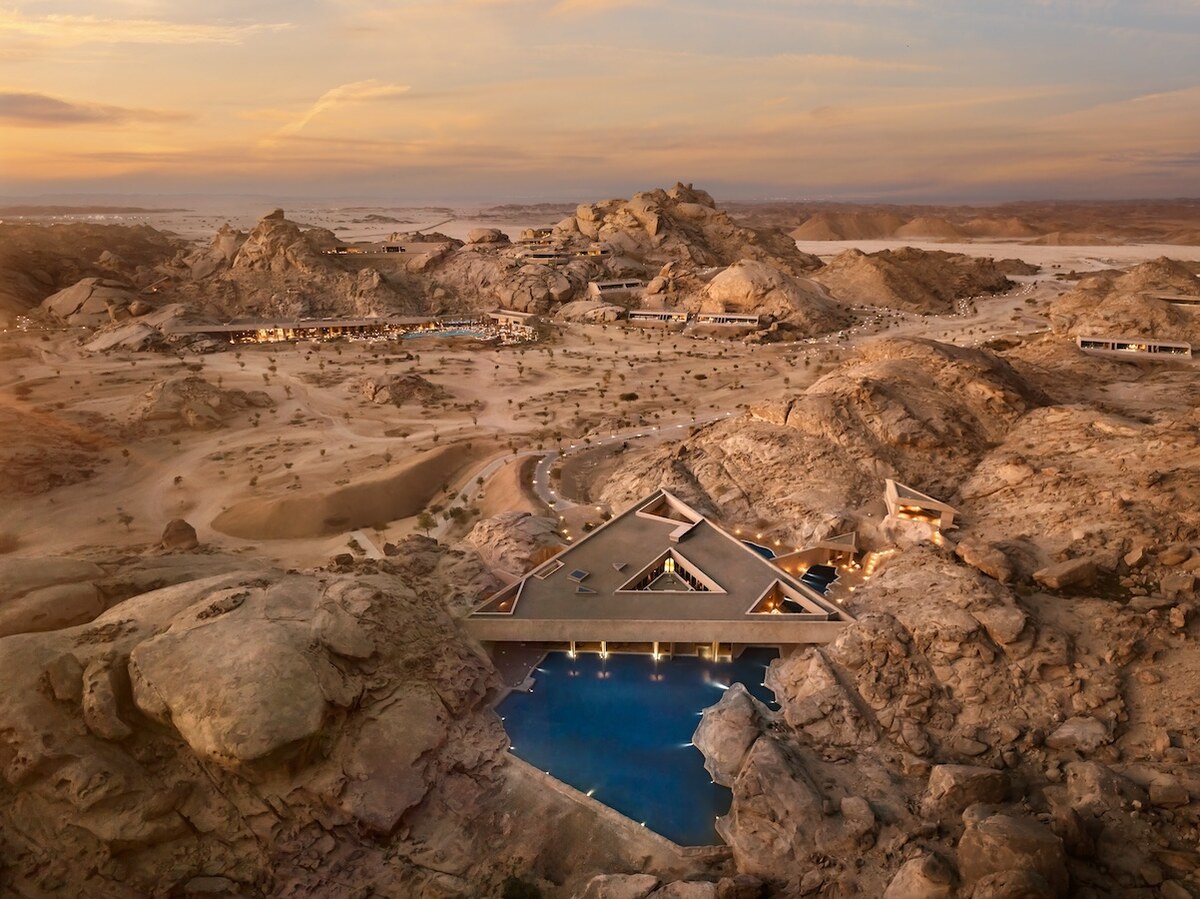
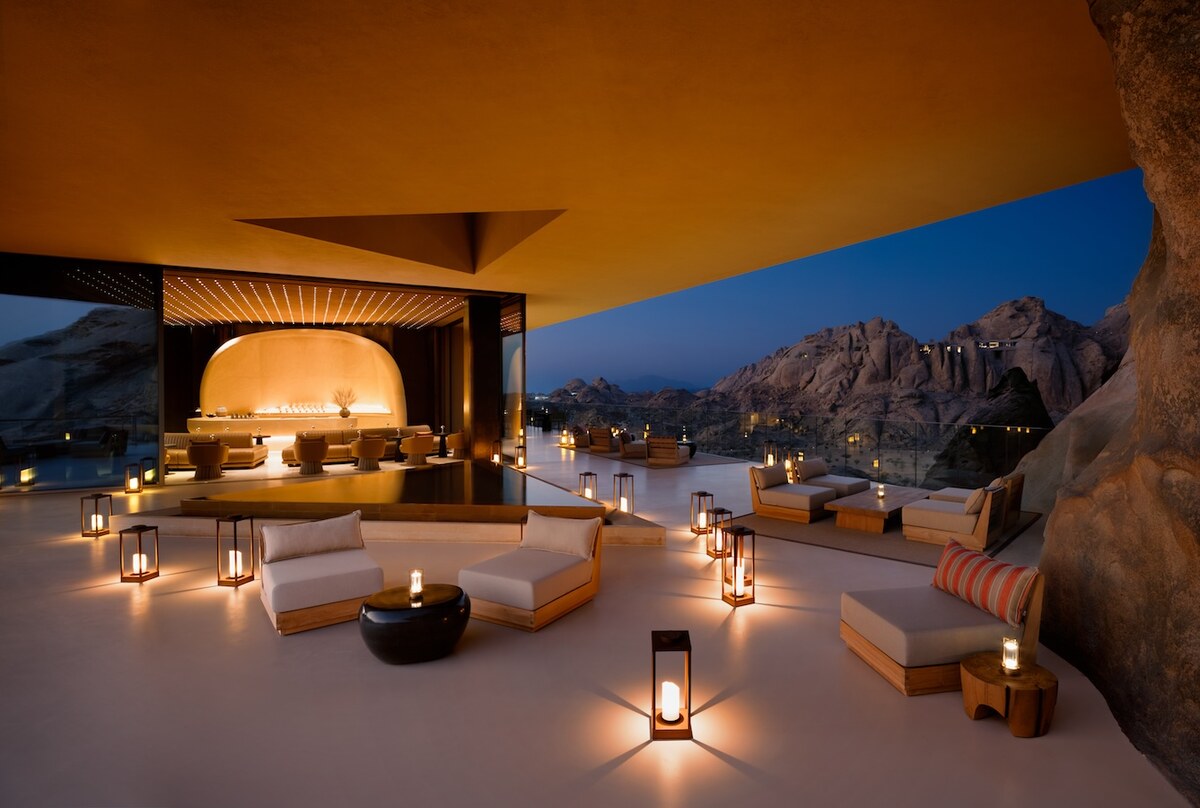
Descend to the valley floor and Oppenheim Architecture’s bunker-like structures melt into the Martian landscape. Use your chic wooden key card — the details are everything at Desert Rock — and you’ll be met by cozy interiors by Toronto’s Studio Paolo Ferrari. Earthy tones, a focus on luxury stone and bronze-brown accents make the large villas and suites opulent without losing the warmth of the desert. 

A pool, kids’ club and star-gazing evenings are complemented by the Akun adventure hub, which offers thrilling ziplining, via ferrata, abseiling, rock climbing and archery, with more activities planned for 2025. 


Desert Rock Resort. (Supplied)

A team is on hand to keep visitors safe, but this is no easy experience — we climbed up to the ziplining jump off point on the bare mountain face, at some points resorting to all fours as we followed a rough path hewn into the rock that often became no path at all. 

That refusal to bend to lazy luxury is also shown in the 622 steps one can climb to the highest point of the hotel, an observatory reached by crossing a rope bridge at a dizzying height. The lack of a lift was a wise choice –— it may not be easily accessible but that is exactly what makes the astounding view once there so worth it. 


Desert Rock Resort. (Supplied)

The flipside, of course, is that certain areas of the resort are not accessible for guests with physical disabilities. It’s also important to note that — due to the space this hotel takes up — travel between rooms, restaurants and the spa is usually by buggy. 


Desert Rock Resort. (Supplied)

The four main eateries — NYRA, helmed by Turkish chef Osman Sezener whose restaurant in Bodrum has one Michelin star; MICA, a buzzy mocktail bar that also offers small plates; breakfast spot Basalt, which transforms into an Indian eatery at night; and the poolside Wadi that offers Peruvian cuisine — rival the brightest stars in the Gulf’s major cities, with NYRA and Wadi standing out for their fresh, colorful dishes including tender beef tongue and artfully presented seafood plates. Many of the courses were presented with specific beverage pairings that drew out the flavors of their accompanying dish and pushed experimental mocktails to heights not before experienced by this writer. 

Round that all off with a spa that boasts views of soaring, craggy cliffs, as well as indoor and outdoor treatment rooms, a water therapy room and a couple’s hammam room, and you’ve got the ideal recipe for a serene sojourn in the Saudi desert. 


Global gems go under the hammer 

Updated 16 January 2026
Follow

Global gems go under the hammer 

  • International highlights from Sotheby’s ‘Origins II’ auction, which takes place Jan. 31 in Diriyah 

Andy Warhol 

‘Muhammad Ali’ 

Arguably the most famous name in pop art meets arguably the most famous sportsman of the 20th century in this set of four screen prints from 1978, created at the behest of US investment banker Richard Weisman. “I felt putting the series together was natural, in that two of the most popular leisure activities at the time were sports and art, yet to my knowledge they had no direct connection,” Weisman said in 2007. “Therefore I thought that having Andy do the series would inspire people who loved sport to come into galleries, maybe for the first time, and people who liked art would take their first look at a sports superstar.” Warhol travelled to Ali’s training camp to take Polaroids for his research, and was “arrested by the serene focus underlying Ali’s power — his contemplative stillness, his inward discipline,” the auction catalogue states. 

Jean-Michel Basquiat 

‘Untitled’ 

Basquiat “emerged from New York’s downtown scene to become one of the most influential artists of the late 20th century,” Sotheby’s says. The largely self-taught artist’s 1985 work, seen here, “stands as a vivid testament to (his) singular ability to transform drawing into a site of intellectual inquiry, cultural memory, and visceral self-expression.” Basquiat, who was of Caribbean and Puerto Rican heritage, “developed a visual language of extraordinary immediacy and intelligence, in which image and text collide with raw urgency,” the catalogue continues. 

Camille Pissarro 

‘Vue de Zevekote, Knokke’ 

The “Knokke” of the title is Knokke-sur-Mer, a Belgian seaside village, where the hugely influential French-Danish Impressionist stayed in the summer of 1894 and produced 14 paintings, including this one. The village, Sotheby’s says, appealed to Pissarro’s “enduring interest in provincial life.” In this work, “staccato brushstrokes, reminiscent of Pissarro’s paintings of the 1880s, coalesce with the earthy color palette of his later work. The resulting landscape, bathed in a sunlit glow, celebrates the quaint rural environments for which (he) is best known.” 

David Hockney 

‘5 May’ 

This iPad drawing comes from the celebrated English artist’s 2011 series “Arrival of Spring in Woldgate, East Yorkshire in 2011,” which Sotheby’s describes as “one of the artist’s most vibrant and ambitious explorations of landscape, perception, and technological possibility.” Each image in the series documents “subtle shifts in color, light and atmosphere” on the same stretch of the Woldgate, “showing the landscape as something experienced over time rather than frozen in an instant.” The catalogue notes that spring has long been an inspiration for European artists, but says that “no artist has ever observed it so closely, with such fascinated and loving attention, nor recorded it in such detail as an evolving process.” 

Zarina  

‘Morning’ 

Sotheby’s describes Indian artist Zarina Hashmi — known by her first name — as “one of the most compelling figures in post-war international art — an artist whose spare, meditative works distilled the tumult of a peripatetic life into visual form.” She was born in Aligarh, British India, and “the tragedy of the 1947 Partition (shaped) a lifelong meditation on the nature of home as both physical place and spiritual concept.” This piece comes from a series of 36 woodcuts Zarina produced under the title “Home is a Foreign Place.” 

George Condo 

‘Untitled’ 

This 2016 oil-on-linen painting is the perfect example of what the US artist has called “psychological cubism,” which Sotheby’s defines as “a radical reconfiguration of the human figure that fractures identity into simultaneous emotional and perceptual states.” It’s a piece that “distills decades of inquiry into the mechanics of portraiture, drawing upon art-historical precedent while decisively asserting a contemporary idiom that is at once incisive and darkly humorous,” the catalogue notes, adding that the work is “searing with psychological tension and painterly bravura.”