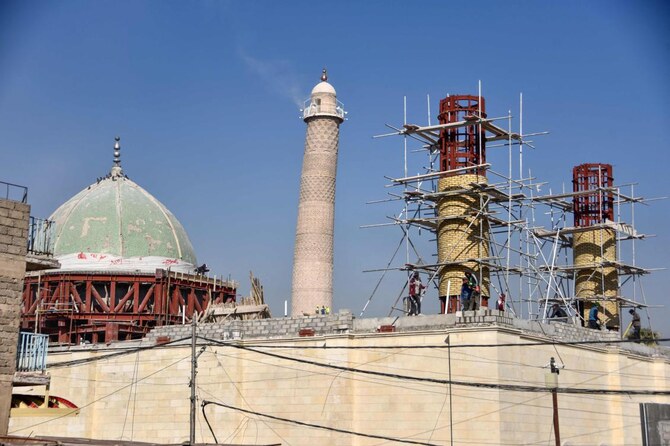
Mosul: The leaning minaret of Mosul in northern Iraq has been restored using its original brickwork, years after it was reduced to rubble under Daesh group rule.
The Al-Hadba or “hunchback” minaret is part of the historic Al-Nuri Mosque from where former IS chief Abu Bakr Al-Baghdadi in July 2014 declared his “caliphate” that committed atrocities across swathes of both Syria and Iraq.
The mosque and minaret were destroyed in June 2017 during the battle to oust Daesh from Mosul, and Iraq’s authorities accused the jihadists of planting explosives before their withdrawal.
The minaret and mosque are the latest landmarks in Mosul to be restored by United Nations heritage body UNESCO, whose teams have worked for five years to revive several sites there.
The Al-Hadba minaret of today is an exact replica of the old one, “built with the same bricks,” said Abdullah Mahmoud of the Iraqi department of antiquities.
“Al-Hadba is our identity, and by restoring it, the identity of the city has been reclaimed.”
The restored minaret’s tilt has been retained at 160 centimeters (63 inches), just as it was in the 1960s.
However, engineers have reinforced the foundations so it no longer leans quite so precariously, as it began to do gradually after being built in the 12th century.
“The minaret’s body from the inside needed 96,000 new bricks,” Mahmoud said.
“But for the exterior we used 26,000 old bricks” to preserve its historical legacy.
’Massive change’
Days before work was completed, hundreds of workers put the finishing touches to Al-Nuri’s columns, dome and yard.
Mahmoud said the mihrab, a niche indicating the direction of Makkah, has been largely repaired using its original stones.
But the minbar, from where sermons are delivered, has lost most of its original pieces.
Across the street, Imad Zaki, a former muezzin at the mosque, said: “Every day I stand here for an hour to watch as they are restored to their original state.”
“Today one can feel the spirituality. It’s as if our souls have finally found peace,” added the 52-year-old, wearing a long traditional Iraqi abaya, or robe.
Eighty percent of Mosul’s old city was destroyed in the fight against IS, and more than 12,000 tons of rubble was removed for the UNESCO restoration project, which also included Al-Tahira and Our Lady of the Hour churches and 124 heritage houses.
The Al-Tahira Church, dating from 1862, has been rebuilt with its arcades, embellished pillars and stained-glass windows.
During restoration, workers discovered an underground cellar and large jars once used for wine. It now has a glass ceiling so visitors can look inside.
Maria Acetoso, senior project manager at UNESCO Iraq, said the project aimed “to work in parallel on meaningful monuments for the city and also to bring life back” to Mosul.
“When I arrived here in 2019 it looked like a ghost city,” Acetoso said. “In five years plus, there has been a massive change.”
In Mosul on Wednesday, UNESCO chief Audrey Azoulay hailed her team’s efforts and said on that the renovation had allowed “the identity of the city” to return.
Scars of battle
After IS was defeated, life returned to the city’s streets, where the chatter of patrons in small cafes blended with the clatter of construction work at the mosque.
In the coming weeks, Iraqi authorities will inaugurate the restored landmarks.
But Mosul still bears scars from the ferocious fight against IS.
Tucked away in narrow old city alleyways are ruined houses. Some bear the word “safe” scrawled in red on walls, signalling that they that have been cleared of explosives.
The crumbling walls and shattered windows tell tales of displacement. Their original owners, mostly Christian, have yet to return.
Mohammed Kassem, 59, came back to the old city a few years ago, to a new house as his former home was just debris.
Mosul still “needs a great deal” of work before it is back to normal, he said.
“It needs its former residents... the Christians to come back. This is their place,” Kassem added.
Across the street from Al-Nuri Mosque, Saad Mohammed, 65, said he hoped the restoration efforts will attract visitors to Mosul, although he still feels sad because of what it has lost.
But he couldn’t help but smile when he looked up at the minaret from his little shop.
“We opened the window once and saw the black IS flag on top of the minaret. Then we opened it again and the minaret was gone,” said Mohammed, who never left Mosul, even at the height of the fighting.
“Today the minaret has risen again, alongside the mosque and the churches. Now we feel safe,” he said.


Iraq’s famed ‘hunchback’ of Mosul rebuilt brick by brick


https://arab.news/v4647
Iraq’s famed ‘hunchback’ of Mosul rebuilt brick by brick

- The mosque and minaret were destroyed in June 2017 during the battle to oust IS from Mosul
- Minaret and mosque are the latest landmarks in Mosul to be restored by United Nations heritage body UNESCO


Turkiye ‘closely’ monitoring Kurdish groups as Iran war rages
- “We are closely following PJAK’s activities in Iran and regional developments,” the Turkish defense ministry said
- “Turkiye supports the territorial integrity of neighboring states, not their fragmentation“
ANKARA: Turkiye’s defense ministry on Thursday said it was “closely” following the actions of Kurdish militant groups over concerns they are being drawn into the war, reportedly by US-led efforts to destabilize Iran.
The conflict began on Saturday when US-Israeli strikes hit Iran, which retaliated with strikes across the region, with Tehran on Wednesday saying it had hit Kurdish militant groups based in Iraq.
The move came as reports suggested Washington was looking to arm Kurdish guerrillas to infiltrate Iran — a move that would likely raise hackles in Turkiye.
“We are closely following PJAK’s activities in Iran and regional developments,” the Turkish defense ministry said of an Iran-based Kurdish group which is an offshoot of the outlawed Kurdish militant PKK.
“Activities of groups like the PJAK terrorist organization, which promote ethnic separatism, negatively affect not only Iran’s security but also the overall peace and stability of the region,” the ministry said.
“Turkiye supports the territorial integrity of neighboring states, not their fragmentation.”
On February 22, the PJAK (the Kurdistan Free Life Party) and four other exiled Kurdish groups announced a political coalition to seek the overthrow of the Islamic Republic and ultimately to secure Kurdish self-determination.
Spread across Turkiye, Syria, Iraq and Iran, the Kurds are one of Iran’s most important non-Persian ethnic minority groups and have long supported anti-government protests in the Islamic Republic.
Turkiye has been seeking to end its conflict with the PKK, which formally disbanded last year after four decades of violence that claimed some 50,000 lives.
Although most PKK-linked groups embraced the call to disarm, the PJAK did not, with Ankara concerned any regional unrest could embolden recalcitrant Kurdish separatists.
In late January, following a wave of deadly anti-government protests in Iran, Turkish Foreign Minister Hakan Fidan told his Iranian counterpart Abbas Araghchi that “the complete neutralization of PJAK constitutes an urgent necessity for Iran’s security.”


