

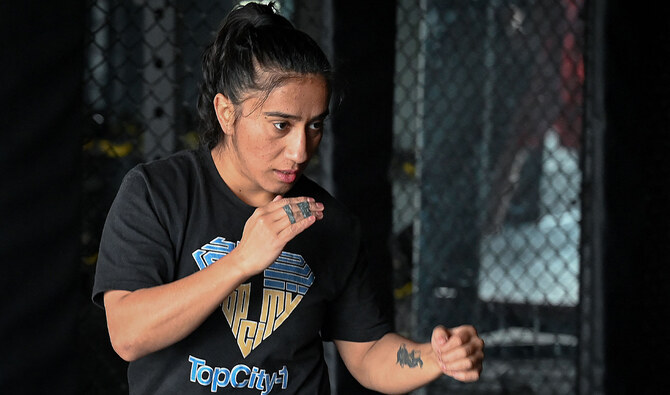

ISLAMABAD: Growing up in the rugged northern reaches of Pakistan, Anita Karim honed her combat skills fighting with three older brothers who pulled no punches.
The bruising experience prepared her for a career in Mixed Martial Arts (MMA) — blending Thai kickboxing, Japanese judo and wrestling — and she is now the nation’s pre-eminent woman fighter.
“The village where I come from, they support women fighters,” she told AFP. “But when I started MMA, they had no awareness of this sport.”
“They said it’s a men’s game exclusively and a woman cannot do that one,” the 28-year-old said.
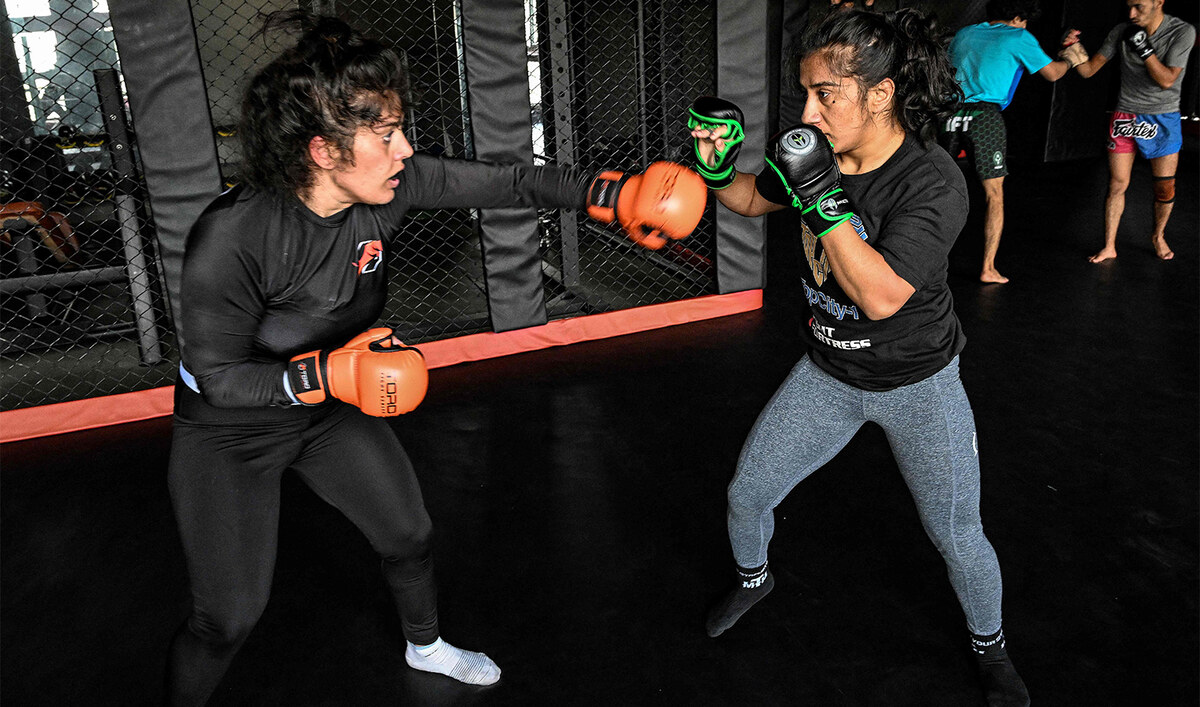
In this photograph taken on December 11, 2024, Anita Karim (R) and Bushra Ahmed, mixed martial arts (MMA) fighters, take part in a training session at a club in Islamabad. (AFP/File)
Eight years ago she won the right to enter the ring, swiftly becoming Pakistan’s first internationally competing woman MMA fighter and appearing in Asia’s biggest promotion, ONE Championship.
“Now misogynistic comments and criticisms have stopped,” she said at her gym in the capital Islamabad, where she trains without heating in the octagonal “cage” where fighters face off.
It is unusual for women to take up sport in deeply conservative Pakistan, where it is often forbidden by families.
But Karim’s native Gilgit-Baltistan region — where female modesty codes are more relaxed — has become an incubator for women’s sport.
In October, two sisters from the region, Maliha and Maneesha Ali, brought back gold and bronze from a taekwondo competition in Indonesia.
Karim’s brother Uloomi, who became her coach after being on the receiving end of her blows, said support began at home.
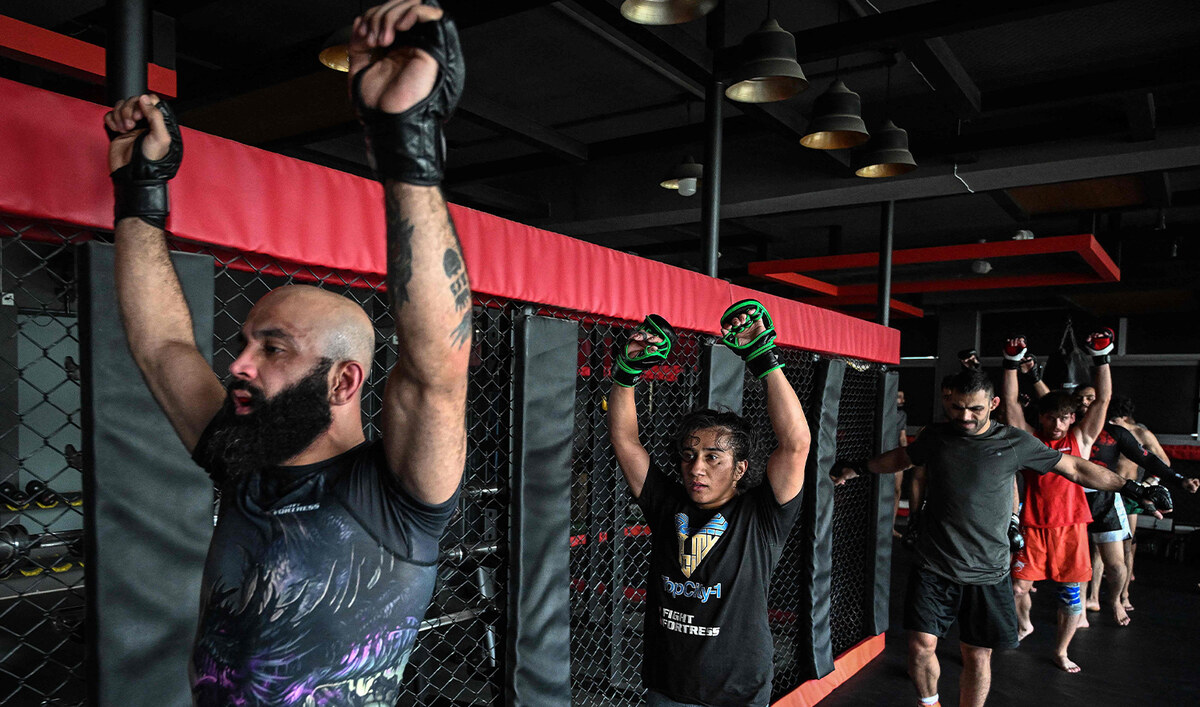
In this photograph taken on December 11, 2024, Anita Karim (2L), a mixed martial arts (MMA) fighter, warms up with her brother and coach Uloomi (L) before a training session at a club in Islamabad. (AFP/File)
“When she showed the commitment, the dedication, we knew that she was going to make it,” said the 33-year-old, standing in their family-owned gym.
“We knew that she could take it and we did not have any issues with her training with any guy.”
Surprisingly timid outside the ring, Karim is at the head of a cohort of Pakistani female MMA fighters — five from Gilgit-Baltistan, according to the regional government.
“She’s shy, but when she enters the cage, it’s completely different,” said Uloomi, who has also competed in the sport.
Her speciality is the armlock, deployed with an agonizing all-body grip, which aims to force an opponent to “tap out” in submission before bones are broken or joints wrecked.
In 2022 she was pictured atop a podium in Pakistan with two opponents wearing slings on their injured arms — a performance that earned her the nickname “the arm collector.”
“They could have tapped to stop the fight, but they didn’t, so I went through with it,” she said.
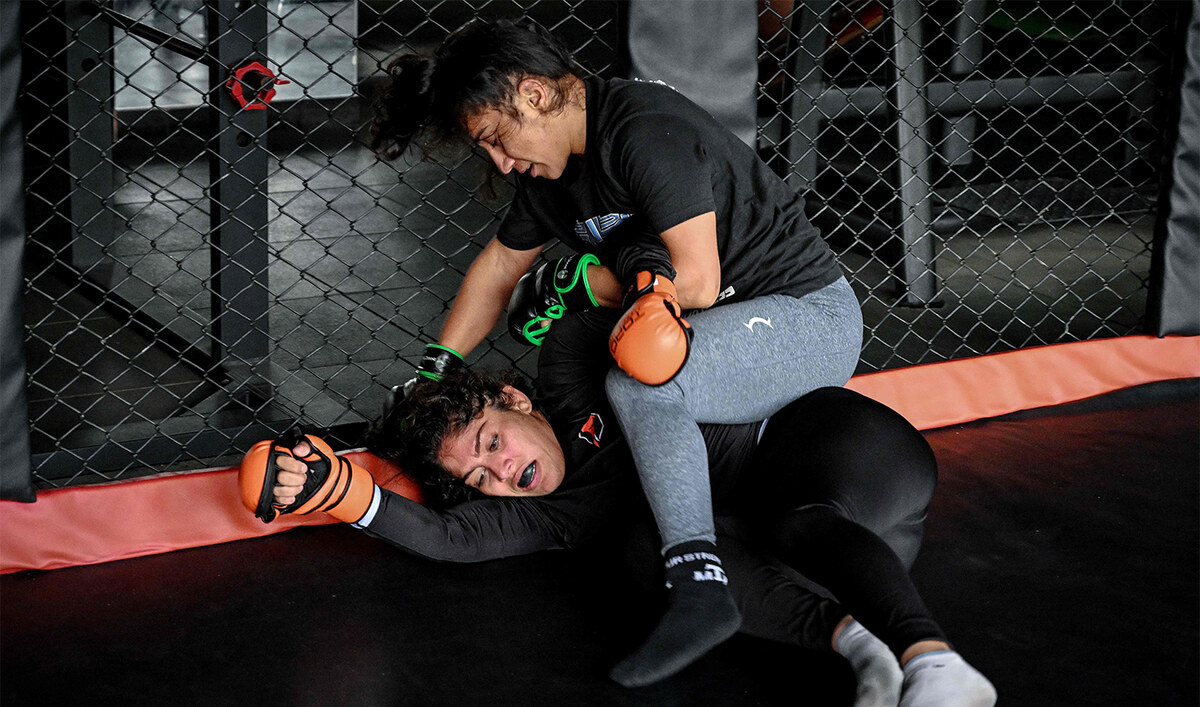
In this photograph taken on December 11, 2024, Anita Karim (top) and Bushra Ahmed, mixed martial arts (MMA) fighters, take part in a training session at a club in Islamabad. (AFP/File)
In her hometown, Karim originally trained in taekwondo and jiu-jitsu before discovering MMA at high school in Islamabad — to the consternation of her community back home.
“A lot of people close to me criticized me, but that’s part of the game. Now they know how it works,” she said.
The message emanating from her hometown now is one of pride.
“The way she has made the name of Gilgit-Baltistan and all of Pakistan shine on the international level, serves as a lesson,” said the regional government’s sports chief Shah Muhammad.
After losing on her professional debut in 2018, where the referee refused to let her fight unless she raised her leggings above the knee, she moved to Thailand to train at an MMA academy.
She now earns a living from competition prizes, modest government grants and coaching at her Islamabad gym.
When she returns after competitions, small crowds gather to greet her at the airport and she is followed by a fledgling community of female fighters.
They too want to turn professional in a nation where only one in five women have jobs, according to United Nations figures.
“Anita is a role model for us,” said Bushra Ahmed, a few years Karim’s junior and out of breath as she trains alongside her, another woman and a dozen men.
Karim also wants to “give Pakistani women confidence and self-defense techniques,” with over 80 percent having been victims of public harassment, according to the UN.
Recently she “hit a man who was harassing me in a market in Islamabad,” Karim said.
“He left with his face stained with blood.”


