

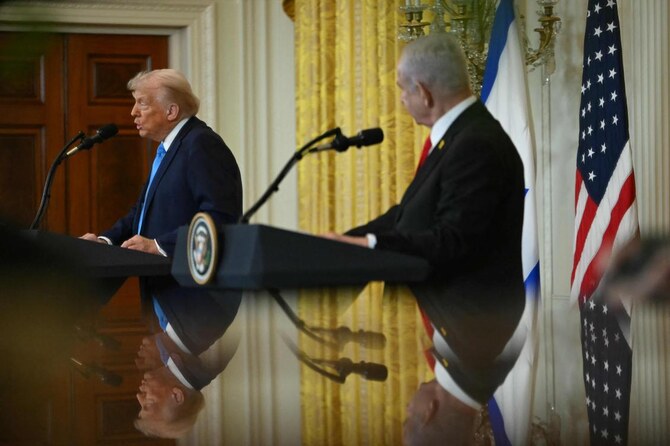

WASHINGTON: By proposing to “take over” Gaza, US President Donald Trump has not only stunned the world but also departed from long-standing US policy in supporting a Palestinian state.
The president, known for provocative statements, spoke Tuesday of permanently displacing Palestinians from the war-devastated Gaza Strip, expressing his desire to transform the Palestinian territory into “the Riviera of the Middle East.”
His comments sparked worldwide outcry Wednesday, particularly in the Arab world, as they appeared to challenge Palestinians’ right to self-determination, with critics denouncing it as potential “ethnic cleansing.”
The Republican billionaire, who portrays himself as a pragmatist with a transactional approach to foreign policy, hasn’t ruled out sending troops to the region.
The White House moved quickly Wednesday to temper his remarks. Spokeswoman Karoline Leavitt clarified that the United States would not “finance” reconstruction in Gaza and had not “committed” to sending troops.
Secretary of State Marco Rubio, speaking from Guatemala, defended Trump’s intentions: “It was meant as, I think, a very generous move — the offer to rebuild and to be in charge of the rebuilding.”
He also said that Trump only wants Palestinians to leave Gaza temporarily while the territory is reconstructed.
Negotiating tactic or distraction?
It remained unclear whether the president floated his proposal as a negotiating tactic or a distraction, as Israel and Hamas prepare to negotiate the second phase of the ceasefire agreement that took effect January 19.
This second phase aims to secure the release of remaining hostages and achieve a definitive end to the war triggered by Hamas’s attack on Israel on October 7, 2023.
“Trump’s remarks about relocating Palestinians would all but guarantee a broader regional conflict if he seriously pursues the idea,” said Sina Toossi of the Center for International Policy, noting that it “would shatter long-standing US policy on a two-state solution in which a Palestinian state includes Gaza.”
“In the short term, a key question is whether Trump will push (Israeli leader Benjamin) Netanyahu to fully implement the ceasefire deal in Gaza, including its critical second phase, or if he will instead allow Netanyahu and his hawkish cabinet to restart the war,” Toossi added.
The events that unfolded Tuesday during the Israeli prime minister’s Washington visit were remarkable on multiple levels.
Trump’s advisers, Middle East envoy Steve Witkoff and national security adviser Mike Waltz, initially questioned the feasibility of Gaza reconstruction, noting that the Palestinian territory would be uninhabitable for years.
Is he serious?
Trump, who had already caused controversy 10 days earlier with his suggestion to “just clean out” Gaza, claimed Palestinians “would love” to leave the territory, which he described as a “demolition site.”
He later received a beaming Netanyahu at the White House, emphasizing the need to relocate Palestinians before unexpectedly proposing to take “possession” of Palestinian territory to make it a “beautiful place.”
Netanyahu, who opposes the creation of a Palestinian state, praised Trump as someone who “thinks outside the box.”
In making these statements, Trump, who rarely explicitly addresses the prospect of a Palestinian state, broke with decades of Western foreign policy — supporting a two-state solution where Israel and Palestine coexist.
“It is very hard to know how seriously to take Trump’s comments, though they certainly seem to undercut the idea that his administration supports a two-state solution,” said Brian Finucane, a US foreign policy expert at the International Crisis Group in Washington.
But he added it didn’t seem like Palestinians would voluntarily leave Gaza, nor would countries in the region would agree to such a plan.


