

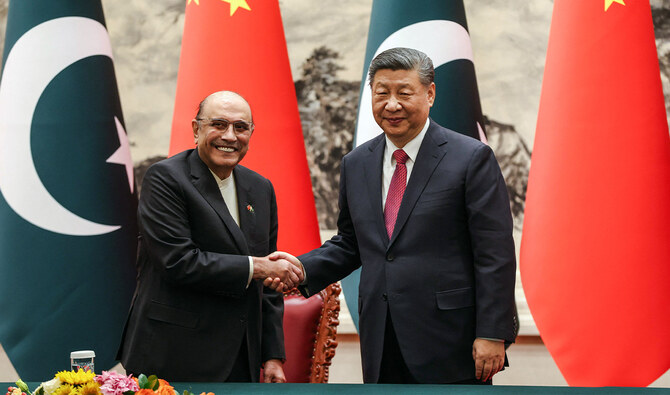

ISLAMABAD: President Asif Ali Zardari said on Wednesday militant attacks will not undermine Pakistan’s ties with China, as the two countries pledged to move forward on the next phase of the multibillion-dollar China-Pakistan Economic Corridor (CPEC).
Zardari issued the statement during his meeting with Chinese President Xi Jinping at the Great Hall of the People in Beijing, where both leaders discussed security issues and economic cooperation.
The interaction came amid increasing concerns in Beijing over the security of its workers in Pakistan, many of whom are involved in CPEC infrastructure projects and have been targeted in a series of attacks in recent years.
Despite acknowledging that his country’s friendship with China had “gone through ups and downs,” the Pakistani president said it would not be broken down by militant attacks.
“Pakistan and China will always be friends, all-weather friends,” he said at the opening of talks with Xi. “No matter how many terrors, how many issues crop up in the world, I will stand, Pakistani people will stand with the people of China.”
According to an official Pakistani statement released after the meeting, the two leaders discussed the high-quality development of CPEC 2.0, which aims to expand beyond infrastructure to include other areas.
Initially launched in 2013 as part of China’s Belt and Road Initiative (BRI), the first phase of CPEC focused on transport infrastructure, energy projects and the development of the Gwadar Port.
The next phase, dubbed CPEC 2.0, seeks to emphasize industrialization, agricultural modernization, and partnerships with third countries to enhance regional connectivity and economic growth.
Both leaders emphasized people-to-people exchanges and cultural linkages as key elements of strengthening the China-Pakistan community of shared future in the new era.
President Xi also acknowledged that China and Pakistan have an enduring friendship and have set a model for relations between two countries by advancing the construction of CPEC and cooperation in various fields.
A Chinese-funded $230 million airport, the largest in Pakistan, started operations last month in the coastal city of Gwadar in Balochistan province, where a separatist group has launched multiple attacks targeting many groups including Chinese.
A shipping port in Gwadar is the end of the envisioned economic corridor, which would cross the length of Pakistan to link the western Chinese region of Xinjiang with the Arabian Sea.
“The Chinese side is willing to work with the Pakistani side to move forward hand-in-hand on our respective paths of modernization,” the Chinese president said.
The start of operations at the airport was delayed from last year after a surge in attacks in Balochistan.
Zardari also extended an invitation to Xi to visit Pakistan, highlighting the strong public admiration for the Chinese leader in Pakistan.
Following the meeting, both presidents witnessed the signing of memorandums of understanding (MoUs) to boost cooperation in science and technology, clean energy, socio-economic development, and media collaboration.
The event concluded with a state banquet hosted by President Xi in honor of the visiting Pakistani delegation.
-With input from AP


