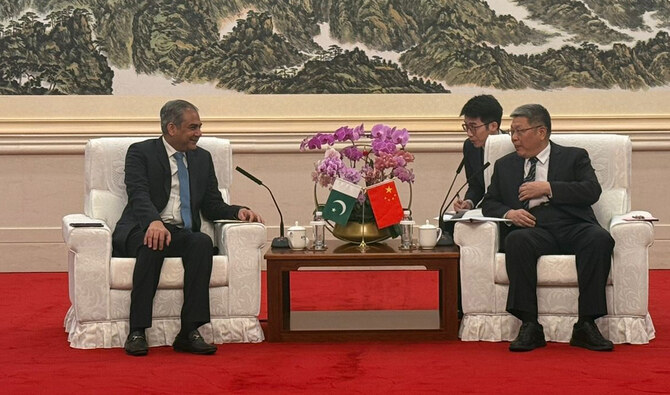
ISLAMABAD: Pakistan and China discussed security cooperation on Wednesday, agreeing to enhance intelligence sharing to address growing threats during a high-level meeting in Beijing, according to an official statement circulated by the interior ministry.
The two nations share concerns over militant violence, particularly due to attacks on Chinese nationals working on the multibillion-dollar China-Pakistan Economic Corridor (CPEC) projects in various Pakistani cities. Such incidents have prompted Beijing to call for enhanced security measures.
Last year, several Chinese nationals lost their lives in deadly suicide bombings, the most recent of which occurred in October 2024, killing two Chinese engineers near Karachi airport just days before the Shanghai Cooperation Organization Summit in the federal capital.
Pakistan’s Interior Minister Mohsin Naqvi, who is currently accompanying President Asif Ali Zardari on a five-day visit to China, met with his Chinese counterpart, Qi Yanjun, in Beijing to discuss concrete measures to bolster security and strengthen intelligence-sharing mechanisms.
“The meeting focused on improving intelligence coordination between the two countries,” said the official Pakistani statement.
It noted that discussions included an exchange on modern technology for police and paramilitary forces, as well as a detailed discussion on acquiring advanced equipment from China for law enforcement agencies.
The talks further covered border security cooperation, including measures to safeguard key routes and infrastructure projects. Both sides expressed a commitment to deeper collaboration in law enforcement and counterterrorism efforts.
Beyond security cooperation, the two countries are also working to establish special economic zones and encourage private sector partnerships to deepen economic ties. The development of these zones is a key component of CPEC, aiming to boost industrialization and economic growth in Pakistan.
President Zardari also met with Zhao Leji, Chairman of the Standing Committee of the National People’s Congress, to reaffirm the enduring friendship between Pakistan and China.
Both officials emphasized strategic mutual trust and discussed advancing CPEC’s high-quality development, focusing on cooperation in science and technology, renewable energy, infrastructure and agriculture.


![]()

Pakistan and China agree to boost intelligence sharing in high-level security talks in Beijing
Short Url
https://arab.news/4rmt8
Pakistan and China agree to boost intelligence sharing in high-level security talks in Beijing
- Both nations share concerns over militant violence, particularly due to attacks on Chinese nationals in Pakistan
- The two countries also discuss border security and advancing high-quality development under CPEC projects
Latest updates


© 2026 SAUDI RESEARCH & PUBLISHING COMPANY, All Rights Reserved And subject to Terms of Use Agreement.