

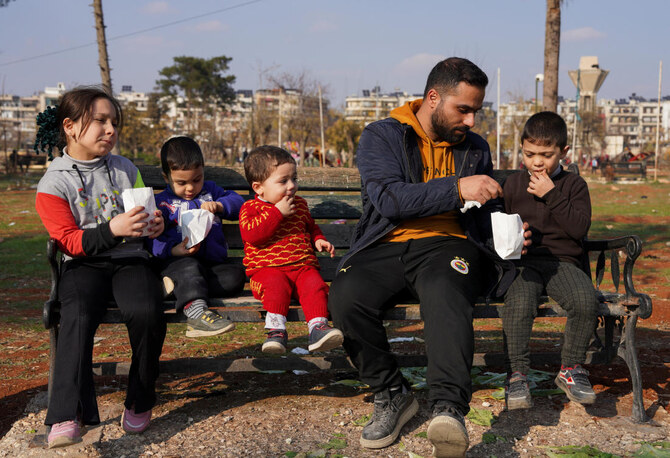

ALEPPO: Ahmed Al-Sheikh’s excitement at returning to his homeland from neighboring Turkiye after the fall of Bashar Assad has turned to bitter disappointment at the grim living conditions in Syria after some 13 years of war.
Sheikh is one of 35,000 Syrians who left Turkiye for Syria full of hope in the first three weeks after Assad was toppled on Dec. 8, giving up the right to come back to Turkiye after signing a voluntary return document.
Turkiye’s refugee association says many, like him, are now disillusioned by the reality of life in a war-ravaged country.
“I was shocked by the catastrophic situation, which was beyond my expectations,” said Sheikh, 35, speaking in his home after returning to Aleppo, eight years after he fled to Turkiye. He said that water and electricity are frequently cut off and Internet communication is almost non-existent.
Migrant returns are a key element of burgeoning ties between Syria and NATO-member Turkiye, which is emerging as a power broker able to wield influence economically and diplomatically. Syria’s transitional President Ahmed Al-Sharaa visited Ankara on Tuesday, discussing an expected rapid expansion of economic ties.
The presence of nearly 3 million Syrians in Turkiye has become a sensitive political issue. Many have faced bouts of anti-migrant sentiment that made them feel like unwanted guests, and some rushed to the border after rebels forced Assad out.
“Most of the refugees were initially excited about returning after the fall of the Assad regime, but this excitement faded over time,” said Kadri Gungorur, social welfare director of the Refugees Association in Turkiye, citing complaints such as the lack of education and health services.
“Some families feel regret and want to return,” he said. “When they compare the living conditions in Turkiye with Syria, we can accept that Turkiye offers them more opportunities.”
BID TO SUPPORT VOLUNTARY RETURNS
Sheikh was among those enthused by the rebels’ victory, dreaming of rebuilding his bombed Aleppo home. He vowed to go back as soon as Assad fell, despite friends’ efforts to dissuade him. Now he is dismayed by the comparatively poor living conditions and scarcity of job and education opportunities.
“I started thinking about returning to Turkiye because my life was stable there, and my children were in school. My living conditions were stable,” he said. “But I can’t go back now because I signed a voluntary return document.”
Due to such negative experiences, Turkish Interior Minister Ali Yerlikaya announced at the end of 2024 a scheme designed to enable migrants to better plan their return home.
The scheme entitles the heads of Syrian migrant families to visit Syria three times between January and June this year, according to an Interior Ministry document.
Between Assad’s fall and late January, 81,576 Syrians had entered Syria, indicating a slight fall in the daily rate of returns from December to some 1,600 a day, Yerlikaya said. It was unclear how many of those returning in January had signed the voluntary return document.
During a visit to Turkiye last week, the UN High Commissioner for Refugees Filippo Grandi expressed support for Turkiye’s refugee response and voluntary returns.
He praised the policy of what he called “go-and-see visits,” saying they were “a best practice, as it allows refugees to assess conditions for themselves and can pave the way for sustainable returns to Syria.”
’PERHAPS IN THE FUTURE’
Some Syrians are more inclined to wait and see.
Syrian chemist Jafer, 27, came to Turkiye 12 years ago and will not consider returning with his wife and three children until conditions improve.
“My children are currently well-adjusted in Turkiye, which makes staying here more likely since they have adapted to life, language, and education in Turkiye,” he said.
“Some people will return, but the lack of basic necessities prevents them from doing so. They think about returning, but not now, perhaps in the future.”
It is an option no longer open to Sheikh.
He was forced out of Aleppo in late 2016 when Assad forces, with the support of Russian air strikes, seized control of the eastern part of the city from rebels. He went on to build a stable life for his wife and four children in Turkiye.
He has opened a mobile phone repair shop in Aleppo, but his plan to fix his house there is on hold.
“I don’t know if the project will succeed here in the country or if it will fail. If it fails, I will have lost everything I earned during my time in Turkiye.”


