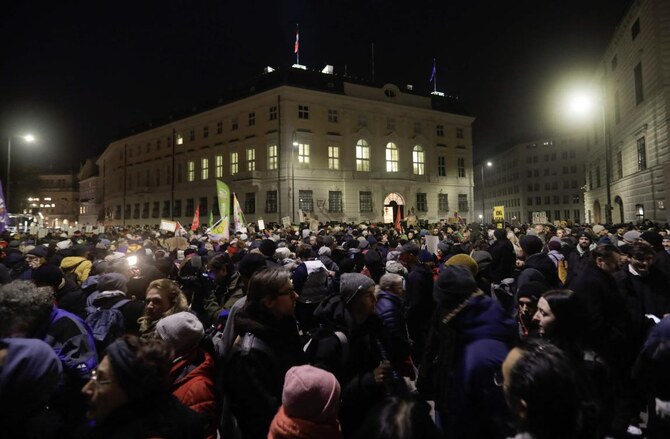
VIENNA: Thousands protested on Tuesday in Vienna against negotiations for Austria’s first far-right-led government, with efforts to form a ruling coalition dragging on toward a record period of time.
While the Freedom Party (FPOe) — which in September topped national polls for the first time ever — has been in government before, it has never led the Alpine nation of nine million people.
“We don’t want that... We want a good and humane government,” researcher Karl Bittner, 27, told AFP, as thousands protested in front of the chancellery.
Organizers put the number at 30,000.
Carrying posters that read “Nazis out” and “Never again,” many expressed fears an FPOe-led government would not respect the rule of law, as well as minority and other rights.
Another protester, a 32-year-old student who only gave her name as Alexandra, said she was rallying “against the right-wing surge in Europe gaining even more momentum.”
The FPOe has been negotiating since early last month with the long-ruling conservative People’s Party (OeVP), which came second in September’s polls.
“The government negotiations are in a difficult phase,” the OeVP said in a statement late Tuesday, without giving details on the stumbling blocks.
The OeVP failed in an earlier attempt to form a government without the FPOe.
Set in the 1960s, the previous record time taken for negotiations to form a government was 129 days.
That mark will tumble on Wednesday.
Analysts still see an FPOe-led government in the EU member nation as the most likely outcome.
“There are differences, especially in their standpoints on the EU... However, the negotiations are unlikely to fail because of this,” political analyst Johannes Huber told AFP.
He added that the conservatives in recent years had demanded a “refocusing of the EU on economic issues,” which is “not far” from the EU-critical FPOe’s own demands.
Other sticking points include FPOe plans to slash the fees Austrians pay to public broadcaster ORF.
FPOe leader Herbert Kickl, in a Facebook post on Sunday, said that he continues to have “trust” in the conservatives.
Tuesday’s protest followed a rally last month which gathered tens of thousands of people across Austria.
In neighboring Germany, at least 160,000 people rallied in Berlin on Sunday to protest last week’s decision by the country’s conservatives to make overtures to the far right ahead of this month’s legislative election.
Austria has had a strong far-right political presence since the 1980s.
In 2000, the FPOe under Joerg Haider entered into a coalition government, a first in the European Union, triggering protests that drew up to 250,000 people.
The FPOe — led by the radical Kickl since 2021 — won almost 29 percent of the vote in September as anger and fears over inflation, migration, the war in Ukraine and the handling of the coronavirus pandemic weighed heavily on the ballot.
The FPOe currently leads one regional government in Austria and is part of regional governments in four other provinces.


![]()

Thousands protest as Austria braces for first far right-led govt
Short Url
https://arab.news/zt7sx
Thousands protest as Austria braces for first far right-led govt
- Carrying posters that read “Nazis out” and “Never again,” many expressed fears an FPOe-led government would not respect the rule of law
- The FPOe has been negotiating since early last month with the long-ruling conservative People’s Party (OeVP)


Latest updates


© 2026 SAUDI RESEARCH & PUBLISHING COMPANY, All Rights Reserved And subject to Terms of Use Agreement.