

Saudi Cabinet approves cooperation agreement with WEF to secure minerals for development

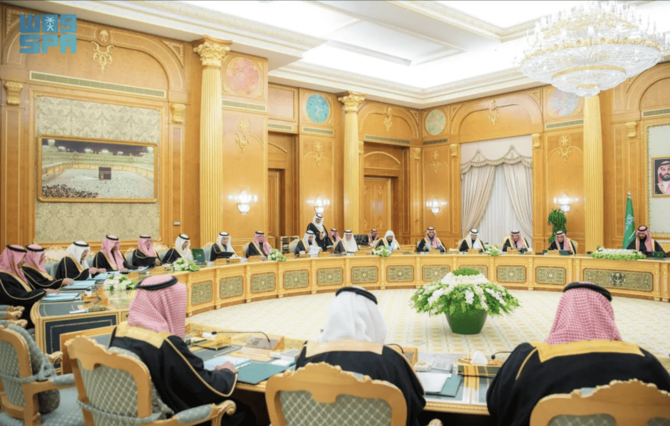
The Cabinet was chaired by Crown Prince Mohammed bin Salman. SPA
Short Url
Updated 04 February 2025
Follow

Saudi Cabinet approves cooperation agreement with WEF to secure minerals for development

RIYADH: Saudi Arabia’s Cabinet has authorized the Ministry of Industry and Mineral Resources to sign a cooperation agreement with the World Economic Forum to secure critical materials for global development.

According to the Saudi Press Agency, the Cabinet — chaired by Crown Prince Mohammed bin Salman — gave the green light for the deal among a host of decisions.

Strengthening the mining sector is a crucial goal outlined in the Kingdom’s Vision 2030 agenda, as the nation is steadily spearheading its economic diversification journey by reducing its reliance on crude revenues. 

Speaking at the Future Minerals Forum in Riyadh in January, Alkhorayef said that Saudi Arabia seeks to promote exploration opportunities across 5,000 sq. km of mineralized belts in 2025, aligned with the Kingdom’s plans to establish mining as the third pillar of its industrial economy. 

At that time, the minister added that Saudi Arabia’s mining sector is the fastest growing globally, with the country holding an estimated mineral potential worth $2.5 trillion. 


Saudi stocks rise above 11,000 as energy shares lead gains  

Updated 11 sec ago
Follow

Saudi stocks rise above 11,000 as energy shares lead gains  

RIYADH: Saudi Exchange’s benchmark Tadawul All Share Index climbed above 11,000 on Sunday, led by energy and materials stocks despite geopolitical uncertainty from ongoing tensions between US-Israel and Iran across the region. 

As of 12:30 p.m. Saudi time, the benchmark index had advanced 224.80 points, or 2.09 percent, to 11,001.12. The MSCI Tadawul Index rose 26.96 points, or 1.84 percent, to 1,488.86, while the Kingdom’s parallel market, Nomu, slipped 0.05 percent to 22,485.78. 

The gains came as Gulf markets reacted to heightened tensions between the US-Israel alliance and Iran, prompting investors to shift toward sectors more resilient to higher oil prices and supply disruptions. 

Saudi Aramco was among the strongest performers, with its share price rising 4.56 percent to SR27.06 as of 12:30 p.m. Saudi time. 

Speaking to Arab News, Tony Hallside, CEO of STP Partners, said: “Energy producers and oilfield services typically outperform on higher crude, while the pain concentrates in airlines, shipping, petrochemicals, and any sector with high fuel or logistics intensity.” 

Century Financial chief investment officer Vijay Valecha told Arab News that energy companies such as Saudi Aramco could see their share prices rise under current market conditions. 

“At the sector level, energy and petrochemical companies are likely to remain relatively resilient due to stronger pricing. In contrast, sectors such as real estate, consumer discretionary, banking, and capital markets would likely see short-term volatility and profit-taking as investors adopt a more cautious stance,” said Valecha. 

He added that elevated energy prices could also increase global inflationary pressures and create uncertainty in supply chains, potentially weighing on broader economic activity. 

Stock exchanges across the Gulf Cooperation Council also showed signs of recovery on March 6, with the Bahrain Bourse edging up 0.24 percent and the Muscat Stock Exchange gaining 1.44 percent. 

The Qatar Stock Exchange, however, declined 0.15 percent. 

UAE equities were closed on Sunday due to an official holiday. 

On March 6, the Dubai Financial Market index fell for a fifth straight session, down 3.2 percent, or 197.49 points, to 5,917.22. It declined 9.01 percent for the week. 

The Abu Dhabi Securities Exchange general index fell for a seventh consecutive session, dropping 1.4 percent, or 141.49 points, to 9,903.36 on March 6. 

“UAE equities ended the week lower as the widening conflict involving the US, Israel, and Iran continued to weigh heavily on risk sentiment. Dubai and Abu Dhabi stocks slid further upon reopening on Wednesday, pressured by regional tensions after the two-day break,” Valecha said in a separate statement. 

He added: “Banking and property stocks have been the largest drags as investors reassessed and questioned whether the market had priced in too much resilience. The shift in perception followed missile and drone attacks on Dubai over the weekend, which undermined the idea that the city remained insulated from global tensions.”