

Saudi academy launches Arabic immersion program

1 / 4
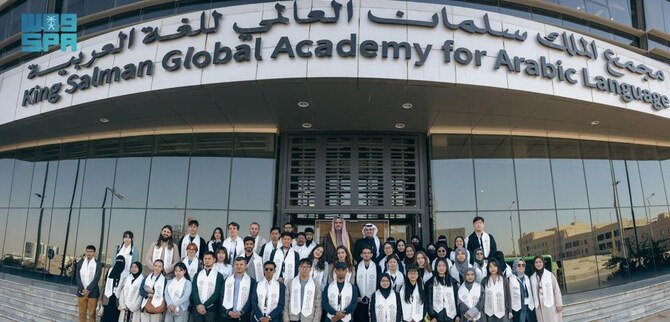
Fifty non-native Arabic-speaking students joined the second edition of the King Salman Global Academy for Arabic Language Linguistic Immersion program. (SPA)
2 / 4
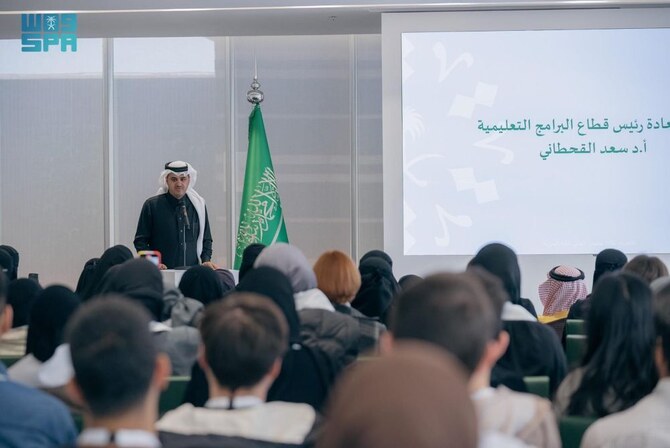
The program includes people from 20 countries and introduces two new tracks to cater to different learning needs. (SPA)
3 / 4
The program includes people from 20 countries and introduces two new tracks to cater to different learning needs. (SPA)
4 / 4
The program includes people from 20 countries and introduces two new tracks to cater to different learning needs. (SPA)
Short Url
Updated 04 February 2025
Follow

Saudi academy launches Arabic immersion program

  • Eight-week program aims to enhance participants’ Arabic skills for cultural and tourism purposes
  • Students will gain a deep understanding of the language through an immersive experience focused on integration into Saudi society

RIYADH: The King Salman Global Academy for Arabic Language has welcomed 50 non-native Arabic-speaking students for the second Linguistic Immersion program.

Held at the academy’s Riyadh headquarters, the program includes people from 20 countries and introduces two new tracks, according to the Saudi Press Agency.

Building on the success of the 2023 edition in Jeddah, which attracted more than 100 learners from 34 countries, the eight-week program aims to enhance participants’ Arabic skills for cultural and tourism purposes.

Students will gain a deep understanding of the language through an immersive experience focused on integration into Saudi society, the SPA reported.

The initiative aligns with the academy’s mission to promote Arabic globally and supports Saudi Arabia’s Human Capability Development Program.

Participants were selected through a precise admission process to ensure they met the criteria for the flagship initiative.

Divided into two tracks, the program caters to different learning needs. The tourism track equips 25 students, tourists and visitors with practical skills to navigate real-life scenarios in Arabic while exploring Saudi culture through field visits and training.

The cultural track targets university students and language center participants, enhancing their linguistic proficiency in a comprehensive learning environment.

The program follows the “Cultural Arabic” and “Touristic Arabic” courses, based on the Common European Framework of Reference for Languages at the B1 level. This enables participants to communicate effectively in Arabic across various contexts.

Using a communicative approach, the institute integrates grammar and syntax within skill-based, interactive activities. Learning is supported by group work, audio-visual material and reading resources.

Structured around an advanced curriculum, the program combines classroom lessons with cultural activities, such as hosting experiences with Saudi families, national celebrations like Founding Day and National Day, and weekly cultural trips.


Threat to Kingdom’s security is ‘red line’ that will be ‘addressed and neutralized,’ Saudi envoy says

Updated 14 January 2026
Follow

Threat to Kingdom’s security is ‘red line’ that will be ‘addressed and neutralized,’ Saudi envoy says

  • Abdulaziz Alwasil tells UN Security Council the situation in southern Yemen is ‘a just cause with social and historic dimensions’ that can only be resolved through dialogue
  • Recent military activity in the south was unilateral, resulting in an escalation that harms the interests of Yemeni people and undermines efforts to address issues in the south, he said

NEW YORK CITY: Any attempt to threaten Saudi Arabia’s national security is a “red line” and will be met with decisive action, the Kingdom’s ambassador to the UN told the Security Council on Wednesday.

Speaking during a meeting of the council to discuss Yemen, Abdulaziz Alwasil said the situation in the south of the country is “a just cause with social and historic dimensions” that can only be resolved through dialogue.

“We stress that any attempt to threaten our national security is a red line, and we will not hesitate to take the necessary actions and steps to address it and neutralize it,” he added.

Alwasil reaffirmed Saudi Arabia’s support for Yemeni President Rashad Al-Alimi, the Presidential Leadership Council, and the Yemeni government in their efforts to achieve security, stability, development and peace while preserving national unity.

He said military activity by Southern Transitional Council forces in Hadramout and Al-Mahra on Dec. 2, 2025, was unilateral, did not have the approval of the Presidential Leadership Council, and was not carried out in coordination with the Coalition to Restore Legitimacy in Yemen.

It had resulted in an unjustified escalation that harmed the interests of the Yemeni people, undermined efforts to address the issues in the south, and ran counter to the coalition’s objectives, Alwasil added.

The Kingdom, working with its coalition partners, the Presidential Leadership Council and the Yemeni government, had moved to contain the situation by dispatching a military force to coordinate arrangements with the Southern Transitional Council in Aden, he said.

The aim was to ensure the return of the southern council’s forces to their previous positions outside of Hadramout and Al-Mahra, and the handover of camps to legitimate government forces and local authorities in line with agreed procedures, Alwasil added.

He expressed regret over the military operations that took place in Hadramout and Al-Mahra, close to Saudi Arabia’s southern border, which he said posed a direct threat to the Kingdom’s national security, as well as the security of Yemen and regional stability. Such steps were extremely dangerous, he added, and contradicted the principles on which the Coalition to Restore Legitimacy in Yemen had been founded.

Alwasil welcomed a prisoner and detainee exchange agreement signed in Muscat on Dec. 23, which he described as an important humanitarian measure to alleviate suffering and build confidence.

He praised Oman for hosting and sponsoring the consultations and supporting negotiations, and commended the efforts of UN’s special envoy for Yemen, Hans Grundberg, the International Committee of the Red Cross and all others that has played a part.

Regarding the political efforts to resolve the crisis, Alwasil said Saudi Arabia welcomed President Al-Alimi’s call for an inclusive conference in Riyadh to bring together all stakeholders to discuss just solutions to the situation in southern Yemen.

Preparations for the conference have begun, he added, in cooperation with the Yemeni government and southern representatives, reflecting the close ties between the two countries and their shared interests in stabilizing Yemen.

He urged all southern stakeholders to participate actively and constructively in the talks, to help find comprehensive and just solutions that meet the legitimate aspirations of the people of southern Yemen.

Alwasil called on all Yemeni forces and stakeholders to cooperate and intensify their efforts to reach a lasting political settlement that would ensure security and stability.

He described the southern issue as “a just cause with social and historic dimensions,” adding that “the only way to address it is through dialogue that leads to a comprehensive political solution” based on nationally and internationally agreed terms of reference.