

Pakistan cuts this year’s Hajj costs, announces $17 million in refunds for last year’s pilgrims

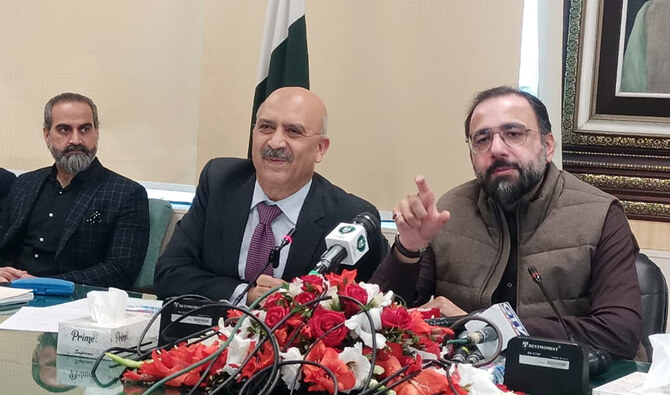
Federal Minister for Religious Affairs Chaudhry Salik Hussain (right) speaks during a press conference in Islamabad, Pakistan, on February 4, 2025. (Photo Courtesy: Ministry of Religious Affairs)
Short Url
Updated 04 February 2025
Follow

Pakistan cuts this year’s Hajj costs, announces $17 million in refunds for last year’s pilgrims

  • The religious affairs minister announces Hajj cost reductions of up to $179 for pilgrims
  • Chaudhry Salik Hussain says the government’s 2025 Hajj quota has been fully utilized

ISLAMABAD: Federal Minister for Religious Affairs Chaudhry Salik Hussain on Tuesday announced a reduction of up to Rs50,000 ($179) in this year’s Hajj packages and a refund of over Rs4.75 billion ($17 million) to 2024 pilgrims.

Last month, Pakistan and Saudi Arabia signed the Hajj Agreement 2025, under which 179,210 Pakistanis will perform the annual pilgrimage this year. The quota is divided equally between government and private schemes.
To make the pilgrimage more convenient and accessible, Pakistan has introduced a shortened Hajj program of 20 to 25 days. The Ministry of Religious Affairs initially set the cost at Rs1,075,000 ($3,854) for the long Hajj package and Rs1,150,000 ($4,122) for the short Hajj package, as shorter stays often incur higher airfare, premium accommodation rates and expedited transport services, driving up overall costs.
For the first time, the Hajj Policy 2025 also allowed pilgrims to pay in installments, easing financial constraints. Under the scheme, the first installment of Rs200,000 ($717) was required with the application, followed by Rs400,000 ($1,435) within 10 days of balloting, while the remaining amount had to be paid by February 10.
“After successful negotiations by our committee in Saudi Arabia, the cost of the 40-day long Hajj package has been reduced by Rs25,000 ($90) to Rs1,050,000 ($3,764), while the 25-day short Hajj package has been reduced by Rs50,000 ($179) to Rs1,100,000 ($3,943),” Hussain told reporters in Islamabad.
He said pilgrims must submit the third installment in designated banks between February 6 and February 14, while every pilgrim will receive a notification via the ‘Pak Hajj’ cellphone app launched by the government.
The app is designed to provide real-time updates, guidance, emergency contacts, lodging details, route navigation and complaint registration to ensure a smooth pilgrimage experience.
“Pilgrims opting for the long Hajj package will need to pay a third installment of Rs450,000 ($1,613), while the third installment for the short Hajj package will be Rs500,000 ($1,794),” Hussain said.
He further informed that over Rs4.75 billion ($17 million) will be refunded to 2024 Hajj pilgrims, citing savings in sacrificial animal costs and airfare reductions.
“Refunds will be disbursed into pilgrims’ accounts from February 7 onwards,” he added.
The minister said this year’s government Hajj quota has been fully utilized and expressed hope that pilgrims will have an even better experience than last year.
“Pilgrims will have assistance available at all times, as one Hajj assistant will be assigned for every 150 pilgrims,” he continued.
“The assistant will travel with the pilgrims from the Hajj camp, stay with them and return with them, ensuring continuous support throughout the journey,” he added.


Pakistan president meets UAE counterpart, explores trade, investment opportunities

Updated 5 sec ago
Follow

Pakistan president meets UAE counterpart, explores trade, investment opportunities

  • Asif Ali Zardari is in UAE on four-day visit to strengthen bilateral ties, review bilateral cooperation
  • Both sides discuss regional, international developments, reaffirm commitment to promote peace

ISLAMABAD: President Asif Ali Zardari met his UAE counterpart Sheikh Mohammed bin Zayed Al-Nahyan in Abu Dhabi on Tuesday during which both sides explored new opportunities in trade, investment, energy and other sectors, Zardari's office said. 

Zardari arrived in Abu Dhabi on Monday evening with a high-level delegation on a four-day official visit to the UAE to review trade, economic and security cooperation. 

"The leaders discussed ways to further deepen the longstanding and brotherly relations between Pakistan and the UAE," a statement from Zardari's office said about his meeting with the UAE president. 

"They reviewed the full spectrum of bilateral cooperation and explored new opportunities in trade, investment, energy, infrastructure, technology, and people-to-people exchanges, highlighting the significant potential for expanding economic and strategic partnership.

Zardari highlighted the significance of Al-Nayhan's visit to Pakistan last month, the statement said, expressing appreciation for the UAE's continued support for strengthening bilateral ties.

It said both sides also exchanged views on a range of regional and international developments, reaffirming their commitment to promoting peace, stability and sustainable development.

The meeting was also attended by Pakistan's First Lady Aseefa Bhutto-Zardari, the Pakistani president's son Bilawal Bhutto-Zardari, who is also the chairman of the Pakistan Peoples Party, Interior Minister Mohsin Naqvi and Pakistan's ambassador to the UAE. 

ZARDARI MEETS AD PORTS CEO

Zardari earlier met AD Ports Group CEO Captain Mohamed Juma Al-Shamisi to discuss the group's investment initiatives in Karachi. 

"Both sides agreed that the expansion and modernization of port infrastructure would strengthen trade flows and support Pakistan’s broader economic development and country’s seaborne trade," the President's Secretariat said in a statement.

It added that Zardari described the AD Ports Group's long-term investment and expanding role in Pakistan's maritime and logistics sector as a key pillar of Pakistan–UAE economic cooperation.

Pakistan and the UAE maintain close political and economic relations, with Abu Dhabi playing a pivotal role in supporting Islamabad during periods of financial stress through deposits, oil facilities and investment commitments. 

The UAE is Pakistan's third-largest trading partner, after China and the United States, and a key destination for Pakistani exports, particularly food, textiles and construction services.

The Gulf state is also home to more than 1.5 million Pakistani expatriates, one of the largest overseas Pakistani communities in the world, who contribute billions of dollars annually in remittances, a crucial source of foreign exchange for Pakistan’s economy.

Beyond trade and labor ties, Pakistan and the UAE have steadily expanded defense and security cooperation over the years, including military training, joint exercises and collaboration in counter-terrorism and regional security matters.