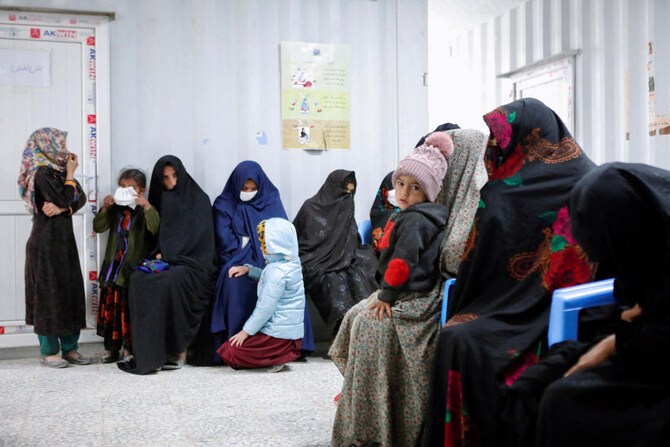
GENEVA: A UN aid official said on Tuesday that a US funding pause would cut off millions of Afghans from sexual and reproductive health services, and the continued absence of this support could cause over 1,000 maternal deaths in Afghanistan from 2025 to 2028.
US President Donald Trump last month ordered a 90-day pause in foreign development assistance, pending assessment of efficiencies and consistency with his foreign policy, setting alarm bells ringing among aid groups around the world that depend on US largesse.
Trump has also restored US participation in international anti-abortion pacts, cutting off US family planning funds for foreign organizations providing or promoting abortion.
Pio Smith, regional director for Asia and the Pacific at the United Nations sexual and reproductive health agency (UNFPA), said that over 9 million people in Afghanistan would lose access to services and over 1.2 million Afghan refugees living in Pakistan due to the closure of health facilities.
Afghanistan has one of the highest death rates in the world for pregnant women, with a mother dying of preventable pregnancy complications every two hours, he said.
“What happens when our work is not funded? Women give birth alone, in unsanitary conditions...Newborns die from preventable causes,” he told a Geneva press briefing. “These are literally the world’s most vulnerable people.”
“If I just take the example of Afghanistan, between 2025 and 2028 we estimate that the absence of US support will result in 1,200 additional maternal deaths and 109,000 additional unintended pregnancies,” he said.
Across the Asia-Pacific region, UNFPA receives about $77 million in US funding, he added.
Riva Eskinazi, director of donor relations at the International Planned Parenthood Federation told Reuters it, too, would have to halt family planning and sexual and reproductive health services in West Africa as a result of the pause.
“We can foresee an increase in unintended pregnancies and maternal deaths. There is going to be a problem sending contraceptives to our members. It’s devastating,” she said.
IPPF, a federation of national organizations that advocates for sexual and reproductive health, calculates that it would have to forego at least $61 million in US funding over four years in 13 countries, most of which are in Africa.


UN warns maternal deaths in Afghanistan may rise after US funding pause
https://arab.news/rbjx8
UN warns maternal deaths in Afghanistan may rise after US funding pause

- Pio Smith, regional director for Asia and the Pacific at UNFPA said that over 9 million people in Afghanistan would lose access to services
- “If I just take the example of Afghanistan, between 2025 and 2028 we estimate that the absence of US support will result in 1,200 additional maternal deaths”


Attacks on Sudan health care facilities killed 69 this year: WHO
- “Five attacks on health care have already been recorded in Sudan, killing 69 people and injuring 49,” WHO chief wrote on X
- The WHO has confirmed at least 206 attacks on health care facilities since the start of the war
CAIRO: Five attacks on health care facilities have killed dozens of people in Sudan since the beginning of the year, the WHO said Saturday, as the war nears the start of its fourth year.
The fighting between Sudan’s army and the paramilitary Rapid Support Forces has dismantled an already fragile medical system, with more than a third of facilities currently out of service.
“During the first 50 days of 2026, five attacks on health care have already been recorded in Sudan, killing 69 people and injuring 49,” WHO chief Tedros Adhanom Ghebreyesus wrote on X.
On Sunday a hospital was targeted in the southeastern state of Sennar, leaving three patients dead and seven people wounded, including an employee, Tedros said.
In three other attacks early this month, more than 30 people were killed when medical centers were targeted in South Kordofan, a vast region south of the capital Khartoum that is currently a focus of the fighting.
The WHO has confirmed at least 206 attacks on health care facilities since the start of the war in April 2023, resulting in the deaths of around 2,000 people and injuries to several hundred.
Last year alone, 65 attacks killed more than 1,620 people, accounting for 80 percent of all deaths worldwide linked to attacks on the medical sector, according to the WHO.
Since it broke out, Sudan’s civil war has killed tens of thousands of people and forced 11 million to flee their homes, triggering what the UN says is one of the world’s worst humanitarian crises.
According to the WHO, the country is facing multiple disease outbreaks, notably cholera, malaria, dengue and measles, in addition to malnutrition.
Some 4.2 million cases of acute malnutrition are expected to arise in Sudan this year, including more than 800,000 cases of severe acute malnutrition, the WHO chief said earlier this month.
Around 33 million people will be left without humanitarian aid in 2026, with the United Nations warning in January that its aid stocks could run out by the end of March.


