UNESCO lists Pakistan’s ancient Bareendo instrument as endangered cultural heritage

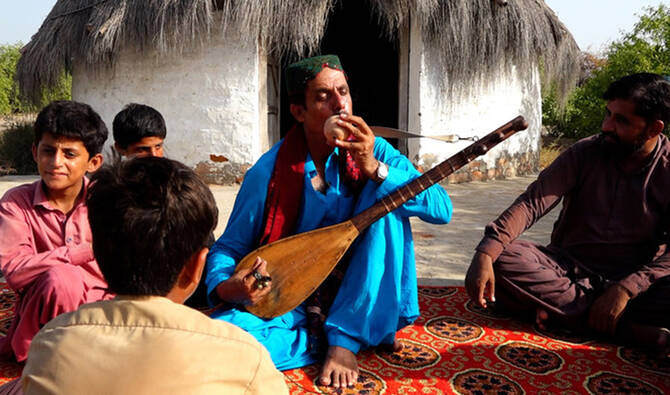
Zulfiqar Ali, a 53-year-old musician in Pakistan's Tharparkar district plays borrindo on September 10, 2023. (AN photo)
Short Url
Updated 10 December 2025
Follow

UNESCO lists Pakistan’s ancient Bareendo instrument as endangered cultural heritage

  • 5,000-year-old Sindhi clay wind instrument placed on UNESCO urgent safeguarding list
  • Only two known practitioners remain as Pakistan launches four-year preservation plan

ISLAMABAD: Pakistan’s 5,000-year-old folk instrument Bareendo has been added to UNESCO’s Intangible Cultural Heritage list for urgent safeguarding, the UN agency said this week, placing it among cultural traditions considered at immediate risk of disappearing.

Believed to originate in the ancient Indus Valley Civilization, the clay wind instrument is the oldest known surviving musical form in the southern Sindh province. Its soft, breath-driven tones have accompanied Sufi devotional gatherings, winter festivals and village ceremonies for generations, forming a core part of Sindh’s musical and spiritual identity.

The inscription was approved at the 20th Session of UNESCO’s Intergovernmental Committee for Intangible Cultural Heritage, which documents vulnerable cultural practices globally, from oral folklore to craftsmanship, to ensure they are preserved and passed on.

UNESCO announced the listing on X on Tuesday:

“New inscription on the Urgent Safeguarding List of Intangible Heritage: Boreendo, Bhorindo: ancient dying folk musical instrument, its melodies, knowledge, and skills.”

Pakistan’s Permanent Delegate to UNESCO, Ambassador Mumtaz Zahra Baloch, welcomed the move, calling it the recognition of a tradition preserved through centuries of community transmission.

“Bareendo is not only an emblem of the Indus Valley’s cultural continuity but also a living expression of Sindh’s artistic and spiritual heritage,” she was quoted as saying by Pakistan’s Embassy in France. 

“This recognition by UNESCO reaffirms Pakistan’s commitment to the protection and promotion of our diverse cultural traditions.”

Only two people are believed to retain full mastery of Bareendo today, musician Ustaad Faqeer Zulfiqar and master potter Allah Jurio, underscoring why the nomination was marked urgent, the embassy said. 

The nomination followed an intensive consultation process between the Sindh government, Pakistan’s Mission to UNESCO and UNESCO headquarters in Keti Mir Muhammad Loond village and led to a four-year safeguarding strategy (2026–2029). Planned measures include a community music school, integration into formal and informal education and digital archiving to open access beyond Sindh’s rural belt.

With this recognition, Bareendo joins existing UNESCO-listed intangible traditions like Suri Jagek (the astronomical knowledge of the Kalash people), Falconry, and Nowruz, the regional spring new year.


At least 15 killed, over 80 injured in blast at Islamabad mosque

Updated 7 min 8 sec ago
Follow

At least 15 killed, over 80 injured in blast at Islamabad mosque

  • Explosion strikes during Friday prayers in Tarlai area on capital’s outskirts
  • Attack follows deadly suicide bombing near Islamabad court complex last year

ISLAMABAD: At least 15 people were killed and more than 80 injured after a blast hit a mosque on the outskirts of the Pakistani capital Islamabad on Friday, the city’s district administration said. 

The explosion occurred in the Tarlai area around the time of Friday prayers, when large numbers of worshippers gather at mosques across the country, raising fears of a mass-casualty attack. 

The attack comes amid a renewed surge in militant violence in Pakistan and follows a suicide bombing outside a district court complex in Islamabad in November last year that killed at least 12 people and wounded dozens, underscoring growing security concerns even in heavily guarded urban centers.

“The death toll from the blast in the federal capital has risen to 15,” a spokesperson for the district administration said in a statement, adding that at least 80 people were injured.

Emergency measures were imposed at the Pakistan Institute of Medical Sciences (PIMS), Polyclinic Hospital and the Capital Development Authority (CDA) Hospital, the statement said, adding that assistant commissioners had been deployed to oversee treatment of the wounded.

“The site of the blast has been completely sealed,” the district administration spokesperson said.

Earlier, police spokesperson Taqi Jawad said the blast occurred at an imambargah, a place of worship for the Shiite Muslim community.

“More details will be shared in due course,” Jawad said.

No group has so far claimed responsibility for the attack.

Islamabad has historically been less affected by militant violence than Pakistan’s northwestern and southwestern regions, but the November suicide bombing near the district courts, and Friday’s explosion, have heightened concerns about the capital’s vulnerability amid a broader nationwide resurgence of militancy.