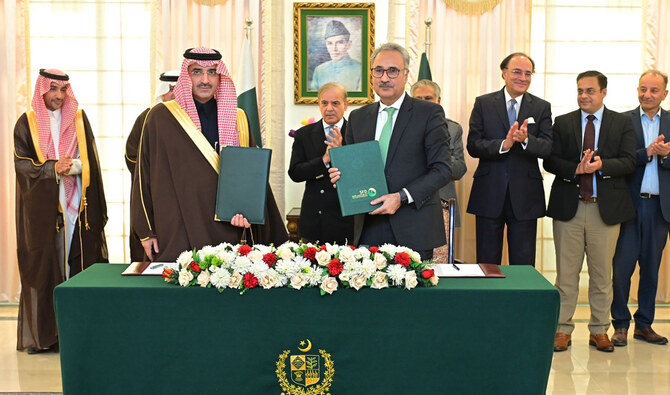
ISLAMABAD: Prime Minister Shehbaz Sharif said on Tuesday the Saudi Fund for Development (SFD) had approved a $40 million grant to build the King Salman Hospital in Pakistan’s northwestern Khyber Pakhtunkhwa province.
The announcement comes a day after Pakistan signed an agreement with SFD to defer by one year a $1.2 billion payment on the country’s oil imports.
SFD has supported more than 40 projects and programs valued at approximately $1.4 billion to finance energy, water, transportation and infrastructure projects in Pakistan since the Fund’s establishment in 1975.
“There are other SFD projects like the King Salman Hospital with an investment of $40 million” Sharif said while addressing a federal cabinet meeting in which he thanked Saudi authorities for approving the $1.2 billion oil facility. “These are grants and the hospital will be fully built with this in Hazara [district].”
The Saudi facility to defer oil payments can help Islamabad boost its foreign reserves ahead of the first review of a $7 billion International Monetary Fund (IMF) bailout, due in March. The agreement comes as Pakistan continues to navigate a tricky economic recovery path and implement tough conditions attached to the IMF loan program.
“Our brother Crown Prince Mohammed bin Salman sent a delegation yesterday [Feb. 4] and our oil facility which was for 10 months in 2023 ended in December 2023,” Sharif added. “Now, it has been renewed and they have provided us with $1.2 billion annually for our oil facility.”
On Monday, Pakistan also finalized a loan agreement for a Gravity Flow Water Supply Scheme in the Mansehra district of KP under which the SFD will provide $41 million to enhance access to clean drinking water for at least 150,000 people, according to Sharif’s office.
The SFD has also proposed a partnership with the Pakistan government to offer training programs for young Pakistanis and impart “modern and relevant” skills to help them meet labor market demands in Saudi Arabia.
Pakistanis constitute one of the largest migrant communities in Saudi Arabia with an estimated 2.64 million working there as of 2023. While 97 percent of them are blue-collar workers, there is a growing demand for skilled labor in the Kingdom as it seeks to modernize its economy under the Vision 2030 scheme.

Saudi Fund for Development approves grant for King Salman Hospital in Pakistan — PM
https://arab.news/5zjrd
Saudi Fund for Development approves grant for King Salman Hospital in Pakistan — PM
- Project will be built in Hazara district with SFD grant of $40 million
- Riyadh also approves $1.2 billion oil deferred oil payment facility
Veon Group invests $20 million in Pakistan’s Mobilink Bank to accelerate digital Islamic banking
- The investment builds on $15 million capital deployed by Veon in January 2025
- The capital will be used to scale the bank’s micro, small and medium enterprises
KARACHI: Global digital operator Veon Group has announced an investment of $20 million in Pakistan’s Mobilink Bank to support its growth and digital Islamic banking expansion in Pakistan, it said on Friday.
Mobilink Bank is a part of Veon Group, a global digital operator that provides services to over 150 million connectivity customers and over 140 million monthly active digital users. The Nasdaq-listed company operates across five countries that are home to more than 6 percent of the world’s population.
The investment builds on $15 million capital deployed by Veon in January 2025 and underscores its confidence in Mobilink Bank’s growth momentum and its integrated digital financial ecosystem with JazzCash, amid the rapid expansion of Pakistan’s digital banking and microfinance sector, according to Veon Group.
The capital will be used to scale Mobilink Bank’s micro, small and medium enterprises (MSME) financing portfolio, advance its Islamic banking offerings, and strengthen its evolution into a technology-driven, digitally native bank, with a continued focus on expanding regulated financial access for underserved communities.
“This investment will accelerate the expansion of our shariah-compliant Islamic banking offerings, helping small businesses formalize cash flows, access regulated credit, and build long-term financial resilience,” said Haaris Mahmood Chaudhary, president and chief executive officer of Mobilink Bank.
“As a future-ready digital bank, our focus remains on delivering practical, technology-enabled financial solutions that empower entrepreneurs — particularly women and underserved communities — across Pakistan.”
Mobilink Bank’s expanding deposit base and MSME-oriented lending portfolio are enabling small businesses to transition from informal cash usage to regulated banking, while targeted women-centric financial products and green financing initiatives support inclusive growth and resilience in the face of Pakistan’s climate and economic challenges, according to a statement issued by Veon Group.
Mobilink Bank, together with JazzCash, which serves over 57 million customers and is supported by a nationwide network of more than one million merchants and agents, anchors one of Pakistan’s largest digital financial ecosystems. During the year, JazzCash processed gross transaction value exceeding Rs15 trillion ($53 billion), underscoring the scale, resilience, and impact of fintech in advancing financial inclusion, social mobility, and responsible digital innovation across Pakistan.
The investment reflects Veon Group’s broader digital strategy of strengthening high-impact financial ecosystems through technology-led solutions and disciplined capital deployment, positioning Mobilink Bank as a key contributor to Pakistan’s evolving financial sector, according to the global digital operator.
“This continued stream of investment from VEON underscores our long-term commitment to Pakistan and confidence in the structural shift underway in the country’s digital financial services ecosystem,” Veon Group Executive Committee Member and Chairman Mobilink Bank, Aamir Ibrahim, was quoted as saying.
“It strengthens Mobilink Bank and JazzCash’s ability to execute on our strategic priorities, invest in resilient technology infrastructure, and contribute to the development of inclusive and sustainable digital banking.”


