

Pakistan issues electric vehicle production licenses to 57 manufacturers

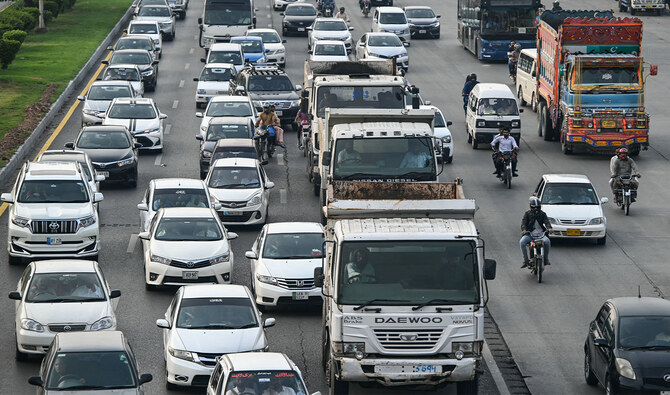
Commuters drive along a highway in Islamabad on September 26, 2024. (AFP/File)
Short Url
Updated 04 February 2025
Follow

Pakistan issues electric vehicle production licenses to 57 manufacturers

  • Pakistan has said it will cut power tariff for operators of EV charging stations by 45 percent as part of ongoing reform of energy sector
  • BYD Pakistan says up to 50 percent of all vehicles bought in Pakistan by 2030 will be electrified in some form in line with global targets

ISLAMABAD: Pakistan has granted licenses to 57 manufacturers of electric vehicles (EVs), state media reported on Tuesday, as the government moves to transition to green transport solutions and beat climate change. 

The government of Pakistan approved an ambitious National Electric Vehicles Policy (NEVP) in 2019 with the goal of electric vehicles comprising 30 percent of all passenger vehicle and heavy-duty truck sales by 2030, and an even more ambitious target of 90 percent by 2040. For two- and three-wheelers, as well as buses, the policy set a goal of achieving 50 percent of new sales by 2030 and 90 percent by 2040.

“The government is focusing on expanding local EV production, with licenses issued to fifty five manufacturers for two and three-wheelers, and two for the assembly of four-wheelers,” Radio Pakistan said in a report. “A plan is under consideration for establishing charging stations, including fast chargers and battery swapping stations.”

The report said under a new EV policy, free registration and exemption from annual token fees and toll taxes would also be offered to consumers. 

“There is a plan to create at least one electric vehicle zone in each province, including Islamabad,” Radio Pakistan added. 

A Senate Standing Committee last week criticized a lag in the production of EVs in Pakistan, saying only 60,000 had been produced by this year against a target of 600,000.

Last month, Pakistan said it would cut the power tariff for operators of EV charging stations by 45 percent as part of the ongoing reform of the energy sector designed to boost demand. The government is also planning to introduce financing schemes for e-bikes and the conversion of two- and three-wheeled petrol vehicles.

The cabinet on Jan. 15 approved a reduced tariff of 39.70 rupees ($0.14) per unit, down from 71.10 rupees previously, which will be in place within a month. The government expects an internal rate of return of more than 20 percent for investors in the sector.

According to a report submitted to the government by power ministry adviser Ammar Habib Khan and reported by Reuters on Jan. 15, there are currently more than 30 million two- and three-wheeled vehicles in Pakistan, which consume more than $5 billion worth of petroleum annually.

The energy ministry plans to convert 1 million two-wheelers to electric bikes in a first phase, at an estimated net cost of 40,000 rupees per bike, according to the report, saving around $165 million in fuel import costs annually.

BYD Pakistan, a partnership between China’s BYD and Pakistani car group Mega Motors, told Reuters in September up to 50 percent of all vehicles bought in Pakistan by 2030 would be electrified in some form in line with global targets.


Pakistan urges Afghan rulers to ‘rid their soil of terrorists’ at regional meeting in Tehran

Updated 14 December 2025
Follow

Pakistan urges Afghan rulers to ‘rid their soil of terrorists’ at regional meeting in Tehran

  • Iran hosts meeting of special representatives on Afghanistan from Pakistan, China, Russia, Central Asian countries
  • Pakistan alleges militants use Afghan soil to launch attacks against it, charges the Afghan Taliban deny repeatedly

ISLAMABAD: Pakistan’s special envoy on Afghanistan Mohammad Sadiq urged rulers in Kabul on Sunday to rid their soil of “terrorists,” saying the move would inspire confidence in its neighbors to engage with the country.

Sadiq, who is Pakistan’s special representative to Afghanistan, was part of a high-level meeting hosted by Iran in Tehran to discuss issues related to Afghanistan. The meeting featured Afghan affairs representatives from Pakistan, Tajikistan, Uzbekistan, Turkmenistan, China and Russia, Iranian state news agency IRNA said. 

Pakistan blames a surge in attacks on its soil on militants it says are based in Afghanistan, a charge Kabul denies. The allegations have caused tensions between the neighbors to rise, resulting in deadly border clashes in October that saw dozens of soldiers killed on both sides. 

“It is imperative that the current de facto rulers [in Afghanistan] take steps to ameliorate their suffering,” Sadiq wrote on social media platform X. 

“And the foremost step in this regard would be to rid their soil indiscriminately of all types of terrorists.”

Sadiq said he agreed with other participating countries during the meeting that the “threat of terrorism” originating from Afghanistan’s soil is a “big challenge” for the region. 

“Also made this point that only an Afghanistan that does not harbor terrorists will inspire confidence in the neighboring and regional countries to meaningfully engage with Afghanistan, helping to realize the country’s immense economic and connectivity potential,” he concluded. 

Officials from Pakistan and Afghanistan engaged in three rounds of peace talks in Türkiye, Qatar and Saudi Arabia since the October clashes but were unable to reach an agreement. 

While Pakistan has vowed it would go after militants in Afghanistan that threaten it, Kabul has said it would retaliate to any act of aggression from Islamabad.