

Pakistan threatens to deport Afghans in resettlement programs if cases not swiftly processed

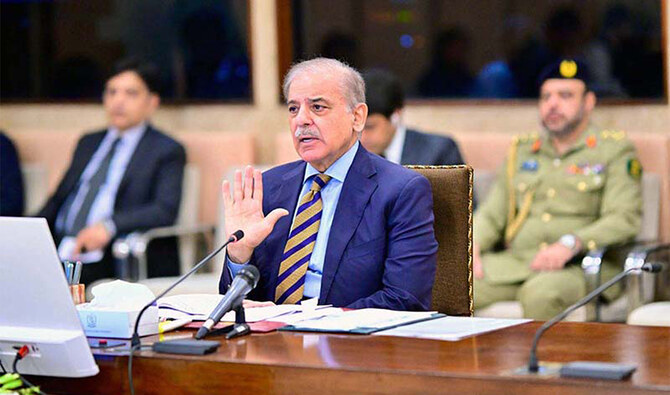
Prime Minister Muhammad Shehbaz Sharif addresses a federal cabinet in Islamabad, Pakistan on July 10, 2024. (PID/File)
Short Url
Updated 04 February 2025
Follow

Pakistan threatens to deport Afghans in resettlement programs if cases not swiftly processed

  • Tens of thousands of Afghans fled to neighboring Pakistan after Taliban took over in 2021 and were approved for resettlement in the US
  • However, after President Donald Trump paused US refugee programslast month, around 20,000 Afghans are now in limbo in Pakistan

ISLAMABAD: Pakistan threatened to deport Afghan refugees awaiting relocation unless their cases are swiftly processed by host governments, officials said Monday.

Tens of thousands of Afghans fled to neighboring Pakistan after the Taliban took over in 2021 and were approved for resettlement in the US through a program that helps people at risk because of their work with the American government, media, aid agencies and rights groups. However, after President Donald Trump paused US refugee programs last month, around 20,000 Afghans are now in limbo in Pakistan. 

The Trump administration also announced the US Refugee Admissions Program would be suspended from Jan. 27 for at least three months, fueling concerns amid Pakistani authorities.

Prime Minister Shehbaz Sharif decided last week that the refugees would be deported back to Afghanistan unless their cases were processed quickly, according to two security officials. They spoke on condition of anonymity as they were not authorized to talk to the media on the record.

The two also said March 31 has been set as a deadline to expel Afghan refugees from the capital, Islamabad, and the nearby city of Rawalpindi in preparation for their deportation if they are not relocated to their host countries.
There was no immediate response from Pakistan’s Ministry of Foreign Affairs.

News about forced deportations has panicked many Afghan nationals who fear for their lives if sent back home.

“We appeal to Pakistan’s Prime Minister Shehbaz Sharif not to be deported like this,” said Khalid Khan who has been waiting for relocation to the United States since 2023. 

Khan said some Afghans prepared to leave Islamabad and move to other cities to avoid arrest. He also urged the host countries to expedite their cases.

Another Afghan refugee who lives in Islamabad with his family, and who refused to be identified because he is worried about the Taliban reprisals and arrest by Pakistan, urged Trump to revive the refugee program “in the name of humanity.” 

Besides those living in Pakistan and the thousands awaiting travel to host countries, there are around 1.45 million Afghan nationals registered with UNHCR as refugees. Their stay has been extended until June.

Pakistan started a crackdown on foreigners who are in the country without proper documentation in November 2023. An estimated 800,000 Afghans have either gone back voluntarily or been deported since despite criticism from UN agencies, rights groups and the Taliban. 

The two officials said the crackdown will continue in the coming months.

Last month, Amnesty International expressed its concern over “reports of arbitrary detention and harassment of Afghan refugees and asylum seekers by law enforcement agencies in Islamabad.”


Pakistan nears $1.5 billion deal to supply weapons, jets to Sudan

Updated 9 sec ago
Follow

Pakistan nears $1.5 billion deal to supply weapons, jets to Sudan

  • Deal may include drones, air defense systems and Karakoram-8 aircraft, with possible JF-17 fighters
  • The sale is expected to bolster Sudan’s army in the ongoing civil war with the Rapid Support Forces

ISLAMABAD: Pakistan is in the final phases of striking a $1.5-billion deal to supply weapons and jets to Sudan, a former top air force official and three sources said, promising a major boost for Sudan’s army, battling the paramilitary Rapid Support Forces.

Their conflict has stoked the world’s worst humanitarian crisis for more than 2-1/2 years, drawing in myriad foreign interests, and threatening to fragment the strategic Red Sea country, a major gold producer.

The deal with Pakistan encompasses 10 Karakoram-8 light attack aircraft, more than 200 drones for scouting and kamikaze attacks, and advanced air defense systems, said two of the three sources with knowledge of the matter, who all sought anonymity.

It was a “done deal,” said Aamir Masood, a retired Pakistani air marshal who continues to be briefed on air force matters.

Besides the Karakoram-8 jets, it includes Super Mushshak training aircraft, and perhaps ‌some coveted JF-17 ‌fighters developed jointly with China and produced in Pakistan, he added, without giving figures ‌or ⁠a delivery ‌schedule.

Pakistan’s military and its defense ministry did not immediately respond to requests for comment.

A spokesman for Sudan’s army did not immediately respond to a message requesting comment.

Assistance from Pakistan, especially drones and jets, could help Sudan’s army regain the air supremacy it had toward the start of its war with the RSF, which has increasingly used drones to gain territory, eroding the army’s position.

PAKISTAN’S DEFENSE AMBITIONS

The deal is another feather in the cap for Pakistan’s growing defense sector, which has drawn growing interest and investment, particularly since its jets were deployed in a conflict with India last year.

Last month, Islamabad struck a weapons deal worth more than $4 billion with the Libyan National Army, officials said, for one of the South Asian nation’s largest arms sales, which includes JF-17 fighter jets and training aircraft.

Pakistan has also held talks with Bangladesh on a defense deal that could includes the Super Mushshak training jets and JF-17s, as ties improve ties with Dhaka.

The government sees Pakistan’s burgeoning industry as a catalyst to secure long-term economic stability.

Pakistan is now in a $7-billion IMF program, following a short-term ‌deal to avert a sovereign default in 2023. It won IMF support after Saudi Arabia and other Gulf allies provided financial and deposit rollovers.