

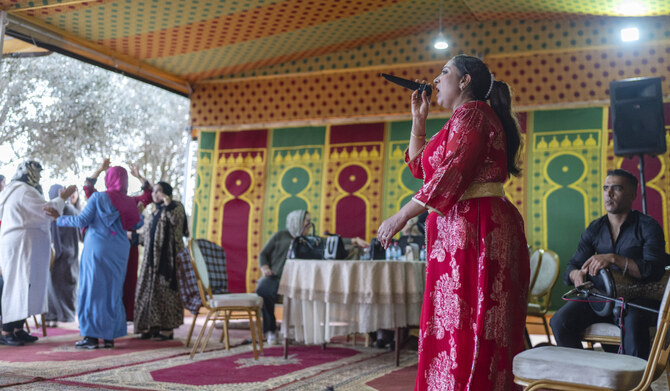
From urban bars to country weddings, Moroccan folk singers break barriers and keep traditions alive

Women dance as folksinger Cheikha Thouria Moullablad gives a traditional performance known as Aita, in Tamesna, south of the capital Rabat, Morocco, Monday, Jan. 27, 2025. (AP)
Short Url
Updated 04 February 2025
Follow

From urban bars to country weddings, Moroccan folk singers break barriers and keep traditions alive

  • Those who come to hear them sing say cheikha can serve as a community’s truth-tellers, singing about often unspoken dynamics related to marriage, agriculture or, historically, colonial resistance
  • Morocco’s music scene is increasingly embracing Middle Eastern pop and rap by North African artists from throughout the diaspora

SIDI YAHYA ZAER, Morocco: Mbarka Moullablad’s family frowned when she first told them she planned to make a living as a cheikha, singing about love, pain, and societal change to the melodies of her ancestors under the stage name “Thouria.”
Women like her are the stewards of one of Morocco’s most cherished oral traditions: a form of folk singing known as aita, which means a “cry” or “lament” in Arabic. From smoky bars and cabarets in Morocco’s largest cities to the gatherings in the country’s rural regions, they croon at weddings, festivals and private events and pub nights, hypnotizing audiences both humble and wealthy.


Girls dance during a traditional performance known as Aita, in Tamesna, south of the capital Rabat, Morocco, Monday, Jan. 27, 2025. (AP)

But despite aita’s position in Moroccan culture, the genre’s popularity does not always translate into acceptance for those who perform it. Cheikha are often stigmatized, eroticized, and pushed to society’s margins. That was once a fear for Moullablad, but she says her community in Sidi Yahya Zaer, a farming town on Morocco’s Atlantic plains, has mostly accepted her.

“My family did not agree at first and I used to suffer from society’s judgment, but now everything is good,” Moullablad said on the sidelines of a recent performance south of Morocco’s capital, Rabat. “I do it in order to earn money for my children.”


Cheikha folk singer Mbarka "Thouria" Moullablad applies makeup as she prepares for a traditional performance known as Aita, in Sidi Yahya Zaer, south of the capital Rabat, Morocco, Monday, Jan. 27, 2025. (AP)

A form of sung poetry, aita has long explored themes of societal triumphs, ironies, and unspoken struggles, including those related to relationships and economic hardship. Cheikha don heavy stage makeup, silk caftans, and golden takchita belts as they sing about their community’s agonies and triumphs. They sway their hips to amplify emotion, dancing seductively or cheerfully depending on the context.
When Moullablad performs, men and women lean in as her voice softens, captivated as she climbs octaves into a full-throated howl. The beads wrapped around her sister Fatiha’s belly shake as she dances. The band leader, another singer, backs her with his own poetry while a drummer keeps the beat, a guitarist strums, and a violinist drags his bow in sync.


A music band prepares for a traditional performance known as Aita, in Sidi Yahya Zaer, south of the capital Rabat, Morocco, Monday, Jan. 27, 2025. (AP)

Those who come to hear them sing say cheikha can serve as a community’s truth-tellers, singing about often unspoken dynamics related to marriage, agriculture or, historically, colonial resistance. Moullablad sings in Moroccan Arabic, embodying traditions specific to her community. But cheikha across the North African Kingdom also perform in the indigenous Amazigh language, adapting the music and lyrics to reflect their region.
The art form has inspired contemporary acts like the electro-infused “Aita, Mon Amour” and Kabareh Cheikhats, a troupe of male actors who pay homage, dress and sing in the tune of Morocco’s most celebrated 20th century women folk singers. It is also the subject of Morocco’s submission for this year’s Academy Awards, “Everybody Loves Touda,” which follows a single mother who leaves her town in the Atlas Mountains to pursue her dream of singing in bars, cabarets, and hotels in Casablanca.


Moroccan tea is distributed during a traditional performance known as Aita, in Tamesna, south of the capital Rabat, Morocco, Monday, Jan. 27, 2025. (AP)

“I was always amazed by their strength and the power that they have toward people when they open their mouths. Whether they are modern or conservative people, they all stand up and get into a kind of trance like gospel,” Nabil Ayouch, the film’s director, said in an interview when the film premiered at the Marrakech Film Festival last year.

Morocco’s music scene is increasingly embracing Middle Eastern pop and rap by North African artists from throughout the diaspora. And rural communities are shrinking amid the country’s rapid development and urbanization. But though the future of aita may seem uncertain, its musicians and listeners remain confident that it will endure.
“Aita will not die because it is renewed by young people. Aita will remain in all times and is loved by old people and young people as well. It is developed and improved, but they preserve its origins,” said Rachid Kadari, a Cheikh who also sings aita.


Major airlines suspend, reroute flights amid US-Israel strikes on Iran

Updated 7 sec ago
Follow

Major airlines suspend, reroute flights amid US-Israel strikes on Iran

  • Saudia says decision taken in line with aviation safety and security standards
  • Emirates says regional airspace closures cause disruption to several of its flights

RIYADH: Major international airlines across the Middle East and South Asia have suspended, canceled or rerouted flights following ongoing US-Israel attacks on Iran and the resulting airspace closures, according to official statements issued via X.

Saudia said in an official statement that it had canceled a number of flights due to developments in the region and the closure of airspace. The airline said the decision was taken in line with aviation safety and security standards, noting that its Emergency Coordination Center is closely monitoring developments with relevant authorities. Saudia urged passengers to verify the status of their flights before heading to the airport and said guests would be notified of updates through the contact details associated with their bookings. The carrier added that further information would be announced in a subsequent statement if available.


Air Arabia said its flights were experiencing cancellations, delays or rerouting as a result of the evolving situation and airspace closures. The airline advised passengers to check the status of their flights before traveling to the airport by visiting its website or contacting its call center. Customers booked on affected flights will be notified directly, the airline said, adding that further updates would be provided as the situation develops.

Air India announced a broader suspension, stating that “in view of the developing situation in parts of the Middle East, all Air India flights to all destinations in the Middle East have been suspended.” The airline said it remains committed to maintaining the highest standards of safety for passengers and crew and will continue to assess the safety and security environment for flight operations, adjusting services proactively as required. Air India said its teams would extend necessary support to passengers and advised customers to check flight status online or contact its 24/7 call center for assistance.


Dubai-based Emirates reported that regional airspace closures had caused disruption to several of its flights. The airline said it is actively monitoring the situation, engaging with relevant authorities and adjusting operations in line with the latest developments. Emirates said it adheres to all regulatory requirements and follows guidance issued by aviation authorities. The carrier apologized to affected customers and said it is assisting them with rebooking, refunds or alternative travel arrangements, reiterating that the safety and security of passengers and crew remain its highest priority.


Qatar Airways confirmed a temporary suspension of flights to and from Doha due to the closure of Qatari airspace. The airline said it is working closely with government stakeholders and relevant authorities to support impacted passengers and will resume operations once the airspace reopens. It warned that delays are anticipated when usual operations resume and said additional ground staff have been deployed at Hamad International Airport and other key airports to assist passengers.


Meanwhile, Al Jazeera reported that British Airways had canceled flights to Tel Aviv and Bahrain, adding to the list of carriers adjusting operations.

Across their statements, airlines consistently cited airspace closures and safety considerations as the primary reasons for suspensions and disruptions, while urging passengers to monitor official channels for updates as the situation continues to evolve.