Afghan deputy governor’s son among four militants killed in northwest Pakistan — state media

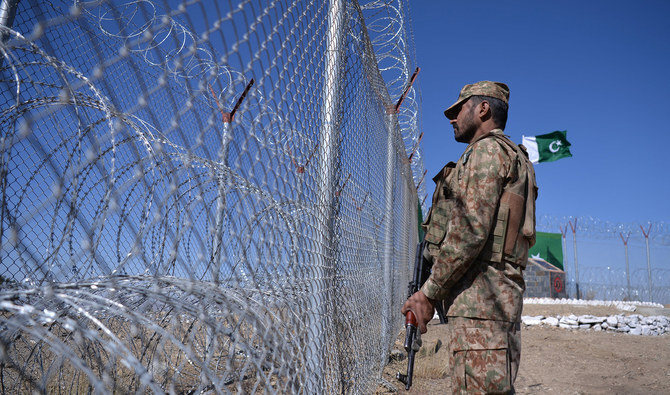
A Pakistani soldier keeps vigil next to a fenced border along with Afghan’s Paktika province border in Angoor Adda in South Waziristan, Pakistan, on October 18, 2017. (AFP/File)
Short Url
Updated 03 February 2025
Follow

Afghan deputy governor’s son among four militants killed in northwest Pakistan — state media

  • Radio Pakistan says Badaruddin “directly involved in new wave of terror attacks from Afghanistan into Pakistan”
  • Kabul denies Islamabad’s accusations Afghanistan shelters anti-Pakistan groups that launch cross-border attacks

ISLAMABAD: The son of an Afghan deputy governor was among four militants killed by Pakistani security forces in a recent operation in the northwestern Khyber Pakhtunkhwa province, state broadcaster Radio Pakistan reported on Monday.

There has been a surge in militant attacks in Pakistan in recent months, particularly in KP province which borders Afghanistan, and the southwestern Balochistan province which borders Iran and Afghanistan. Most attacks in KP are claimed by the Pakistani Taliban, known as Tehreek-e-Taliban Pakistan (TTP), an umbrella alliance for militant groups. The TTP is separate but allied with the Afghan Taliban who rule Afghanistan. 

In a report published on Monday, Radio Pakistan said four militants were killed by security forces during a counterterrorism operation in the Kulachi area of KP’s Dera Ismail Khan district recently. 

“Among those killed was the son of the Deputy Governor of Badghis province of Afghanistan. He was identified as Badaruddin alias Yousaf,” the broadcaster said, quoting “sources” as saying Afghan authorities were as yet refusing to receive Badaruddin’s body despite multiple requests from Pakistan.

The report called the killing “irrefutable evidence” of the nexus between the Afghan government and militants attacking Pakistan. 

“Modern American-made night vision equipment, along with M16A4 and M24 sniper rifles, were recovered from the killed terrorists,” Radio Pakistan said. “Badaruddin had previously received training at an Afghan Taliban training center … Badaruddin was directly involved in the new wave of terrorist attacks from Afghanistan into Pakistan.”

Islamabad has frequently accused neighboring Afghanistan of sheltering anti-Pakistan groups that launch cross-border attacks. Afghan officials deny allowing the use of Afghanistan’s territory against any country. The Taliban rulers in Kabul say Pakistan’s security issues are a domestic issue.


Pakistan says EU notes progress on rights commitments during GSP+ compliance discussions

Updated 20 December 2025
Follow

Pakistan says EU notes progress on rights commitments during GSP+ compliance discussions

  • The review formed part of a wide-ranging EU-Pakistan Joint Commission meeting held in Brussels
  • The two sides also covered irregular migration, climate cooperation and safe Afghan refugee return

ISLAMABAD: The European Union reviewed Pakistan’s compliance with its preferential GSP+ trade scheme this week and welcomed progress on key human rights commitments, according to a statement on Saturday, as Islamabad seeks to protect access to European markets vital for its export-led growth strategy.

The EU’s Generalized Scheme of Preferences Plus (GSP+) grants duty-free access to most European markets for eligible developing countries in return for their commitment to implement 27 international conventions covering human rights, labor standards, environmental protection and good governance. Pakistan, which has benefited from the scheme since 2014, is one of the biggest beneficiaries, with the EU its second-largest trading partner and a destination for roughly a third of its exports.

Pakistan’s GSP+ status has come under scrutiny in the past after, in April 2021, the European Parliament adopted a resolution calling for an immediate review, citing concerns over violence against religious minorities, curbs on media freedom and broader human rights issues. The move followed widespread anti-France protests in Pakistan over the publication of anti-Islamic caricatures, which EU legislators said raised questions about Islamabad’s commitment to fundamental freedoms.

“Both sides reviewed Pakistan’s progress on the implementation of the 27 international conventions as required under the GSP+ framework,” the foreign office said in a statement circulated in Islamabad. “The EU welcomed progress made in bringing Pakistan’s application of the death penalty in line with international standards and encouraged further steps in this regard.”

“It also recognised important first steps against torture, as well as the creation of a Commission on Minorities,” it added.

IRREGULAR MIGRATION, CLIMATE COOPERATION

The discussions took place during the 15th meeting of the EU–Pakistan Joint Commission, held in Brussels on Dec. 17, where officials also addressed irregular migration, including cooperation on the return and readmission of migrants without legal status, and legal mobility pathways under the bloc’s broader migration framework.

The foreign office statement came just a day after Greek authorities said they rescued more than 500 migrants from a fishing boat in the Mediterranean, adding that the group included several Pakistani nationals, highlighting continued migration pressures despite tighter controls.

Climate cooperation was another focus, with both sides reviewing ongoing collaboration on climate resilience, disaster risk reduction and sustainable development, areas of growing importance for Pakistan after repeated climate-related shocks.

The meeting also touched on the situation of Afghan refugees.

The statement said the EU welcomed the ongoing discussions between Pakistan and the UN refugee agency “to identify and compile a list of vulnerable cases, to ensure their adequate protection.”

“The EU appreciated that Pakistan is hosting millions of Afghan nationals for over four decades,” it continued. “They emphasised that any return must be safe, dignified and in line with international standards.”

The two sides agreed to continue engagement under the EU–Pakistan Strategic Engagement Plan, a framework guiding cooperation on political dialogue, trade, development, security and people-to-people exchanges, with the next joint commission meeting scheduled to be held in Islamabad next year.