South Africa’s Ramaphosa to engage Trump over aid suspension

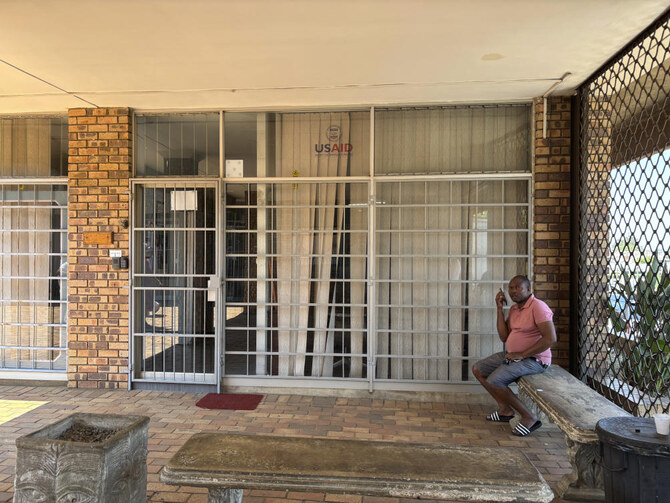
A man sits outside the closed Isizinda Sempilo clinic in the Johannesburg township of Soweto Thursday, Jan. 30, 2025. (AP Photo/Alfonso Nqunjana)
Short Url
Updated 03 February 2025
Follow

South Africa’s Ramaphosa to engage Trump over aid suspension

JOHANNESBURG: South African President Cyril Ramaphosa said on Monday that he looked forward to engaging with US President Donald Trump, after Trump said he would cut off funding for South Africa, citing land confiscations.
“We look forward to engaging with the Trump administration over our land reform policy and issues of bilateral interest. We are certain that out of those engagements, we will share a better and common understanding over these matters,” Ramaphosa said in a statement issued by the presidency.
“South Africa is a constitutional democracy that is deeply rooted in the rule of law, justice and equality. The South African government has not confiscated any land.”
Ramaphosa said except for PEPFAR aid, which constitutes 17 percent of South Africa’s HIV/Aids program, there was no other significant funding provided by the United States.


Britain, Japan agree to deepen defense and security cooperation

Updated 7 sec ago
Follow

Britain, Japan agree to deepen defense and security cooperation

  • “We set out a clear priority to build an even deeper partnership in the years to come,” Starmer said
  • Takaichi said they agreed to hold a meeting of British and Japanese foreign and defense ministers this year

TOKYO: Britain and Japan agreed to strengthen defense and economic ties, visiting Prime Minister Keir Starmer said on Saturday, after his bid to forge closer links with China drew warnings from US President Donald Trump.
Starmer noted that Japan and Britain were the leading economies in a trans-Pacific that includes fellow G7 member Canada, as well as other international trade and defense pacts.
“We set out a clear priority to build an even deeper partnership in the years to come,” Starmer said as he stood beside Japan’s Prime Minister Sanae Takaichi after a bilateral meeting in Tokyo.
“That includes working together to strengthen our collective security, across the Euro-Atlantic and in the Indo-Pacific.”
Takaichi said they agreed to hold a meeting of British and Japanese foreign and defense ministers this year.
She said she also wanted to discuss “cooperation toward realizing a free and open Indo-Pacific, the Middle East situation and Ukraine situation” at a dinner with Starmer later on Saturday.
Starmer arrived on a one-day Tokyo stop after a four-day visit in China, where he followed in the footsteps of other Western leaders looking to counter an increasingly volatile United States.
Leaders from France, Canada and Finland have all traveled to Beijing in recent weeks, recoiling from Trump’s bid to seize Greenland and tariff threats against NATO allies.
Trump warned on Thursday it was “very dangerous” for its close ally Britain to be dealing with China, although Starmer brushed off those comments.
Tokyo’s ties with Beijing have deteriorated since Takaichi suggested in November that Japan could intervene militarily during a potential attack on Taiwan.
China regards the self-ruled democratic island as its territory.
Starmer met Chinese President Xi Jinping and Premier Li Qiang on Thursday, with both sides highlighting the need for closer ties.
He also signed a series of agreements there, with Downing Street announcing Beijing had agreed to visa-free travel for British citizens visiting China for under 30 days.
No start date for that arrangement has been given yet.
Takaich said the two leaders agreed during discussions on economic security that a strengthening of supply chains “including important minerals is urgently needed.”
There is concern that Beijing could choke off exports of the rare earths crucial for making everything from electric cars to missiles.
China, the world’s leading producer of such minerals, announced new export controls in October on rare earths and associated technologies.
They have also been a major sticking point in trade negotiations between China and the United States.
Britain, Japan and Italy are also developing a new fighter jet after Tokyo relied for decades on the United States for military hardware.