

Pakistan, Iran chambers of commerce sign agreement aimed at increasing exports to $10 billion

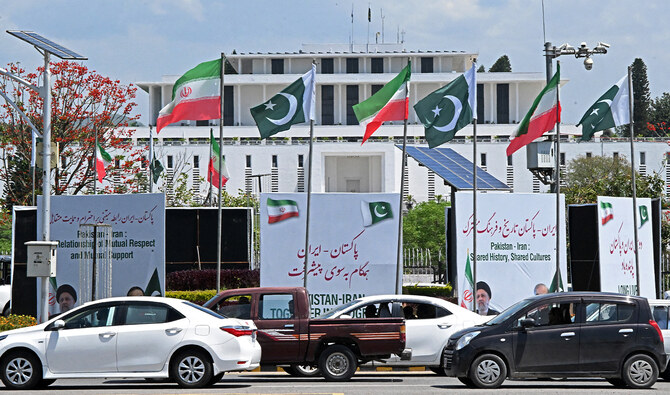
Commuters make their way past the welcoming billboards installed at the constitution avenue for the visit of late Iranian President Ebrahim Raisi, in Islamabad on April 22, 2024. (AFP/File)
Short Url
Updated 03 February 2025
Follow

Pakistan, Iran chambers of commerce sign agreement aimed at increasing exports to $10 billion

  • Governors of Pakistan’s Punjab and Iran’s Razavi Khorasan provinces attend signing of MoU in Lahore
  • Pakistan, Iran have often been at odds over militancy and instability along shared, porous border 

ISLAMABAD: Pakistan’s and Iran’s chambers of commerce have signed an agreement aimed at increasing exports between the two countries to $10 billion, state-run media reported on Monday, as the two sides eye increasing trade to move past strained ties. 

The development takes place after Maj. Gen. Mohammad Bagheri, chief of general staff of Iran’s armed forces, visited Pakistan last month to hold talks with the country’s civil and military leadership on border management, economic cooperation and regional issues. 

Pakistan and Iran have often been at odds over instability along their shared, porous border and routinely trade blame for not rooting out militancy. Tensions surged in January last year when Pakistan and Iran exchanged airstrikes, with both claiming to target alleged militant hideouts in each other’s territory.

“A memorandum of understanding has been signed between the Federation of Pakistan Chambers of Commerce and Industry and the Mashhad Chamber of Commerce and Industries in Lahore,” state broadcaster Radio Pakistan reported. 

“The purpose of the MoU is to take bilateral volume of exports to ten billion dollars between the two countries,” the statement said. 

It said the governor of Pakistan’s eastern Punjab province, Sardar Saleem Haider Khan and the governor general of Iran’s Razavi Khorasan province, Gholam Hossein Mozaffari, both attended the signing ceremony.

Khan said his Iranian counterpart expressed “great interest” in Pakistani products, stressing that both countries should focus on expanding trade relations.

“He said the Iranian Governor has assured to consider reducing tourist and business visa fees and improving facilities for easier travel and trade,” the report said. 

Later, both governors inaugurated a one-day shopping festival organized by the Lahore Chamber of Commerce and Industry at the Expo Center Lahore.

Iran’s late president Ebrahim Raisi toured Pakistan in April 2024 as both countries sought to mend ties after unprecedented tit-for-tat military strikes. 

During Raisi’s three-day visit, the two governments signed MoUs and agreements covering different fields including trade, science and technology, agriculture, health, culture and judicial matters. 

Raisi had said that the volume of trade between the two countries “is not acceptable at all” and that they should enhance bilateral trade to $10 billion. 


Pakistan, Iraq agree on tighter coordination over pilgrims under new regulated travel system

Updated 4 sec ago
Follow

Pakistan, Iraq agree on tighter coordination over pilgrims under new regulated travel system

  • New system requires all Iraq-Iran pilgrimages to be organized by licensed groups under state oversight
  • Long-running “Salar” model relied on informal caravan leaders, leading to overstays and missing pilgrims

ISLAMABAD: Pakistan and Iraq this week agreed to closely coordinate on the management and security of Pakistani pilgrims, as Islamabad rolls out a new, tightly regulated travel system aimed at preventing overstays, undocumented migration and security breaches during religious visits to Iraq and Iran.

The understanding was reached during a meeting between Pakistan’s Interior and Narcotics Control Minister Mohsin Naqvi and Iraq’s Interior Minister General Abdul Amir Al-Shammari on Thursday evening, where both sides discussed measures to facilitate pilgrims while strengthening oversight, Pakistan’s interior ministry said.

The agreement comes as Pakistan dismantles its decades-old pilgrim travel model and replaces it with a centralized, licensed system after authorities confirmed that tens of thousands of Pakistani pilgrims had overstayed or gone missing abroad over the past decade, triggering concerns from host governments.

“You have, for the first time during your tenure, taken effective measures to organize pilgrim groups, which are commendable,” Al-Shammari told Naqvi, according to Pakistan’s interior ministry.

“All pilgrims included in the list provided by Pakistan’s Ministry of Interior will be allowed to enter Iraq,” he added, making clear that only travelers cleared under the new system would be permitted.

Naqvi said Pakistan would strictly enforce return timelines under the revised framework.

“Pilgrims traveling to Iraq will not be allowed to stay beyond the designated period,” he said, adding that relevant authorities in both countries would remain in close coordination.

Both interior ministers also agreed to strengthen information-sharing and joint mechanisms on security cooperation, counterterrorism and the prevention of human smuggling, officials said.

“The safety, dignity, and facilitation of Pakistani pilgrims is the top priority of the Government of Pakistan,” Naqvi said.

Al-Shammari said he would visit Pakistan soon to finalize a joint roadmap to further improve pilgrim facilitation, security coordination and broader bilateral cooperation, according to the interior ministry.

Pakistan’s government has overhauled its pilgrim travel regime this year, abolishing the long-running “Salar” system under which informal caravan leaders managed pilgrimages. The move followed official confirmation that around 40,000 Pakistani pilgrims had overstayed or disappeared in Iran, Iraq and Syria over the past ten years.

Under the new Ziyarat Management Policy, only licensed Ziyarat Group Organizers (ZGOs) are allowed to arrange pilgrimages, with companies held directly responsible for ensuring pilgrims return on time. Authorities have completed security clearance for 585 companies seeking registration, while scrutiny of applications remains ongoing.

Islamabad has also barred overland travel for major pilgrimages, including Arbaeen, citing security risks in Pakistan’s southwestern Balochistan province, meaning all travel to Iraq and Iran is now restricted to regulated air routes.

Tens of thousands of Pakistani pilgrims travel each year to Iraq and Iran to visit some of the most revered shrines in Shia Islam, including the mausoleums of Imam Ali in Najaf and Imam Hussain in Karbala in Iraq, and major religious sites in Mashhad and Qom in Iran. Pilgrimages peak during religious occasions such as Arbaeen, when millions of worshippers converge on Karbala from across the region. The scale of travel, often involving long stays and cross-border movements, has long posed logistical, security and migration-management challenges for Pakistani authorities and host governments alike.