

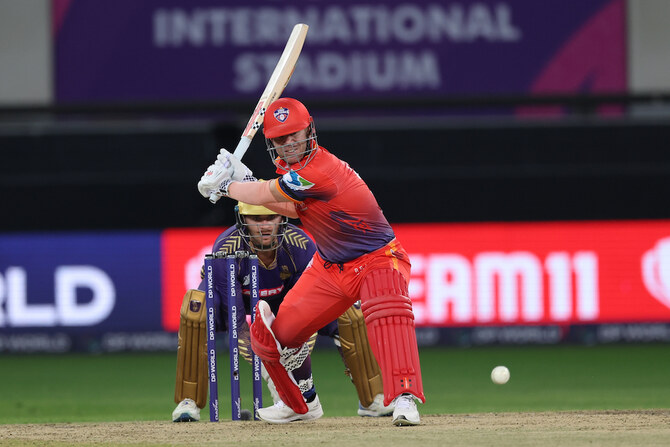
Warner’s heroics lead Dubai Capitals to ILT20 playoffs with 26-run victory over Knight Riders

David Warner delivered a masterclass in power-hitting to propel the Dubai Capitals into the playoffs of the DP World ILT20, as they secured a commanding 26-run victory over the Abu Dhabi Knight Riders. (Supplied/ILT20)
Short Url
Updated 03 February 2025
Follow

Warner’s heroics lead Dubai Capitals to ILT20 playoffs with 26-run victory over Knight Riders

  • Win confirms Capitals as fourth and final team to reach knockout stage of the tournament

DUBAI: David Warner delivered a masterclass in power hitting to propel the Dubai Capitals into the playoffs of the DP World ILT20 on Sunday, as they secured a commanding 26-run victory over the Abu Dhabi Knight Riders at the Dubai International Cricket Stadium.

The win confirmed the Capitals as the fourth and final team to reach the knockout stage of the tournament.

Warner, playing his first match of the season, was the game changer with an unbeaten 93, guiding his team to their sixth win in seven encounters against the Knight Riders. He helped the Capitals post a formidable 217 for four — the highest score in the tournament’s history at the venue.

Chasing 218 to keep their playoff hopes alive, the Knight Riders started cautiously before Andries Gous injected momentum with a rapid-fire knock.

Gous smashed six boundaries in his first 11 deliveries, propelling his side to 50/0 at the end of the powerplay. Partnered by Kyle Mayers, the duo laid a strong foundation, reaching 89/0 at the halfway stage of the innings.

However, a crucial bowling change swung the match in the Capitals’ favor. Afghan all-rounder Gulbadin Naib deceived Mayers with a clever slower ball, dismissing him for a well-made 42 off 29.

Gous, undeterred, continued to attack, reaching 55 before teaming up with Joe Clarke, who unleashed a stunning 91-meter six before retiring hurt. The introduction of Andre Russell was expected to shift the game back in the Knight Riders’ favor, but the strategy backfired.

Gous departed for 78 off 47 after mistiming a shot to mid-wicket, while Russell lasted just one ball before being dismissed. David Willey also fell cheaply, leaving the Knight Riders reeling at 153 for five and needing an improbable 65 runs from the final three overs.

Dushmantha Chameera’s outstanding 17th over sealed the result, ensuring the Capitals held on for a crucial victory — marking the first time in seven games at the stadium that a team batting first emerged victorious.

Opting to bat first, the Dubai Capitals made a strong start, with openers Shai Hope and Warner setting the tone early. Despite Willey’s tight spell, which saw him concede just 11 runs in three overs, the Capitals reached 43/0 inside the powerplay.

Warner had an early scare in the seventh over when he holed out to Russell, but the catch was dropped. He capitalized on the lifeline, smashing four boundaries in an over off Gudakesh Motie. Hope contributed with two sixes before being bowled by Roston Chase, ending an 82-run opening partnership.

Warner reached his half-century off 33 deliveries, marking his 116th 50-plus score in T20 cricket — an all-time record. The veteran Australian then shifted gears, dispatching Sunil Narine for a massive six as the Capitals surpassed 100 in 12 overs.

Naib provided further impetus with a brisk 47 off 25 balls, punishing Jason Holder’s wayward deliveries. Despite Narine dismissing Naib, Dasun Shanaka’s late cameo (17 off seven balls) ensured the Capitals surged past 200.

Warner remained unbeaten on 93, anchoring the innings with a mix of calculated aggression and experience. “(The innings) took me back to when I was 21 again. You need to have that positive attitude.

“Shai made my job easier. We got off to a positive start and put up a competitive total. I tried to hit straight. I am still learning. I love this game. I owe this game a lot. Hopefully, I can get one better next game.”

The Knight Riders’ captain Narine acknowledged his team’s effort but admitted the Capitals were the better side on the night. “It was a decent season. We gave it all we could, but it’s not the result we wanted.

“In a must-win game, you don’t want to chase 217. We had a decent start and tried to take it deep, but they bowled brilliantly, and that was the key factor,” he said.


Middle East war puts Asian Football Confederation in a tricky situation

Updated 6 sec ago
Follow

Middle East war puts Asian Football Confederation in a tricky situation

  • Asian football has long been structured around regions, with competitions split between East and West
  • With conflict in the Middle East escalating on Feb. 28, the AFC was forced into emergency mode as the knockout stages of its club competitions approach

DAMMAM: Football in Asia has never been an easy task to manage. Long flights, numerous time zones, conflicting calendars, vastly different football cultures and — perhaps more than any other confederation in the world — politics.
While the war in the Middle East falls under the AFC’s umbrella, its direct effects have so far been limited to the clubs in West Asia. Asian football has long been structured around regions, with competitions split between East and West, although for a period, the second-tier AFC Cup operated in five separate regions.
As a result, AFC club competitions in East Asia continued uninterrupted in the first week of March. A crowd of 31,225 watched Johor Darul Ta’zim’s historic 3-1 victory over Sanfrecce Hiroshima in the AFC Champions League Elite round of 16. Bangkok United defeated Tampines Rovers in the AFC Champions League Two quarter-final, and an all-Cambodian clash between Phnom Penh Crown and PKR Svay Rieng in the AFC Challenge League ended in a 4-1 victory for the visitors.
The situation in West Asia, however, is vastly different.
With the conflict in the Middle East escalating on Feb. 28, the AFC was forced into emergency mode as the knockout stages of its club competitions approach.
Within 24 hours, the confederation announced that all first-leg matches involving West Asian clubs in AFC competitions would be rescheduled until further notice. The same decision was taken for the second-leg matches fixtures just 48 hours later.
Domestic football has also been heavily disrupted. Leagues in Qatar, Bahrain, Kuwait and Lebanon have been postponed indefinitely, with matches continuing behind closed doors in Jordan.
Leagues in Saudi Arabia, Oman, Iraq and Syria continue to operate, but flights in the region are limited.
With the season already compressed by the FIFA Arab Cup, FIFA Intercontinental playoffs and the upcoming FIFA World Cup, member associations throughout the Middle East now find themselves scrambling alongside the AFC to solve a problem that ultimately lies outside their control.
Another issue looms on the horizon. The AFC Champions League final stage will be hosted in Saudi Arabia next month for the second year in a row. While football has not halted in the Kingdom and the security situation is stable, it remains to be seen whether East Asian clubs will be willing to travel if the conflict continues.
What is the real solution, fans ask?
One proposal that has been circulated is to centralize the knockout rounds from the Round of 16 stage instead of the quarter-finals. That option, however, presents its own challenges. East Asian clubs have already begun their journey in the round of 16, and the idea of centralized hosting has historically not been popular across the continent.
When Saudi Arabia and Qatar were selected to host the AFC World Cup Qualifiers fourth round last year, the decision sparked backlash from Indonesia, Iraq, Oman and the UAE. More recently, journalist Ali Al-Marshoud claimed on Saudi sports program “In the 90” that the UAE’s Al-Wasl rejected a proposal for their AFC Champions League Two quarter-final against Al-Nassr as a single-leg match in Jeddah.
The AFC therefore finds itself in a difficult position. It cannot control regional geopolitics, nor can it influence government policies. At the same time, there is no guarantee that East Asian clubs will travel to the region, or that West Asian clubs will agree to surrender their right to play matches at home.
The conflict has also begun to affect international football.
With the FIFA World Cup intercontinental playoffs scheduled for later this month and Iraq facing a crucial qualifier in Mexico on March 31, uncertainty continues to grow.
In a statement released by the Iraqi Football Association, officials confirmed they were in constant contact with FIFA and the AFC regarding potential travel complications.
Head coach Graham Arnold is currently unable to leave the UAE, while several players and staff have struggled to obtain visas to Mexico due to embassy closures. All the while flights through Iraqi airspace have been suspended.
Political complications are not new to Asian football. For years, Saudi and Iranian clubs played each other at neutral grounds. Conflicts in Syria, Palestine, Iraq and Lebanon also forced the AFC to adopt special arrangements at various times. And of course, the COVID-19 pandemic, which fundamentally reshaped the state of football in Asia.
Yet the current situation presents a different scale of challenge.
For the first time in modern history, the AFC must navigate a regional conflict that touches nearly every part of the confederation. With the season entering its decisive stages and the largest World Cup in history approaching, solutions must be found quickly, or Asian football risks a crisis that could reshape the continental game.