American strikes in Somalia neutralize ‘key’ Daesh figures

1 / 2
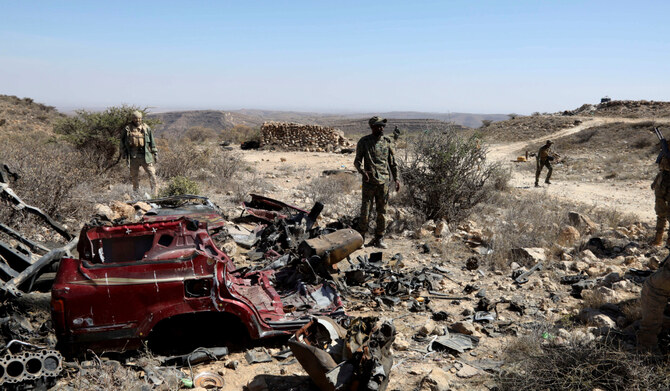
Daesh has a relatively small presence in Somalia compared to the Al-Qaeda-linked Al-Shabab, but experts have warned of growing activity. (Reuters)
2 / 2
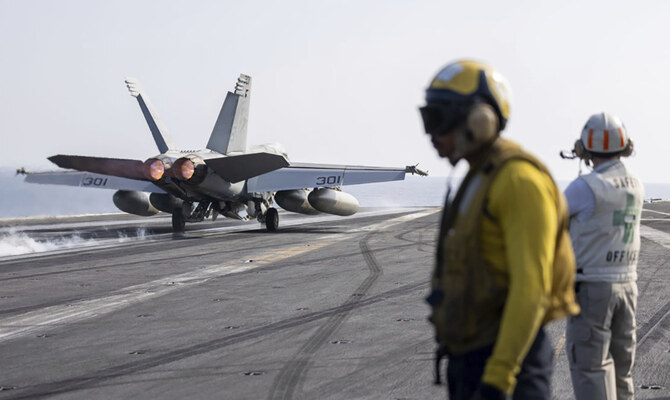
This photo provided by US Africa Command, the US military conducts coordinated airstrikes against Daesh operatives in Somalia on Saturday, Feb. 1, 2025. (AP)
Short Url
Updated 02 February 2025
Follow

American strikes in Somalia neutralize ‘key’ Daesh figures

  • US military officials have warned that Daesh cells have received increasing direction from the group’s leadership that relocated to northern Somalia

MOGADISHU: The government of Somalia’s semi-autonomous Puntland region said Sunday that US military strikes in the Golis Mountains had killed “key figures” of Daesh.

US President Donald Trump announced the airstrike late Saturday, posting on the Truth Social platform that he had ordered “precision military airstrikes on the senior Daesh attack planner and other terrorists” in Somalia.
Daesh has a relatively small presence in Somalia compared to the Al-Qaeda-linked Al-Shabab, but experts have warned of growing activity.

HIGHLIGHTS

• The strikes were carried out in a northern region of Somalia, where the Puntland Defense Forces have been carrying out operations against Daesh since December.

• A Somali government statement issued in Mogadishu said the operation in the Bari region was ‘jointly coordinated by the Somali and American governments’

The strikes were carried out in a northern region of Somalia, where the Puntland Defense Forces have been carrying out operations against Daesh since December. The radical group is said to have established a presence in the Golis Mountains.
“Recent airstrikes have led to the neutralization of key figures within Daesh, marking a significant advancement as we progress into the second phase of our operation,” the regional government said Sunday.
It called the US involvement in airstrikes “invaluable” and expressed “sincere gratitude” but the statement did not provide more details on the strikes.
A Somali government statement issued in Mogadishu said the operation in the Bari region was “jointly coordinated by the Somali and American governments” and had targeted “senior Daesh leaders.”
President Hassan Sheikh Mohamud was briefed on the strikes, according to the president’s office, which added the attack “reinforces the strong security partnership” between the two nations.
He also expressed his “deepest gratitude” to Washington following the strikes in a post on X Sunday.
“Terrorism will neither find friends, nor any place to call home, in Puntland state and entire Somalia,” he added.
US Defense Secretary Pete Hegseth said the “initial assessment is that multiple operatives were killed in the airstrikes.” He added that no civilians were harmed in the strike.
According to experts and officials, Daesh in Somalia is run by Abdul Qadir Mumin, a Puntland native.
“He is the most important person, the most powerful one, he is the one controlling the global Daesh network,” said Tore Hamming from the International Center for the Study of Radicalization.
Mumin is among a few Daesh leaders who have survived US military strikes in recent years, said Hamming, “which does give him some status within the group.”


Pope names veteran Vatican diplomat as ambassador to the US to manage relations with Trump

Updated 4 sec ago
Follow

Pope names veteran Vatican diplomat as ambassador to the US to manage relations with Trump

  • Italian Archbishop Gabriele Caccia, 68, is currently the Holy See’s ambassador to the UN
  • He replaces French-born Cardinal Christophe Pierre

ROME: Pope Leo XIV on Saturday named a veteran Vatican diplomat as his new ambassador to the United States to manage one of the Holy See’s most important bilateral relationships at a crucial time, with ties strained over the Trump administration’s war in Iran and immigration crackdown.
Italian Archbishop Gabriele Caccia, 68, is currently the Holy See’s ambassador to the United Nations in New York. He replaces French-born Cardinal Christophe Pierre, who at age 80 is retiring as apostolic nuncio in Washington.
Caccia served as the Holy See’s ambassador to Lebanon and the Philippines before being posted to the UN in 2019. Ordained a priest in Milan in 1983, Caccia later served as “assessor” in the Vatican secretariat of state, a key administrative post in the Holy See’s most important office.
He inherits a complicated and consequential dossier on both the US church and state fronts at a time of global turmoil.
Pierre’s tenure as ambassador was notable for clear signs of friction between the leadership of the US Conference of Catholic Bishops, which tends to skew conservative, and the more progressive priorities of Pope Francis’ pontificate.
The relationship with the US and its church is crucial for the Holy See, not least because US Catholics are the most generous donors to the Holy See’s coffers.
Leo, history’s first US-born pope, is well aware of the dynamic, having served as Francis’ point man on bishop nominations for two years before his 2025 election. Leo has emphasized a message of pacification and unity in the church.
The first Trump administration clashed with Francis especially on migration, and that tension has continued in Leo’s pontificate and the second Trump term. Leo has repeatedly insisted that the Trump administration respect the human dignity of migrants, while acknowledging its right to its borders.
More recently, Leo has expressed “profound concern” about the US-Israeli war in Iran and urged both sides to “stop the spiral of violence before it becomes an irreparable abyss.”
In comments last Sunday, Leo called for the resumption of diplomacy. Weapons, he said, only sow “destruction, pain and death.”
In a major foreign policy speech earlier this year, Leo also made clear he opposed the US aggressive use of military power, in an apparent reference to Washington’s incursion in Venezuela and threats to take Greenland. He denounced how nations were using force to assert their dominion worldwide and “completely undermine” peace and the post-World War II international legal order.
Caccia said in a statement Saturday he was humbled by Leo’s appointment and faith in naming him ambassador to his native country.
“I receive this mission with both joy and a sense of trepidation,” according to a statement reported by Vatican News. He said his was a mission “at the service of communion and peace,” recalling that this year marks the 250th anniversary of the US independence.
The current president of the US conference, Archbishop Paul S. Coakley, welcomed Caccia’s appointment and offered the US hierarchy’s “warmest welcome and our prayerful support.”
The Holy See has a tradition of diplomatic neutrality, though Leo has spoken out strongly against the humanitarian toll of Israel’s military action in Gaza and Russia’s invasion of Ukraine.