- Source at Al-Nao Hospital said wounded were “still being brought to the hospital” following attack by RSF
- Hospital one of the last medical facilities operating in the area, has been repeatedly attacked
PORT SUDAN: Artillery shelling and air strikes killed at least 56 people across greater Khartoum on Saturday, according to a medical source and Sudanese activists.
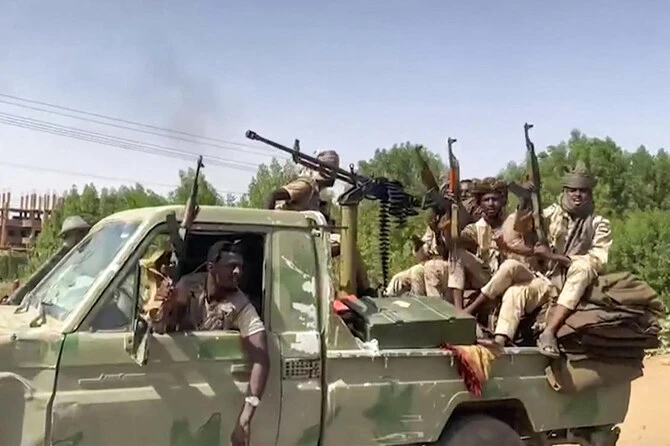
Sudan’s regular army and the paramilitary Rapid Support Forces (RSF) have been locked in a battle for power since April 2023 that has intensified this month as the army fights to take all of the capital Khartoum and its sister cities of Omdurman and Khartoum North.
RSF shelling killed 54 people at a busy market in Omdurman on Saturday, overwhelming the city’s Al-Nao Hospital, a medical source told AFP.
“The shells hit in the middle of the vegetable market, that’s why the victims and the wounded are so many,” one survivor told AFP.
Across the Nile in Khartoum, two civilians were killed and dozens wounded in an air strike on an RSF-controlled area, the local Emergency Response Room (ERR) said.
Although the RSF has used drones in attacks including on Saturday, the fighter jets of the regular armed forces maintain a monopoly on air strikes.
The ERR is one of hundreds of volunteer committees across Sudan coordinating emergency care.
In addition to killing tens of thousands of people, the war has uprooted more than 12 million and forced most health facilities out of service.
A volunteer at Al-Nao Hospital told AFP it faced dire shortages of “shrouds, blood donors and stretchers to transport the wounded.”
The hospital is one of the last medical facilities operating in Omdurman and has been repeatedly attacked.
After months of stalemate in greater Khartoum, the army retook several bases in Khartoum last month, including its pre-war headquarters, pushing the RSF increasingly into the city’s outskirts.
Witnesses said Saturday’s bombardment of Omdurman came from the city’s western outskirts, where the RSF remains in control.
A resident of a southern neighborhood reported rocket and artillery fire on the city’s streets.
Saturday’s bombardment came a day after RSF commander Mohamed Hamdan Dagalo vowed to retake the capital from the army.
“We expelled them (from Khartoum) before, and we will expel them again,” he told troops in a rare video address.
Greater Khartoum has been a key battleground in nearly 22 months of fighting between the army and the RSF, and has been reduced to a shell of its former self.
An investigation by the London School of Hygiene and Tropical Medicine found that 26,000 people were killed in the capital alone between April 2023 and June 2024.
Entire neighborhoods have been taken over by fighters as at least 3.6 million civilians have fled, according to United Nations figures.
Those unable or unwilling to leave have reported frequent artillery fire on residential areas, and widespread hunger in besieged neighborhoods blockaded by opposing forces.
At least 106,000 people are estimated to be suffering from famine in Khartoum, according to the UN-backed Integrated Food Security Phase Classification, with a further 3.2 million experiencing crisis levels of hunger.
Nationwide, famine has been declared in five areas — most of them in the mainly RSF-controlled western region of Darfur — and is expected to take hold of five more by May.
Before leaving office, the Joe Biden administration sanctioned Sudanese army chief Abdel Fattah Al-Burhan, accusing the army of attacking schools, markets and hospitals and using starvation as a weapon of war.
That designation came a week after Washington sanctioned the RSF commander for his role in “gross violations of human rights” in Darfur, where the State Department said his forces had “committed genocide” against non-Arab minority groups.