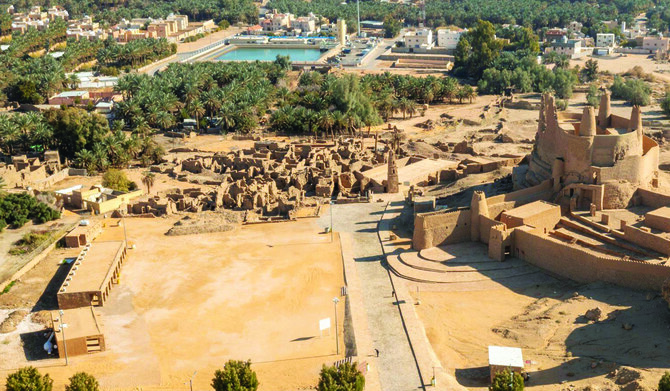

RIYADH: In the heart of Al-Jouf, around 50km away from Sakaka, is the city of Dumat Al-Jandal — or, to give it its ancient name, “Adumato.”
Civilizations and kingdoms have thrived here for thousands of years, leaving behind traces of their existence carved onto walls and corners.
“It was a rainy period with rivers and forests, then it turned into a savanna, then into a period of little rain, then the habitation moved to other nearby sites such as the site of Al-Jamal and the site of Al-Rajajil,” explained Hussain Al-Khalifah, a Saudi archaeologist with over 30 years’ experience.

Italian ambassador Carlo Baldocci, during his visit to archaeological sites at Dumat Aljandal in October 2024. (Supplied)
“After that, the Arabian Peninsula became a desert as we see it today. In ancient times, humans moved to sites with fertile soil and water resources. Therefore, Dumat Al-Jandal is one of the oldest cities inhabited around the second millennium BCE,” he said.
FASTFACT
Among the kingdoms and empires that tried to control Dumat Al-Jandal were the Assyrians, who made numerous attempts to control and capture the lands.
A trade road was created to exchange goods and link regions, and Dumat Al-Jandal was one of the significant points on this for people coming from the south of the Arabian Peninsula.
“It was an important point at the beginning of the land trade,” Al-Khalifah told Arab News.

Marid Palace, one of the remarks of Dumat Aljandal and evidence of the rich history of the city. (SPA)
“Dumat Al-Jandal was strong and rich because of trade. The people were protectors of the trade that passed by the city and, therefore, they took some of the goods in exchange for protecting merchants.”
Among the kingdoms and empires that tried to control Dumat Al-Jandal were the Assyrians, who made numerous attempts to control and capture the lands.
However, another kingdom was rising at the same time — the Arabian Qedarites, which not only prevented the Assyrians from taking Dumat Al-Jandal but also expanded their territory until they reached Palestine, Al-Khalifah said.
The Assyrians captured Adumato eventually, though the exact date is unknown.
They were known to document information on clay tablets, some of which can still be seen today at Dumat Al-Jandal. They are among the primary sources that mention Arabs, providing a description of the people of the city and one of their queens, Talkhunu, among others.
They also mention a rebel named Yabu who revolted against Ayatea, the king of Dumat Al-Jandal who was loyal to the Assyrians.
The Assyrian king, an advocate of justice who despised aggression and rebellion, sent warriors to aid Ayatea who caught Yabu and put him in chains.
The tablets also mention a popular souk which took place each year on the first day of spring.