

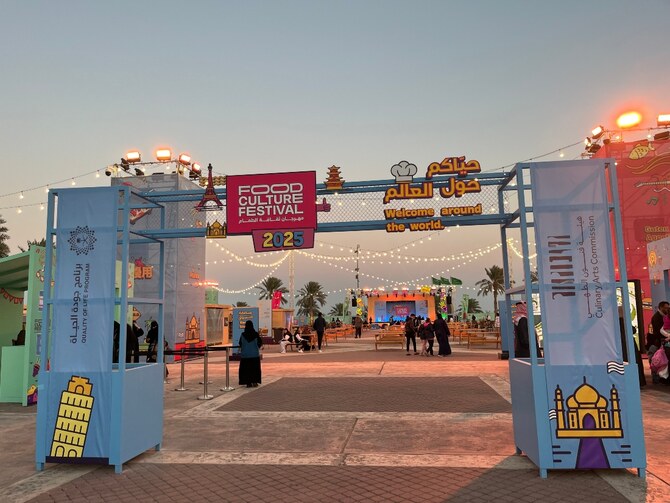
Food and fun come to Alkhobar at the Food Culture Festival

Short Url
Updated 31 January 2025
Follow

Food and fun come to Alkhobar at the Food Culture Festival

ALKHOBAR: The Food Culture Festival, running until Feb. 2, has transformed Alkhobar’s seafront into a hub of culinary and cultural exchange.

The event features oversized food sculptures — including a giant hamburger and pizza slice — leading visitors into a world of flavors.

With 30 food varieties, 12 kiosks, and interactive spaces, the festival offers a rich culinary journey, complemented by live music.

In collaboration with the Quality of Life Program, the festival features a lineup of international cuisines, including Saudi, Italian, Turkish, American, Chinese and Thai, offering a diverse range of dishes, from street food favorites to gourmet specialties.

On arrival, visitors receive a festival passport that guides them through culinary quests. Completing all challenges earns them a free prize — either a T-shirt or a mug — but participation is optional. Guests can simply walk around, purchase food, and enjoy the live performances without following the passport activities.

One vendor, Norah Mari of Soma, shared her pride in showcasing a local twist on a dish. “People are coming to sample culinary delights from around the world, and we are proud to showcase our Saudi twist on a dish that originates in Syria. We added Hasawi lemon to our new variation, and this festival gives everyone a chance to sample it,” she told Arab News.

Workshops led by expert chefs cover food decoration, sushi making, pasta preparation and food photography, requiring a separate ticket for participation.

Entertainment takes center stage with live performances, including Arabic music, Indian Bharatanatyam dance and a Chinese dragon dance in celebration of the lunar new year. Carnival games and shows add to the excitement.

For families, there are interactive workshops introducing children to global food cultures through fruit tastings, baking sessions and farm experiences.

“We are now here in Alkhobar, Saudi Arabia, promoting Filipino products with the help of our Philippine embassy,” said vendor Philip Lim, highlighting the festival’s diverse offerings.

Cousins Lama Al-Shaikh, 7, and Haya Al-Shaikh, 8, attended with their mothers to explore the festival: “The event is so fun, and the food is so good!” they told Arab News.

Open from 4 p.m. to midnight, the festival provides an ideal setting for residents and visitors to gather, indulge in world-class cuisine and enjoy a festive atmosphere.

“As a Saudi entrepreneur, I’m so pleased that we were able to participate in this festival in the same city where my journey began,” Mari said.

Following its stopover in Alkhobar, the festival will move to Riyadh from Feb. 5-9 and Jeddah from Feb. 12-16.

To book tickets, visit https://www.instagram.com/mocculinary?igsh=bXB5bnVwZ3V2dm92


Experimental farm in Al-Lith looks into future of Saudi Arabian agriculture

Updated 02 February 2026
Follow

Experimental farm in Al-Lith looks into future of Saudi Arabian agriculture

  • Research initiative reflects strategic transformation

JEDDAH: An experimental farm in Saudi Arabia’s Al-Lith Governorate is one of the research initiatives reflecting the strategic transformation taking place in the Kingdom’s agricultural sector.

The farm uses highly efficient, sustainable production models that combine scientific research with commercial application, contributing to strengthening the country’s food security system and the sustainability of water resources.

Located in the Ghumaiqa Center on an area of about 10 hectares, the cutting-edge farm is a testing platform for modern agricultural technologies that tackle the challenge of water scarcity.

The farm includes developed open fields and modern greenhouses, supported by smart irrigation encompassing drip and sprinkler irrigation alongside surface and subsurface technologies.

All the systems operate via smart controls that enable the monitoring of water consumption and ensure improved efficiency, thereby achieving a balance between agricultural production and water conservation.

The farm also uses treated and diluted low-salinity seawater.

It aims to diversify agricultural water sources, reduce reliance on freshwater, and open new horizons for agriculture in coastal and semi-arid environments.

A view of the experimental farm in Al-Lith. (SPA)

The project represents a promising investment opportunity in the field of smart agriculture, enabling the development of commercially scalable production models, particularly for high-value vegetables and fruits, while reducing operational costs associated with water and energy, enhancing the economic feasibility of future agricultural projects.

In addition, the project contributes to transferring and localizing agricultural expertise, supporting local food supply chains, and creating an attractive environment for agricultural investment.

This aligns with Sustainable Development Goals and enhances the efficiency of the private sector in adopting innovative agricultural solutions.

Yahya bin Abdulrahman Al-Mahabi, the director of the Ministry of Environment, Water and Agriculture office in Al-Lith Governorate, told the Saudi Press Agency that the project represented the future of agriculture in the Kingdom.

He explained that the vision was based on investing in technology, enhancing the return on water per unit, and integrating scientific research with investment opportunities.

Al-Mahabi spoke of the experimental farm as a modern, scalable and replicable model applicable in several regions of the Kingdom, particularly in coastal environments.

Al-Mahabi highlighted the Ministry of Environment, Water and Agriculture’s commitment to supporting distinctive projects that contributed to achieving food security while developing rural areas and enhancing agricultural production efficiency, in line with the objectives of the Kingdom’s Vision 2030.