Imran Khan’s party rejects Pakistani PM’s offer to relaunch reconciliation talks

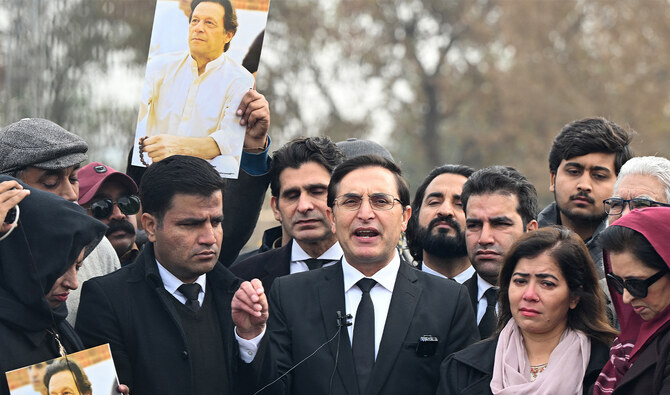
Former prime minister Imran Khan's Pakistan Tehreek-e-Insaaf (PTI) party's chairman and barrister Gohar Ali Khan (C) speaks to media outside the Adiala prison in Rawalpindi on January 17, 2025. (AFP/File)
Short Url
Updated 31 January 2025
Follow

Imran Khan’s party rejects Pakistani PM’s offer to relaunch reconciliation talks

  • Negotiations began last month to ease political tensions in Pakistan with three rounds held so far
  • PTI says government failed to meet deadline to form judicial commissions to probe so-called violent protests

ISLAMABAD: The Pakistan Tehreek-e-Insaf (PTI) party of jailed former prime minister Imran Khan has turned down Prime Minister Shehbaz Sharif’s invitation on Thursday to resume reconciliatory talks with the government, which broke down last week.

The PTI mainly demands the release of political prisoners and the setting up of two judicial commissions to probe the events that led to his arrest in August 2023, and violent protest rallies, including one on May 9, 2023, when his supporters rampaged through military offices and installations, and a second one to demand Khan’s release from prison on Nov. 26, 2024, in which the government says four troops were killed. 

Negotiations started last month and three rounds have been held so far. At the last meeting on Jan. 16, the PTI had given the government seven days to announce the truth commissions, a deadline that expired last Thursday. The PTI subsequently announced it was abandoning the talks process and did not attend the latest round on Jan. 28. 

On Thursday, Sharif invited the party to resume talks with the government, also offering to form a parliamentary committee to investigate the results of general elections last year, which the PTI says were rigged.

“This offer by Shehbaz Sharif is totally rejected,” Leader of the Opposition in the National Assembly, Omar Ayub Khan, a key aide of Imran Khan, said, adding that the party would “actively move forward” with an anti-government movement in collaboration with other opposition parties under the Tehreek Tahafuz Ayeen-i-Pakistan (TTAP) banner.


A Pakistani court earlier this month sentenced Khan to 14 years in prison in a land corruption case, another setback to the nascent talks’ process.

On Friday, speaking during a television interview, Federal Minister Rana Sanaullah said the talks’ offer made by Sharif did not have a deadline.

“The PM made an all-time offer,” Sanaullah said. “If they had come to us by 12 last night or today till 12am or even if they come after that, we are still ready … We will be ready because problems are only solved at the negotiating table, and there is no other way or solution.”

Khan’s ouster in a parliamentary no-trust vote in 2022 has plunged Pakistan into a political crisis, particularly since the PTI founder was jailed in August 2023 on corruption and other charges and remains behind bars. His party and supporters have regularly held protests calling for his release, with many of the demonstrations turning violent.

Khan’s first arrest in May 2023 in the land graft case in which he was sentenced last week sparked countrywide protests that saw his supporters attack and ransack military installations in an unprecedented backlash against Pakistan’s powerful army generals.

Although Khan was released days later, he was rearrested in August 2023 after being convicted in a corruption case. He remains in prison and says all cases against him are politically motivated.

Protests demanding Khan’s release last November also turned violent, with the PTI saying 12 supporters were killed while the state said four troops had died.

Last week, Khan had called on his party members and supporters to mark the one year anniversary of the Feb. 8 general elections as a “”black day” and hold protests across the country. 


UN agencies report spike in Afghan arrests as nearly two million return from Pakistan

Updated 8 sec ago
Follow

UN agencies report spike in Afghan arrests as nearly two million return from Pakistan

  • UNHCR and IOM data show weekly spike in detentions, with Balochistan emerging as main hotspot
  • International rights groups say the deportation drive risks violating international protection obligations

ISLAMABAD: United Nations agencies for refugees and migration recorded a sharp rise in the arrest and detention of Afghan nationals in Pakistan since the beginning of the year, highlighting in a report this week that about two million Afghans have been repatriated to their country since late 2023.

According to a joint report released by the Office of the United Nations High Commissioner for Refugees (UNHCR) and the International Organization for Migration (IOM), the scale of the movement has gone up significantly.

“During the reporting period (4 – 10 January), a total of 1,726 Afghan nationals were arrested and detained, marking an 18 percent increase compared to the previous week,” the report said. “Cumulatively, from 15 September 2023 to 10 January 2026, 1,957,694 individuals have returned.”

The mass migration and deportation drive began on November 1, 2023, after Pakistani authorities announced a repatriation plan for “illegal immigrants,” mostly Afghans. The decision followed a spike in suicide bombings, which the Pakistani government said were carried out by Afghan nationals or by militants launching cross-border attacks from neighboring Afghanistan.
Islamabad has also blamed illegal Afghan immigrants and refugees for involvement in smuggling and other crimes, though Afghanistan denies the allegations.

In 2025, Pakistan expanded the scope of its deportation drive, moving beyond undocumented foreign nationals to include holders of Afghan Citizen Cards (ACC). The campaign was later extended to bearers of Proof of Registration (PoR) cards after their validity expired in June.

While PoR cards were meant to recognize Afghan refugees under a formal registration framework, ACCs were merely introduced to document Afghan nationality without conferring refugee status on those in possession of them.
“Out of all arrests and detentions during the reporting period ... ACC holders and undocumented Afghans represented 87 percent of the total rate of arrest and detentions, and PoR holders represented 13 percent,” the report said.

In addition to the arrests, the reporting period saw a marked increase in activity at the border. Between January 4 and January 10, 2026, alone, an estimated 19,666 Afghans returned through various crossing points including Torkham and Chaman, representing a 38 percent increase in returns and a 17 percent increase in deportations compared to the week prior.

The UN report noted that “fear of arrest remained the main reason for return among undocumented individuals and ACC holders (95 percent)” while PoR card holders cited “strict border entry requirements” as their primary driver for leaving.
Geographically, 73 percent of recent arrests occurred in Balochistan, with the Islamabad Capital Territory (ICT) also being a focal point with 16 percent of the total arrests following government directives for Afghans to relocate from the capital.

Earlier in January, Amnesty International renewed pressure on Islamabad, urging it to stop deportations.

“Amnesty International calls on the Pakistani authorities to halt the deportation of Afghan refugees and ensure that individuals with international protection needs are safeguarded as per international human rights law,” it said in an open letter addressed to Prime Minister Shehbaz Sharif.

Amnesty maintained Pakistan’s repatriation policy violated the principle of non-refoulement, which prohibits returning refugees to countries where they could face persecution or serious harm, and described the campaign as potentially “one of the largest forcible returns of refugees in modern history.”