

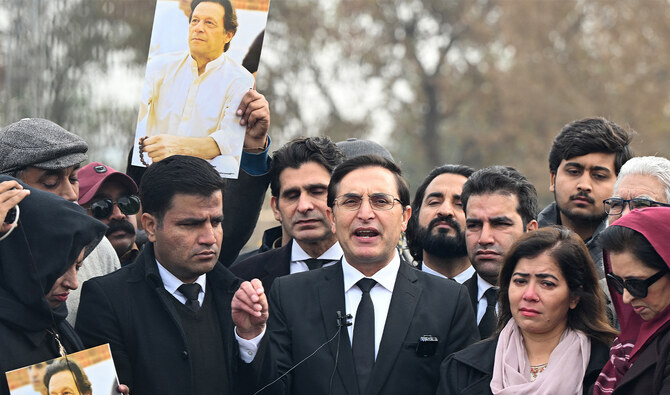

ISLAMABAD: The Pakistan Tehreek-e-Insaf (PTI) party of jailed former prime minister Imran Khan has turned down Prime Minister Shehbaz Sharif’s invitation on Thursday to resume reconciliatory talks with the government, which broke down last week.
The PTI mainly demands the release of political prisoners and the setting up of two judicial commissions to probe the events that led to his arrest in August 2023, and violent protest rallies, including one on May 9, 2023, when his supporters rampaged through military offices and installations, and a second one to demand Khan’s release from prison on Nov. 26, 2024, in which the government says four troops were killed.
Negotiations started last month and three rounds have been held so far. At the last meeting on Jan. 16, the PTI had given the government seven days to announce the truth commissions, a deadline that expired last Thursday. The PTI subsequently announced it was abandoning the talks process and did not attend the latest round on Jan. 28.
On Thursday, Sharif invited the party to resume talks with the government, also offering to form a parliamentary committee to investigate the results of general elections last year, which the PTI says were rigged.
“This offer by Shehbaz Sharif is totally rejected,” Leader of the Opposition in the National Assembly, Omar Ayub Khan, a key aide of Imran Khan, said, adding that the party would “actively move forward” with an anti-government movement in collaboration with other opposition parties under the Tehreek Tahafuz Ayeen-i-Pakistan (TTAP) banner.
A Pakistani court earlier this month sentenced Khan to 14 years in prison in a land corruption case, another setback to the nascent talks’ process.
On Friday, speaking during a television interview, Federal Minister Rana Sanaullah said the talks’ offer made by Sharif did not have a deadline.
“The PM made an all-time offer,” Sanaullah said. “If they had come to us by 12 last night or today till 12am or even if they come after that, we are still ready … We will be ready because problems are only solved at the negotiating table, and there is no other way or solution.”
Khan’s ouster in a parliamentary no-trust vote in 2022 has plunged Pakistan into a political crisis, particularly since the PTI founder was jailed in August 2023 on corruption and other charges and remains behind bars. His party and supporters have regularly held protests calling for his release, with many of the demonstrations turning violent.
Khan’s first arrest in May 2023 in the land graft case in which he was sentenced last week sparked countrywide protests that saw his supporters attack and ransack military installations in an unprecedented backlash against Pakistan’s powerful army generals.
Although Khan was released days later, he was rearrested in August 2023 after being convicted in a corruption case. He remains in prison and says all cases against him are politically motivated.
Protests demanding Khan’s release last November also turned violent, with the PTI saying 12 supporters were killed while the state said four troops had died.
Last week, Khan had called on his party members and supporters to mark the one year anniversary of the Feb. 8 general elections as a “”black day” and hold protests across the country.


