Any forced halt of UNRWA’s work would jeopardize Gaza ceasefire, agency says

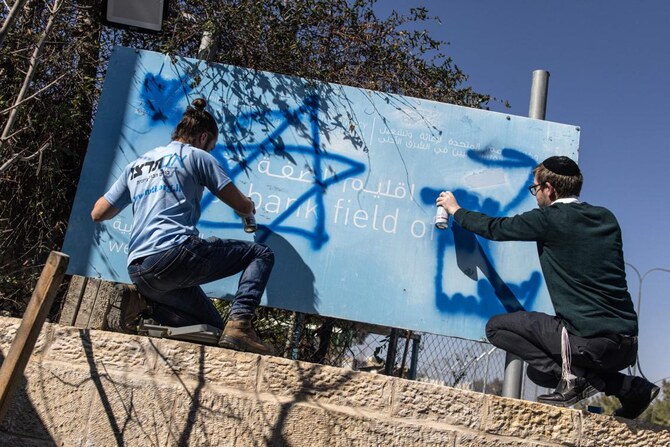
Israeli right wing activists deface the sign board in front of the shuttered gate of the United Nations Relief and Works Agency’s West Bank Field Office in Jerusalem on Jan. 30, 2025. (AFP)
Short Url
Updated 31 January 2025
Follow

Any forced halt of UNRWA’s work would jeopardize Gaza ceasefire, agency says

  • For now, its work in Gaza and elsewhere continues despite an Israeli ban that was due to take effect on Jan. 30

GENEVA: The UN Palestinian relief agency UNRWA said on Friday that if its humanitarian work in Gaza is forced to halt, it would put a ceasefire deal between Israel and Hamas at risk.
The agreement has paused a 15-month-old war between Israel and Gaza’s rulers Hamas that has decimated the Gaza Strip, killed tens of thousands of Palestinians and destabilized the Middle East.
The deal has allowed for a surge in humanitarian aid and enabled the release of Israeli hostages in Gaza and Palestinian detainees from Israeli jails.
“If UNRWA is not allowed to continue to bring and distribute supplies, then the fate of this very fragile ceasefire is going to be at risk and is going to be in jeopardy,” Juliette Touma, director of communications of UNRWA, told a Geneva press briefing.
For now, its work in Gaza and elsewhere continues despite an Israeli ban that was due to take effect on Jan. 30, she added.
However, she said that its Palestinian staff located in the West Bank and East Jerusalem are facing difficulties, citing examples of stone-throwing and hold-ups at checkpoints.
“They face an exceptionally hostile environment as a fierce disinformation campaign against UNRWA continues,” she said.


Drone strikes blamed on Iran hit Iranian Kurdish camp in Iraq: official, exiled group

Updated 2 sec ago
Follow

Drone strikes blamed on Iran hit Iranian Kurdish camp in Iraq: official, exiled group

IRBIL: Drone stikes blamed on Iran hit on Tuesday a camp hosting Iranian Kurdish fighters and family members in northern Iraq, a local official and an exiled opposition group said.
Iraq’s northern autonomous Kurdish region hosts camps and rear-bases operated by several Iranian Kurdish rebel groups, which have repeatedly faced cross-border strikes from Iran.
A local official in the Koysinjaq district, Tareq Al-Haidari, told AFP “three Iranian drones targeted the Azadi camp, which belongs to Iranian Kurdish opposition parties in the district.”
One drone directly hit the camp’s hospital, wounding one person, said Haidari and a commander from the Democratic Party of Iranian Kurdistan (PDKI).
PDKI commander Mohammed Nazif Kader told AFP “drones and missiles attacked the camp,” blaming the attack on Iran.
For decades, the Koysinjaq district, known as Koya to Kurds, has been home to the PDKI.
Iran has designated Kurdish opposition groups as terrorist organizations, and has accused them of serving Western or Israeli interests in the past.
These groups have previously fought Iranian security forces in Kurdish-majority areas along the border.
But in recent years, they have largely refrained from armed activity, although they continue to actively campaign from exile against the Islamic republic.
Last week, five groups, including the PDKI, announced a political coalition to seek the overthrow of Iran’s Islamic republic and ultimately to secure Kurdish self-determination.