

Donald Trump talks so much that even his White House stenographers are struggling to keep up

President Donald Trump speaks with reporters at the White House on Jan. 30, 2025, in Washington. (AP)
Short Url
Updated 31 January 2025
Follow

Donald Trump talks so much that even his White House stenographers are struggling to keep up

  • He’s been speaking nearly nonstop since starting his second term, drowning out dissenting voices and leaving his opponents struggling to be heard
  • Trump’s commentary remains laden with falsehoods, but now that he is back in the presidency, it’s hard to ignore him
  • Kate Berner, who worked on Biden’s communications staff, said Trump’s constant talking helps keep his adversaries off balance

WASHINGTON: The White House stenographers have a problem. Donald Trump is talking so much, the people responsible for transcribing his public remarks are struggling to keep up with all the words.
There were more than 22,000 on Inauguration Day, then another 17,000 when Trump visited disaster sites in North Carolina and California. It’s enough to strain the ears and fingers of even the most dedicated stenographer, especially after four years of Joe Biden’s relative quiet.
Now there are discussions about hiring additional staff to keep up with the workload, according to people with knowledge of the conversations who insisted on anonymity to discuss internal matters.
The flood of words is one of the most visible — or audible — shifts from Biden to Trump, who craves the spotlight and understands better than most politicians that attention is a form of power. He’s been speaking nearly nonstop since starting his second term, drowning out dissenting voices and leaving his opponents struggling to be heard.
Take Wednesday, for example. During a signing ceremony for legislation to accelerate deportations, Trump, a Republican, talked up his accomplishments, claimed Hamas was using US-funded condoms to make bombs in Gaza, defended his administration’s efforts to freeze federal spending and reduce the government workforce, veered through descriptions of migrant violence and made the surprise announcement that Guantánamo Bay, Cuba, would be used as a detention center for people who are in the US illegally.
Trump’s commentary remains laden with falsehoods, including baseless allegations about voter fraud and assertions that California water policies worsened the recent wildfires. Sometimes he speaks off the cuff about consequential geopolitical matters, such as a recent suggestion that Palestinians should be displaced from Gaza while the enclave is rebuilt. It can be hard to know when to take him seriously, like when he muses about serving a third term, which the US Constitution does not allow.
But now that Trump is back in the presidency, it’s hard to ignore him.
“He’s dictating the news on his terms,” said Michael LaRosa, who worked as a television producer before serving as a spokesperson for former first lady Jill Biden. “He’s become America’s assignment editor.”

INNUMBERS

24,259 words used by Joe Biden when he spent 2 hours and 36 minutes talking on camera in his first week in office in 2020

81,235 words spewed by Donald Trump as he spoke for nearly 7 hours and 44 minutes last week. That’s longer than watching the original “Star Wars” trilogy back-to-back-to-back, and more words than “Macbeth,” “Hamlet” and “Richard III” combined

(Source: Factba.se.)

Most presidents try to start their terms with a bang, seizing the moment when their influence could be at its peak. However, Trump is in a different league.
Biden, a Democrat, spent 2 hours and 36 minutes talking on camera and used 24,259 words in his first week in office four years ago, according to numbers generated by Factba.se.
Trump’s comparable stats: nearly 7 hours and 44 minutes and 81,235 words last week. That’s longer than watching the original “Star Wars” trilogy back-to-back-to-back, and more words than “Macbeth,” “Hamlet” and “Richard III” combined.
It’s also much more than when Trump took office for his first term eight years ago. Back then, he was only on camera talking for 3 hours and 41 minutes and spoke 33,571 words.
Trump has spent decades practicing the best ways to get people to pay attention to him. As a New York businessman, he fed stories to gossip columnists, added gold plating to buildings and slapped his name on every product that he sold. His efforts reached an apex with “The Apprentice,” the reality television show that beamed him into American living rooms.
“One of the things that has given him the advantage is that he thinks like an executive producer,” said Kevin Madden, a Republican communications strategist. “He’s constantly programming the next hour and trying to keep his audience engaged.”
A sign of what was to come arrived shortly after Trump was sworn in. He delivered an inaugural address and then promptly gave more remarks to supporters that were even longer than his speech. And then he spoke at a downtown arena, where people had gathered for a rally, and later he parried questions from reporters for nearly an hour in the Oval Office while signing executive orders.
At one point, he turned to Fox News Channel’s Peter Doocy.
“Does Biden ever do news conferences like this?” Trump said. “How many news conferences, Peter, has he done like this?”
“Like this?” Doocy responded.
“None,” Trump said, answering his own question.
On Friday, Trump presented a tour de force of talking, demonstrating that he’s far more willing to put himself in unscripted situations than Biden was.
He spoke with reporters while leaving the White House in the morning. He talked to them again after landing in North Carolina, then again at a briefing on the recovery from Hurricane Helene, and then again while meeting with victims of the storm.
Trump flew that afternoon to Los Angeles, where he conversed with local officials about the recent wildfires. Before boarding Air Force One to leave the city in the evening, he answered more questions from reporters on the tarmac.
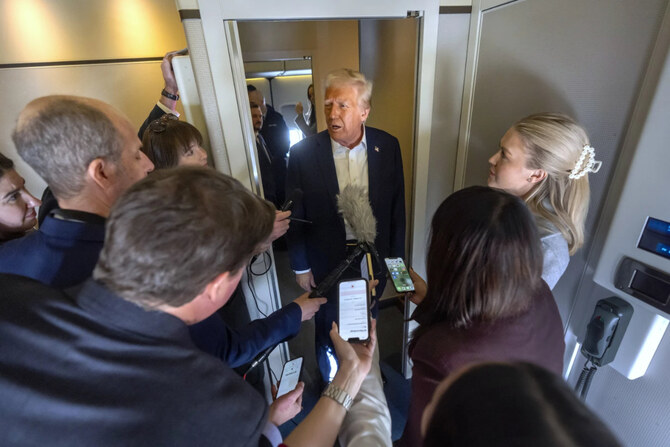
As his travels continued over the weekend, Trump spoke to reporters twice at the back of Air Force One — as often as Biden did for his entire term.
“Transparency is back!” wrote longtime aide Margo Martin on social media.
That’s not the word that Kathleen Hall Jamieson, director of the Annenberg Public Policy Center at the University of Pennsylvania, would use.
“Being accessible and being transparent are two different things,” she said.
Sometimes more talking doesn’t produce more clarity. One afternoon, Trump told reporters that there were “no surprises” when Republican Sens. Susan Collins and Lisa Murkowski decided to oppose Pete Hegseth to lead the Pentagon. The next morning, Trump said he was “very surprised” by their votes.
Jamieson worries that the frenzied pace will exhaust people.
“More people will simply check out,” she said. “And that’s a problem. An informed citizenry is an engaged citizenry.”
Kate Berner, who worked on Biden’s communications staff, said Trump’s constant talking helps keep his adversaries off balance.
“By doing so much and saying so much, it is hard for people who oppose him to organize,” she said. “And it is hard for any one thing to take hold.”
But there’s also a risk for Trump, Berner said. If he’s not careful, she said, he could once again start “wearing out his welcome with the American people.”


India’s wealthy embrace a new luxury symbol: water

Updated 2 sec ago
Follow

India’s wealthy embrace a new luxury symbol: water

  • Tap water in India is not fit for human consumption
  • Wealthy opt for premium water as wellness craze boosts industry
NEW DELHI: At an Indian gourmet food store, Avanti Mehta is organizing a blind tasting of drinks sourced from France, Italy and India. No, ​this isn’t wine, it’s water.
Participants use tiny shot glasses to check the minerality, carbonation and salinity in samples of Evian from the French Alps, Perrier from southern France, San Pellegrino from Italy and India’s Aava from the foothills of the Aravalli mountains.
“They will all taste different ... you should be choosing a water that can give you some sort of nutritional value,” said Mehta, who is 32 and calls herself India’s youngest water sommelier, a term usually associated with premium wine. Her family owns the Aava mineral water brand. Premium water is a $400 million business in the world’s most populous nation and is growing bigger as its wealthy see it as a new status symbol that fits in with a spreading wellness craze.
Premium Indian mineral water costs around $1 for a one-liter bottle, while imported brands are upwards of $3, or 15 times the price of the country’s lowest-priced basic bottled water.
Clean water is a privilege in the country of 1.4 billion people where ‌researchers say 70 percent of ‌the groundwater is contaminated. Tap water remains unfit to drink, and 16 people died in Indore city ‌after ⁠consuming contaminated ​tap water ‌in December.
Many in India see bottled water as a necessity and standard 20 US-cent bottles are available widely at convenience stores, restaurants and hotels. The market is worth nearly $5 billion annually and is set to grow 24 percent a year — among the fastest in the world.
Bottled water demand in United States or China is driven by convenience, making it a $30 billion-plus market in each country which will grow just 4-5 percent each year, Euromonitor says.
In India, the premium water segment is leading the surge in demand, accounting for 8 percent of the bottled water market last year compared to just 1 percent in 2021, Euromonitor said.
“Distrust of municipal water in some areas has escalated the demand for bottled water. Now, people understand how mineral water has more health benefits. It’s expensive, but the category will boom,” said Amulya Pandit, a senior consultant at Euromonitor specializing in the drinks ⁠market.
Among its consumers are New Delhi-based real estate developer B.S. Batra, who says his family uses only premium water at home to get more minerals and safeguard health.
“You feel different, more energetic during the day,” ‌said Batra, 49, an avid badminton player.
“I consume mineral water even with whisky at home, and ‍kids use it for their smoothies.”

WATER LURES BOLLYWOOD STAR, WEALTHY
The popular 20-cent plastic ‍bottled water is mainly made by Pepsi, Coca-Cola and Indian market leader Bisleri. In addition, Indians who can afford it, install purifiers in their homes which ‍clean the water but also remove most minerals.
Imported and local premium waters are luring wealthy consumers and businesses alike.
Bollywood star Bhumi Pednekar and her sister have launched Backbay — selling 750 ml cartons of mineral water for $2.2; Indian conglomerate Tata is expanding its premium water portfolio, and retailers and businesses are reporting higher sales.
Tata Consumer Products, also Starbucks’ partner in India, sells 20-cent bottled water, but premium water is its priority as it sees affluent, health-focused consumers willing to spend on the drink without worrying about the price, CEO Sunil D’Souza said in ​an interview.
“I don’t have to push water uphill...I see a long, long, long runway for the business,” he said.
Tata’s premium “Himalayan” mineral water factory — which a Reuters photographer visited — is located in the foothills of the Himalayan range in Himachal Pradesh state. Workers there largely ⁠keep a hands-free watch on machines filling plastic and glass bottles with water sourced from a natural underground aquifer.

LOOKING FOR SPRINGS
Most Indians prefer still water, and the sparkling variant remains niche. Tata said it plans to launch a sparkling Himalayan water, and is also scouting for natural springs for expanding its other offerings. At three Foodstories Indian gourmet stores, sales of premium waters tripled in 2025. Customer demand prompted the chain to import “light and creamy” Saratoga Spring Water from New York, which costs 799 rupees ($9) for a 355-milliliter (12-fluid-ounce) bottle, and stocks sold out within days, said co-founder Avni Biyani.
Indian mineral water brand Aava’s sales touched a record 805 million rupees ($9 million) last year, growing 40 percent a year since 2021. Tata said its basic and premium water portfolio will grow 30 percent a year, after growing tenfold to $65 million in six years.
Imported waters, which attract an over 30 percent tax, are pricier than Indian brands. Nestle’s Perrier and San Pellegrino, and Danone’s Evian retail for over 300 rupees, or $3.20, for a 750 ml bottle.
Nestle declined to comment, while Danone said the Indian bottled water market was growing at a “robust” pace but imported waters “tend to be niche and boutique.”
“When you open your tap, you’re not getting an Aava, Evian ... And that is what you’re essentially paying for,” said water sommelier Mehta.
At the water tasting session, some participants said they enjoyed the experience ‌but many found the price hard to swallow.
“To be honest, it is kind of expensive,” said executive Hoshini Vallabhaneni, one of 14 people at the event. “For everyday use — it will burn a hole in the pocket.” (Reporting by Aditya Kalra in New Delhi and Rishika Sadam in Hyderabad; Additional reporting by Alexander Marrow in London and Anushree Fadnavis ‌in Himachal Pradesh; Editing by Raju Gopalakrishnan)