

Pakistan ratifies charter of Middle East Green Initiative

Pakistan Prime Minister Shehbaz Sharif chairs the federal cabinet meeting in Islamabad on January 30, 2025. (Photo courtesy: PMO)
Short Url
Updated 30 January 2025
Follow

Pakistan ratifies charter of Middle East Green Initiative

  • Initiative announced in 2021 by Saudi crown prince to secure over $10.4 billion for investment fund, clean energy project
  • Plan aims to reduce carbon emissions from regional hydrocarbon production by over 60%, plant 50 billion trees across Mideast

ISLAMABAD: Pakistan’s federal cabinet on Thursday ratified the charter of the Middle East Green Initiative, announced in 2021 by Saudi Crown Prince Mohammed bin Salman with the aim to secure over $10.4 billion for an investment fund and clean energy project as part of efforts to reduce regional carbon emissions.
At the time of the plan’s announcement, the crown prince said the Kingdom, which is the world’s top oil exporter, would contribute 15% of the funds and would work with other states and development funds on the funding and execution of the initiatives. The Middle East Green Initiative aims to reduce carbon emissions from regional hydrocarbon production by more than 60%. It also plans to plant 50 billion trees across the Middle East and restore an area equivalent to 200 million hectares of degraded land. The initiative will help reduce global carbon levels by 2.5%.
“The federal cabinet ratified the charter of the Middle East Green Initiative on the recommendation of the Ministry of Climate Change,” a statement released by the office of Pakistani Prime Minister Shehbaz Sharif said. 
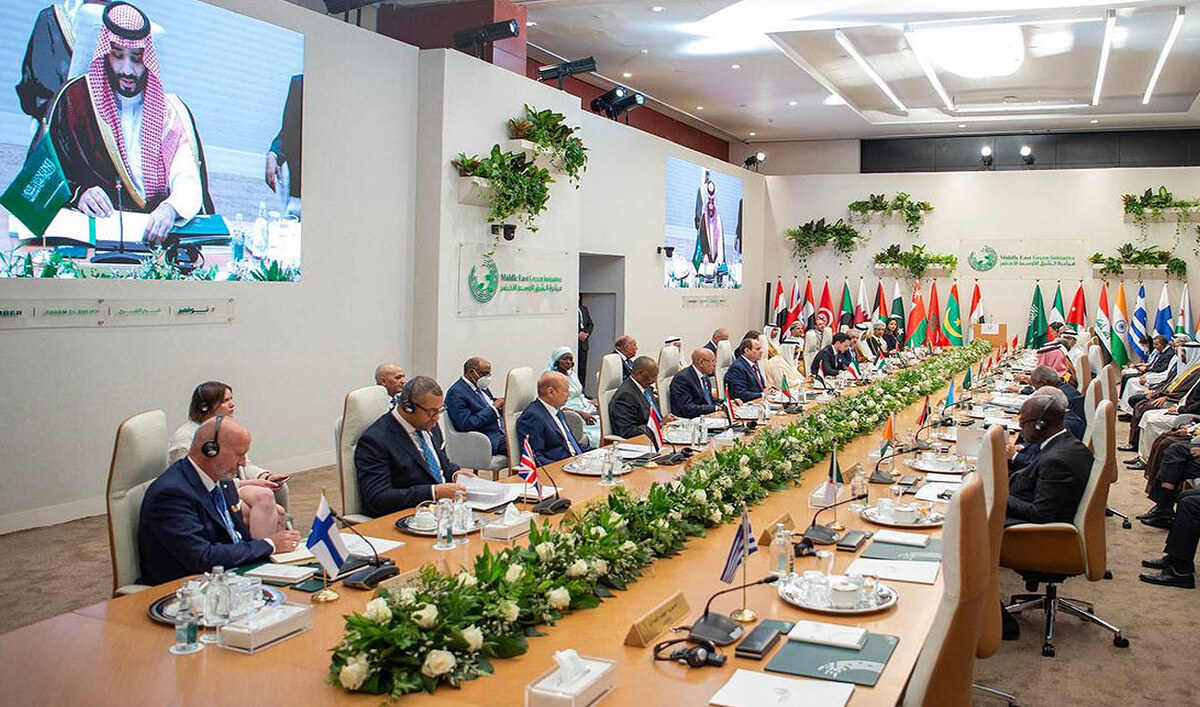


In this file photo, taken on November 7, 2022, shows Saudi Crown Prince Mohammed bin Salman speaks during the second edition of the Middle East Green Initiative Summit in Sharm El Sheikh, Egypt. (Radio Pakistan/File)

“The meeting was informed that Pakistan is one of the founding members of the said charter. Under this initiative, 200 million hectares of land area will be restored and 50 billion trees will be planted.”
Climate change is a major issue in Pakistan, causing extreme weather, droughts and rising temperatures. Although Pakistan contributes only about 0.88% of the world’s greenhouse gas
emissions, it is the fifth most vulnerable country to climate change.
Pakistan has experienced significant temperature increases over the past few decades. The average annual temperature has increased by about 0.5°C since the 1960s. By 2050, it is projected that the average temperature will rise by an additional 1.3°C to 1.5°C.
Over the past years, the intensity of climate-induced disasters in Pakistan has significantly increased. With over 1,700 deaths and 12,000 injuries, the World Bank reported the economic losses and reconstruction in flood-hit areas of Pakistan in 2022 to be over $40 billion.
An increase is also projected in the number of people affected by flooding, with a likely increase of around 5 million people exposed to extreme river floods by 2035–2044, and a potential increase of around 1 million annually exposed to coastal flooding by 2070–2100.
Rainfall patterns are becoming increasingly erratic. While annual precipitation is expected to decrease in some regions, others may see more intense and unpredictable rainfall events. This variability is already contributing to extreme weather events like floods and droughts.
The World Bank estimates that the combined risks of extreme climate-related events, environmental degradation, and air pollution are projected to reduce Pakistan’s GDP by at least 18 to 20% by 2050, which will stall progress on economic development and poverty reduction.


Pakistan, ADB sign $730 loan agreements to boost SOE reforms, energy infrastructure

Updated 25 December 2025
Follow

Pakistan, ADB sign $730 loan agreements to boost SOE reforms, energy infrastructure

  • Both sign $330 million Power Transmission Strengthening Project and $400 million SOE Transformation Program loan agreements
  • Economic Affairs Division official says Transmission Project will secure Pakistan’s energy future by strengthening national grid’s backbone

KARACHI: Pakistan and the Asian Development Bank (ADB) on Thursday signed two loan agreements totaling $730 million to boost reforms in state-owned enterprises (SOEs) and energy infrastructure in the country, the bank said.

The first of the two agreements pertains to the SOE Transformation Program worth $400 million while the second loan, worth $330 million, is for a Power Transmission Strengthening Project, the lender said. 

The agreements were signed by ADB Country Director for Pakistan Emma Fan and Pakistan’s Secretary of Economic Affairs Division Humair Karim. 

“The agreements demonstrate ADB’s enduring commitment to supporting sustainable and inclusive economic growth in Pakistan,” the ADB said. 

Pakistan’s SOEs have incurred losses worth billions of dollars over the years due to financial mismanagement and corruption. These entities, including the country’s national airline Pakistan International Airlines, which was sold to a private group this week, have relied on subsequent government bailouts over the years to operate.

The ADB approved the $400 million loan for SOE reforms on Dec. 12. It said the program seeks to improve governance and optimize the performance of Pakistan’s commercial SOEs. 

Karim highlighted that the Power Transmission Strengthening Project will enable reliable evacuation of 2,300 MW from Pakistan’s upcoming hydropower projects, relieve overloading of existing transmission lines and enhance resilience under contingency conditions, the Press Information Department (PID) said. 

“The Secretary emphasized that both initiatives are transformative in nature as the Transmission Project will secure Pakistan’s energy future by strengthening the backbone of the national grid whereas the SOE Program will enhance transparency, efficiency and sustainability of state-owned enterprises nationwide,” the PID said. 

The ADB has supported reforms by Pakistan to strengthen its public finance and social protection systems. It has also undertaken programs in the country to help with post-flood reconstruction, improve food security and social and human capital. 

To date, ADB says it has committed 764 public sector loans, grants and technical assistance totaling $43.4 billion to Pakistan.