

Battle for powerful IOC presidency enters final stretch

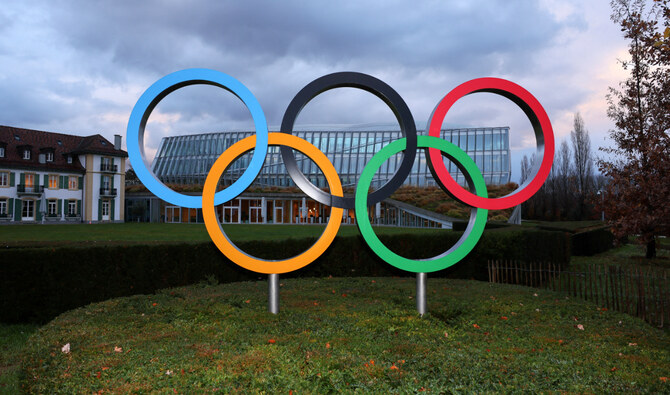
The Olympic rings symbol is displayed by the Olympic House, ahead of the Executive Board meeting of the International Olympic Committee in Lausanne on Dec. 3, 2024. (File/Reuters)
Short Url
Updated 30 January 2025
Follow

Battle for powerful IOC presidency enters final stretch

  • IOC boss is most powerful person in global sport
  • Sebastian Coe highest-profile name of aspirants
  • IOC has huge revenues and dominates decision-making

BERLIN: Only a few people around the world know the name Thomas Bach and even fewer can rattle off those of the seven candidates out to replace him in March after 12 years as president of the International Olympic Committee.

Yet despite that low profile, there is no bigger or more influential job in sport, and Bach’s successor will wield extraordinary political and financial clout across every country in the world.

When the IOC’s 100-plus members, who include billionaires, global captains of industry, federation chiefs and royalty, go to the ballot in Greece on March 20 they will be effectively deciding on the direction much of the world of sport will take for the next eight years.

World Athletics chief and former Olympic 1,500 meters champion Sebastian Coe is the biggest name of the seven candidates.

Standing against him are Zimbabwe’s sports minister and former Olympic swimmer Kirsty Coventry, the late former IOC president’s son Juan Antonio Samaranch, and international cycling chief David Lappartient. Completing the lineup are Prince Feisal Al Hussein of Jordan, international gymnastics federation head Morinari Watanabe and Olympic newcomer and multi-millionaire Johan Eliasch.

They will each present their case to replace 71-year-old Bach to the membership in Lausanne on Thursday, ahead of a final two-month push of behind-the-scenes lobbying.

Richest organization

The IOC is by far the biggest and richest sports organization in the world, dwarfing even world soccer’s ruling body FIFA, and wields its influence over almost every major international federation, new sports and national Olympic Committees.

With multi-billion revenues from sponsors and broadcasters, it is far from limited to just hosting the summer and winter Olympics. The IOC has a direct or indirect say in every major international decision on sport, whether financial, political or structural.

Sports do not only depend on Olympic funding over the Games’ four-year cycle, they are also reliant on the Olympic spotlight. New sports battle for Olympic recognition which brings a significant boost in publicity and awareness and can trigger new streams of revenue to fund growth.

In Bach’s 12 years in charge, the German lawyer also developed close ties with many political leaders, including French President Emmanuel Macron, whose country hosted the 2024 Olympics, and Russian President Vladimir Putin.

Putin was the first to congratulate Bach immediately after his election back in 2013, calling minutes after the vote as his country prepared to host the Sochi Winter Olympics, with an unprecedented cost of $51 billion.

Sochi was subsequently tarnished by revelations of a massive state-backed doping system in Russia that turned into the biggest international drugs scandal in decades and forced the country’s athletes to compete as neutrals in several Olympics.

Dealing with Russia, and the issue of trans and DSD (differences in sexual development) athletes in sport, featured in most of the candidates’ manifestos. But anyone thinking they will be primarily judged on their ability to bring peace and harmony, and promote sport and health around the world, is sadly deluded.

“In this presidential election everyone votes for themselves. It is about money. The share for each stakeholder. It is no surprise that there are four federation presidents campaigning,” an international federation chief, speaking on condition of anonymity, told Reuters.

“Maybe it would have been more effective if there was only one representing the federations. But everyone has their own agenda in this election.”

Robust finances

The IOC collected revenues of $2.295 billion from its top sponsors for the period 2017-2021, the second-biggest source of income for the Olympic movement, with broadcasters paying $4.544 billion over the same period.

Bach’s departure comes with the organization in a financially robust position, having secured $7.3 billion for 2025-28 and $6.2 billion for 2029-2032. More deals are expected for both four-year periods.

The IOC says it pumps about 90 percent of its revenues back into sports with payments to each Olympic federation, to national Olympic committees and athletes’ scholarships among others.

Many of the smaller federations depend on that IOC contribution to get through the four years until the next Olympics.

More than half a billion dollars was split among the federations from the Tokyo Olympics, with the share from the Paris 2024 Games to top $600 million.

Top earners like athletics, gymnastics and swimming get more than $50 million. National Olympic Committees also received a total of $540 million after the Tokyo Olympics.

The IOC covers 50 percent of the costs of running the World Anti-Doping Agency which it helped to set up more than 25 years ago.

Much of what cash goes where, though, is down to the president’s personal Olympic vision and in a matter of weeks that extraordinary global power is about to change hands.


Liverpool without Salah beats Inter in Champions League. Barcelona and Bayern win

Updated 10 December 2025
Follow

Liverpool without Salah beats Inter in Champions League. Barcelona and Bayern win

  • Karl became the youngest player to score in three consecutive Champions League games
  • Headers by Jules Koundé three minutes apart gave Barcelona a 2-1 comeback victory over Eintracht Frankfurt

After leaving Mohamed Salah in England, Liverpool got a much-needed boost with a 1-0 win over Inter Milan in the Champions League on Tuesday, while Barcelona and Bayern Munich celebrated comeback wins and Chelsea lost.
With Salah out of the squad following his public criticism of the club last week, Dominik Szoboszlai stepped up instead to score the 88th-minute penalty which earned a 1-0 win over one of the competition’s best-performing teams.
It was all the more valuable for coming after a run of one win in six games in all competitions for Arne Slot’s under-pressure team, which moved up to eighth.
Liverpool’s players thought they had taken the lead with Ibrahima Konate’s header in the 31st minute but, after a video review that lasted more than four minutes, it was ruled out for handball as Virgil van Dijk had earlier nodded the ball on to the arm of Hugo Ekitike.
Having taken away a goal from Liverpool, VAR came to the visitors’ aid when it spotted that Alessandro Bastoni had tugged Florian Wirtz’s shirt in the area, with the midfielder flailing to the ground. Szoboszlai converted the penalty.
Bayern’s new star shines
Bayern’s 17-year-old midfielder Lennart Karl produced an audacious bit of skill to continue his high-scoring start to life in the Champions League in a 3-1 win over Sporting Lisbon earlier Tuesday.
Karl scored his third goal in four career Champions League games, controlling a pass from Konrad Laimer in mid-air before volleying a shot from a tight angle over two onrushing defenders and past the goalkeeper.
It was part of a 12-minute, three-goal turnaround for Bayern after Joshua Kimmich’s own-goal handed Sporting the lead after João Simões put Bayern under pressure on the counter.
Serge Gnabry leveled for Bayern when he was left unmarked at a corner in the 65th, before Karl scored Bayern’s second in the 69th and defender Jonathan Tah made it 3-1 in the 77th.
Widely viewed as German soccer’s best young talent this season, Karl became Bayern’s youngest-ever Champions League scorer in October on his first start in the competitions.
Late on, Alphonso Davies came off the bench for the Canadian left back’s first game since March after a serious knee injury.
Chelsea loses
Chelsea was beaten in the Champions League for the first time in nearly three months as Belgium forward Charles De Ketelaere set up the equalizer and scored an 83rd-minute winner as Atalanta came from behind to win 2-1.
Chelsea, which went ahead through Joao Pedro, dropped out of the top eight automatic qualifying spots with its second loss.
It was a fourth win for Atalanta, which climbed to third and is the highest-placed Italian team.
Gianluca Scamacca made it 1-1 by heading home a cross from De Ketelaere, who then drove in a shot that Chelsea goalkeeper Robert Sanchez got a hand to but couldn’t keep out.
Koundé drives Barcelona comeback
Headers by Jules Koundé three minutes apart gave Barcelona a 2-1 comeback victory over Eintracht Frankfurt.
Marcus Rashford assisted in the first goal in the 50th and Lamine Yamal in the second in the 53rd.
The visitors had taken the lead with a goal by Ansgar Knauff in a 21st-minute breakaway at the renovated Camp Nou stadium, which still can’t hold full capacity.
Son watches Spurs win
Son Heung-min said a belated goodbye to Tottenham as his former club moved up to ninth after beating Slavia Prague 3-0 on an own goal and two penalties in a game overshadowed by a dispute over moving a rainbow flag showing support for the LGBTQ+ community.
Julián Alvarez scored for the ninth time in his last nine league-phase appearances to lead Atletico Madrid to a 3-2 come-from-behind win at PSV Eindhoven.
Marseille held on for a 3-2 win over Union Saint-Gilloise, whose players and fans twice celebrated what they thought were goals to level the score late on, only for both to be ruled out for narrow offsides on video review.
Folarin Balogun bundled the ball over the line from close range to give Monaco a 1-0 win over Galatasaray.
Olympiakos broke through a determined Kairat Almaty defense to take a 1-0 win in Kazakhstan and boost its hopes of qualifying for the knockout stages. Gelson Martins scored for the Greek side in the 73rd.