

Jordan hospital offers injured Gazans hope for recovery

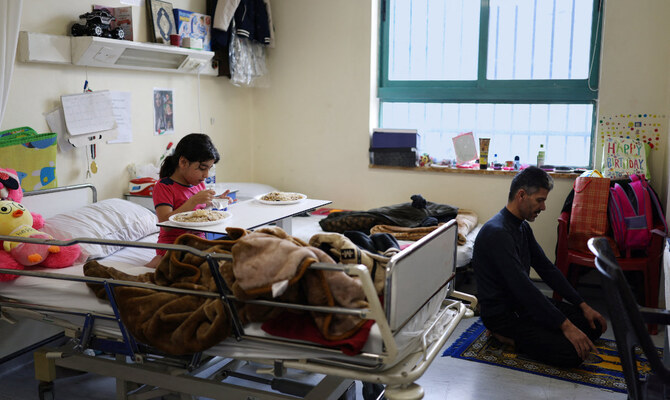
Palestinian Karam Nawjaa, 8, eats as his father Ziad, 53, prays at Amman’s Reconstructive Surgery Hospital, where Ziad’s son Karam, 17, is being treated. (Reuters)
Short Url
Updated 29 January 2025
Follow

Jordan hospital offers injured Gazans hope for recovery

  • Israel’s 15-month offensive in Gaza left the coastal enclave a wasteland of rubble that will take years to rebuild

AMMAN: Karam Nawjaa, 17, was so badly injured when an Israeli strike hit his home in Gaza nearly a year ago that his own cousin, pulling him from the rubble, did not recognize him.

After rushing Karam to hospital he returned to continue searching for his cousin all night in the rubble.

In that strike on Feb. 14, 2024, Karam lost his mother, a sister and two brothers. As well as receiving serious burns to his face and body, he lost the ability to use his arms and hands.

Now, the burns are largely healed and he is slowly regaining the use of his limbs after months of treatment at a hospital run by Doctors Without Borders in the Jordanian capital Amman which operates a program of reconstructive surgery.

“I only remember that on that day, Feb. 14, there was a knock on our door ... I opened it, my brother came in, and after that ... (I remember) nothing,” he said.

“Before the war I was studying, and thank God, I was an outstanding student,” Karam said, adding that his dream had been to become a dentist. Now he does not think about the future.

“What happened, happened ... you feel that all your ambitions have been shattered, that what happened to you has destroyed you.”

Karam is one of many patients from Gaza being treated at Amman’s Specialized Hospital for Reconstructive Surgery, Al-Mowasah Hospital. He shares a room there with his younger sister and their father.

“All these patients are war victims ... with complex injuries, complex burns ... They need very long rehabilitation services, both surgical but also physical and mental,” said Moeen Mahmood Shaief, head of the MSF mission in Jordan.

“The stories around those patients are heartbreaking, a lot of them have lost their families” and require huge support to be reintegrated into normal life, he added.

Israel’s 15-month offensive in Gaza left the coastal enclave a wasteland of rubble that will take years to rebuild. 

Displaced Palestinians have been returning to their mostly destroyed homes after a ceasefire came into effect on Jan. 19.



Lebanon foreign minister declines Tehran visit, proposes talks in neutral country

Updated 31 sec ago
Follow

Lebanon foreign minister declines Tehran visit, proposes talks in neutral country

  • Lebanon’s foreign minister Youssef Raji cited ‘current conditions’ for the decision not to go to Iran

Lebanon’s foreign minister Youssef Raji said on Wednesday he had declined an invitation to visit Tehran for now, proposing instead talks with Iran in a mutually agreed neutral third country, Lebanese state news agency NNA reported.

Raji cited “current conditions” for the decision not to go to Iran, without elaborating, and stressed that the move did not mean rejection of dialogue with Iran. He did not immediately respond to a request from Reuters for additional comment.

Iran’s Foreign Minister Abbas Araqchi had extended the invitation last week, seeking talks on bilateral ties.

Raji said Lebanon stood ready to open a new phase of constructive relations with Iran, on the condition that ties be based strictly on mutual respect, full recognition of each country’s independence and sovereignty, and non-interference in internal affairs under any pretext.

In an apparent reference to calls to disarm Hezbollah, the Lebanese armed movement allied for decades to Iran, Raji added that no strong state could be built unless the government held the exclusive right to hold weapons.

Hezbollah, once a dominant political force with wide influence over the Lebanese state, was severely weakened by Israeli strikes last year that ended with a US-brokered ceasefire. It has been under mounting domestic and international pressure to surrender its weapons and place all arms under state control.

In August, Iran’s top security official Ali Larijani visited Beirut, warning Lebanon not to “confuse its enemies with its friends.” In June, Foreign Minister Araqchi said Tehran sought a

“new page” in ties.