

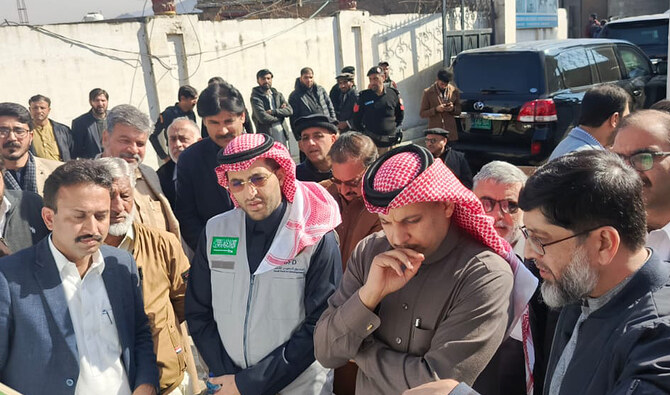
Saudi Fund for Development reviews agriculture, medical projects in northwest Pakistan

This handout photo, released by Pakistan’s Provincial Disaster Management Authority of Khyber Pakhtunkhwa, shows a delegation of Saudi Fund for Development reviewing agriculture and medical projects in Swat on January 28, 2025. (Handout/PDMA)
Short Url
Updated 30 January 2025
Follow

Saudi Fund for Development reviews agriculture, medical projects in northwest Pakistan

  • Projects include agricultural institute, veterinary and thalassemia centers and children’s hospital in Malakand
  • Visiting delegation expresses satisfaction with ongoing progress, directs timely completion of all projects

PESHAWAR: A Saudi Fund for Development (SFD) delegation visited Pakistan’s northwestern Khyber Pakhtunkhwa province on Wednesday to review their ongoing agriculture, medical and educational projects in the area, the KP government’s disaster management authority said. 
KP’s Malakand Division is known for its picturesque Swat Valley and popular tourist destinations. It has navigated a turbulent path due to militancy and conflict in recent years, coupled with the devastating effects of natural disasters like floods. 
The SFD has provided financial assistance to Pakistan and funded development projects in various parts of the country. It has already done significant work to rehabilitate infrastructure in Malakand to improve people’s access to socioeconomic services and civic amenities.
“Today a Saudi delegation led by Director of Central Asia Operations Muhammed Almasoud visited Swat and reviewed three key ongoing projects,” the Provincial Disaster Management Authority (PDMA) KP said in a statement.
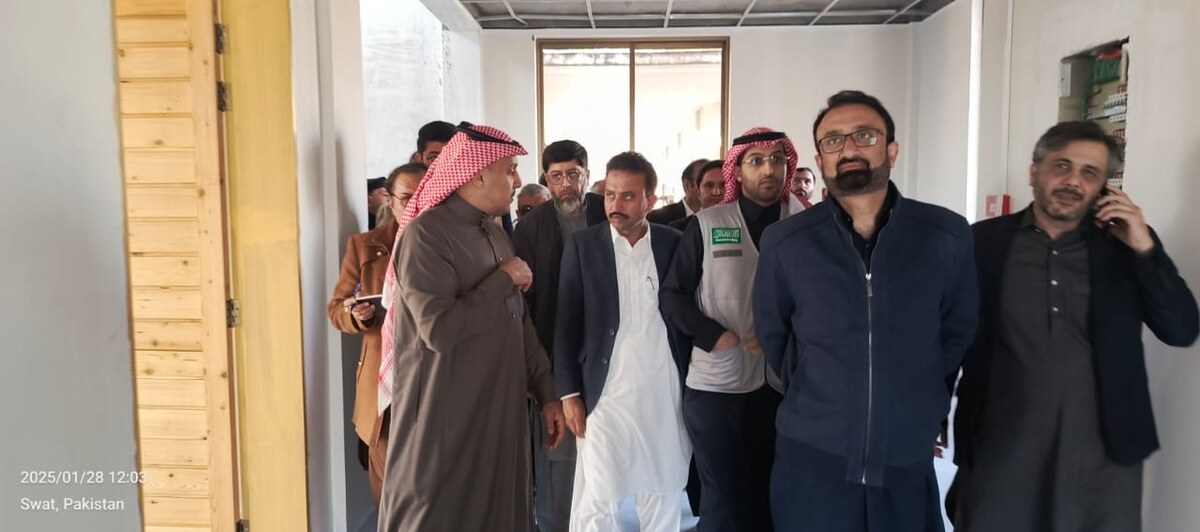


This handout photo, released by Pakistan’s Provincial Disaster Management Authority of Khyber Pakhtunkhwa, shows a delegation of Saudi Fund for Development reviewing agriculture and medical projects in Swat on January 28, 2025. (Handout/PDMA)

“The Saudi delegation expressed deep satisfaction with the construction work and instructed the timely completion of the projects.”
These projects include an Agriculture Research Institute, a Veterinary Research Center, a Category D Hospital, a Thalassemia Center in Battagram, and a Special Children’s School in Swat with a total cost of approximately $4.6 million, the statement said. 
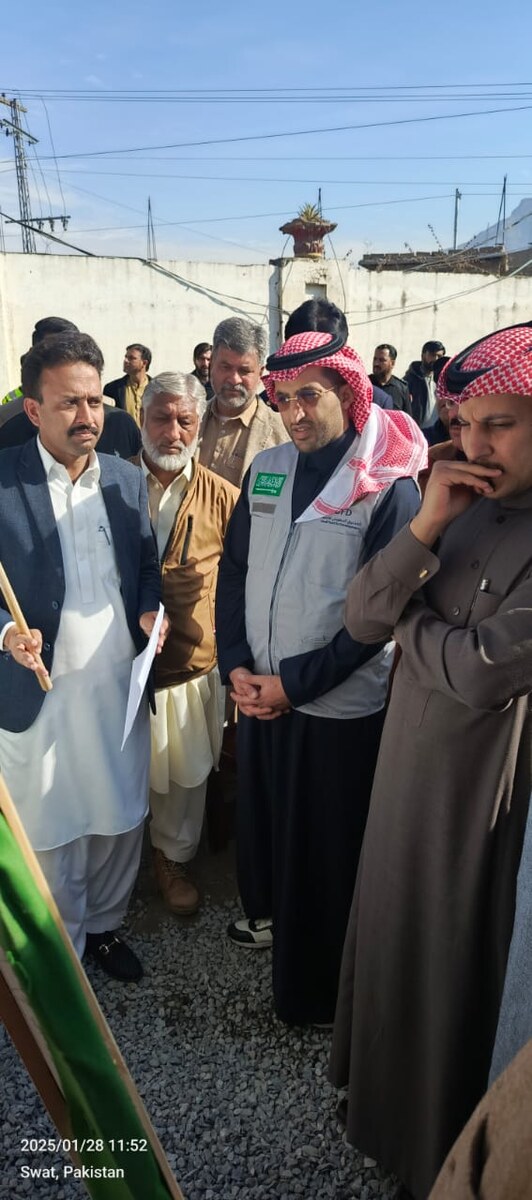


This handout photo, released by Pakistan’s Provincial Disaster Management Authority of Khyber Pakhtunkhwa, shows a delegation of Saudi Fund for Development reviewing agriculture and medical projects in Swat on January 28, 2025. (Handout/PDMA)

“Additionally, the construction of the 82-kilometer road from Chakdara to Fatehpur has been completed at a cost of Rs3.4 billion [$12.2 million] which is a significant development milestone for the area,” the KP PDMA said. 
Pakistan has sought closer economic cooperation with Saudi Arabia in recent months, with Prime Minister Shehbaz Sharif publicly stating his desire to collaborate with the Kingdom in trade, defense, economy, agriculture, tourism, energy, mining and minerals. 



This handout photo, released by Pakistan’s Provincial Disaster Management Authority of Khyber Pakhtunkhwa, shows a delegation of Saudi Fund for Development reviewing agriculture and medical projects in Swat on January 28, 2025. (Handout/PDMA)

In October last year, businesses in Pakistan and Saudi Arabia signed several agreements to the tune of $2.8 billion to promote bilateral trade and investment with each other. 
Last year in April, the Kingdom also pledged to expedite a $5 billion investment portfolio for Islamabad, further boosting foreign investment prospects in the country.


IMF Executive Board to review $1.2 billion loan disbursement for Pakistan today

Updated 4 sec ago
Follow

IMF Executive Board to review $1.2 billion loan disbursement for Pakistan today

  • Pakistan, IMF reached a Staff-Level Agreement in October for second review of $7 billion Extended Fund, climate fund program
  • Economists view IMF bailout packages as essential for cash-strapped Pakistan grappling with a prolonged macroeconomic crisis

ISLAMABAD: The Executive Board of the International Monetary Fund (IMF) is set to meet in Washington today to review a $1.2 billion loan disbursement for Pakistan, state media reported on Monday.

Pakistan and the IMF reached a Staff-Level Agreement (SLA) in October for the second review of a $7 billion Extended Fund Facility (EFF) and the first review of its $1.4 billion Resilience and Sustainability Facility (RSF). 

The agreement between the two sides took place after an IMF mission, led by the international lender’s representative Iva Petrova, held discussions with Pakistani authorities during a Sept. 24–Oct. 8 visit to Karachi, Islamabad and Washington D.C.

“The International Monetary Fund’s (IMF) Executive Board is set to meet in Washington today to review and approve $1.2 billion in loan for Pakistan,” state broadcaster Pakistan TV reported. 

Pakistan has been grappling with a prolonged macroeconomic crisis that has drained its financial resources and triggered a balance of payments crisis for the past couple of years. Islamabad, however, has reported some financial gains since 2022, which include recording a surplus in its current account and bringing inflation down considerably.

Economists view the IMF’s bailout packages as crucial for cash-strapped Pakistan, which has relied heavily on financing from bilateral partners such as Saudi Arabia, China and the United Arab Emirates, as well as multilateral lenders including the IMF, World Bank, Asian Development Bank and Islamic Development Bank. 

Speaking to Arab News last month, Pakistan’s former finance adviser Khaqan Najeeb said the $1.2 billion disbursement will further stabilize Pakistan’s near-term external position and unlock additional official inflows.

“Continued engagement also reinforces macro stability, as reflected in recent improvements in inflation, the current account, and reserve buffers,” Najeeb said.

Pakistan came close to sovereign default in mid-2023, when foreign exchange reserves fell below three weeks of import cover, inflation surged to a record 38% in May, and the country struggled to secure external financing after delays in its IMF program. Fuel shortages, import restrictions, and a rapidly depreciating rupee added to the pressure, while ratings agencies downgraded Pakistan’s debt and warned of heightened default risk.

The crisis eased only after Pakistan reached a last-minute Stand-By Arrangement with the IMF in June 2023, unlocking emergency support and preventing an immediate default.