

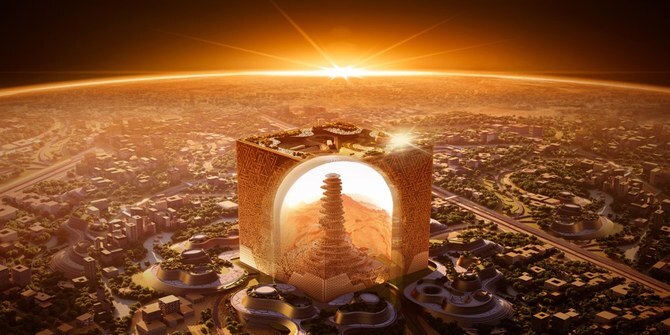

RIYADH: Saudi Arabia is set to build the “most complex structure known to man” as part of a major architectural project within the New Murabba development, according to the head of the company behind the project
Positioned at the heart of the large-scale urban project, the Mukaab is designed to be a futuristic mixed-use landmark that will contribute to Riyadh’s evolving skyline.
In a panel discussion during the Real Estate Future Forum, Michael Dyke, CEO of New Murabba Development Co., described the ambitious scale and vision of the building which is being developed under the patronage of the Crown Prince Mohammed bin Salman.
“Mukkab is a structure, it will be pound for pound, I think the world’s most complex structure ever created known to man or woman in the history of time,” said Dyke.
“We have a structure which is 400 meters by 400 meters above the ground. We’re talking about a structure which will look at more than 1,000 meters above sea level,” he said.
While much of the focus is on the Mukaab’s above-ground presence, Dyke began dissecting the project by emphasizing the vast underground development.
“Below the ground is enormous as well. It’s a complete cavernous labyrinth of various different asset classes,” he explained, adding: “One example, the retail under Mukaab and around Mukaab is the size of Dubai Mall today and will be capable of extending to be bigger. So that’s just a small example of what you don’t see because it’s under the ground.”
The design is set to feature multiple skyscrapers within the structure.
“We will have something like two to three Empire State Buildings on each corner, which anchor the four corners of Mukaab,” said Dyke, adding: “We will have a dome which will be something in the order of about 360,000 sq. meters, which will be 380 meters high by 340 meters in diameter inside what effectively is the equivalent of Empire State Buildings.”
At the center of the Mukaab, a tower will stand as a unique architectural feat, which, according to Dykye, “will be the only skyscraper in the world that lives inside another building, which will be an equivalent size of the Eiffel Tower, but will be fully inhabited.”
There will be 27,000 people moving around the lower levels of the tower at any point in time. The structure will also feature “the world’s largest roof on the top at 16 hectares, which will be a fully living space.”
Additionally, the Mukaab’s design incorporates Riyadh’s architectural heritage with a fully activated Najdi facade, he said, adding that it is “the most beautiful Najdi facade that reflects the architectural history of the Kingdom.”
Dyke believes the structure will offer an immersive experience unlike any other, saying: “When you are inside the dome, you will be transported to other worlds. The worlds will change frequently, and you will not be able to see the dome when you’re inside it because we’re creating that.”
He explained that the project incorporates advanced technological layers to create an immersive experience, with applications in hospitality, retail, and entertainment.
In a separate panel, Marco Macagnano, head of Digital Real Estate Canada at Deloitte, highlighted the importance of innovation in real estate, emphasizing that modern developments should go beyond static assets.
“It means additional capital to the bottom line innovation products, and it also importantly provokes a new approach to real estate, where we’re not just maintaining or stabilizing our assets, but we’re investing in constant improvement— buildings that upgrade, not just flexible, but upgradable buildings that can automatically turn on new features with a software update, as opposed to installing new systems,” he said.
This perspective aligns with the vision behind Riyadh’s Mukaab, which aims to integrate latest technology and flexible infrastructure.
Macagnano further pointed out that large-scale projects, when designed with a systems-thinking approach, have the potential to redefine business and economic environments.
“The bold approaches to massive investments in infrastructure, big projects that can think about the ecosystem as a whole put Saudi Arabia in an incredible position to differentiate,” he said.
He emphasized that new developments should not be constrained by outdated infrastructure but instead be designed for future adaptability.
Beyond its architectural complexity, Dyke highlighted the economic and social impact of New Murabba as a whole.
“The economic stimulus that New Murabba will create upon full completion, when all three phases are built out, we’re talking about 400,000 people living in New Murabba. We’re talking about tens of millions of people visiting Mukaab every year. And we’re talking about a whole economy that will not be separate from Riyadh,” he said.
A key element of the development is the introduction of higher-density living in Riyadh. “New Murabba will have a characteristic of mid and high-level living,” Dyke noted.
“That’s one thing which creates an opportunity, which creates this livability aspect, and above and beyond that, the density of people within New Murabba will be in the order of 20,000 people per sq. km, compared to 4,000 today,” Dyke added.


