- Delegation interested in key sectors like mining and minerals, renewable energy, infrastructure development, and technology
- Despite the challenging investment climate, the United States is one of Pakistan’s largest sources of foreign direct investment
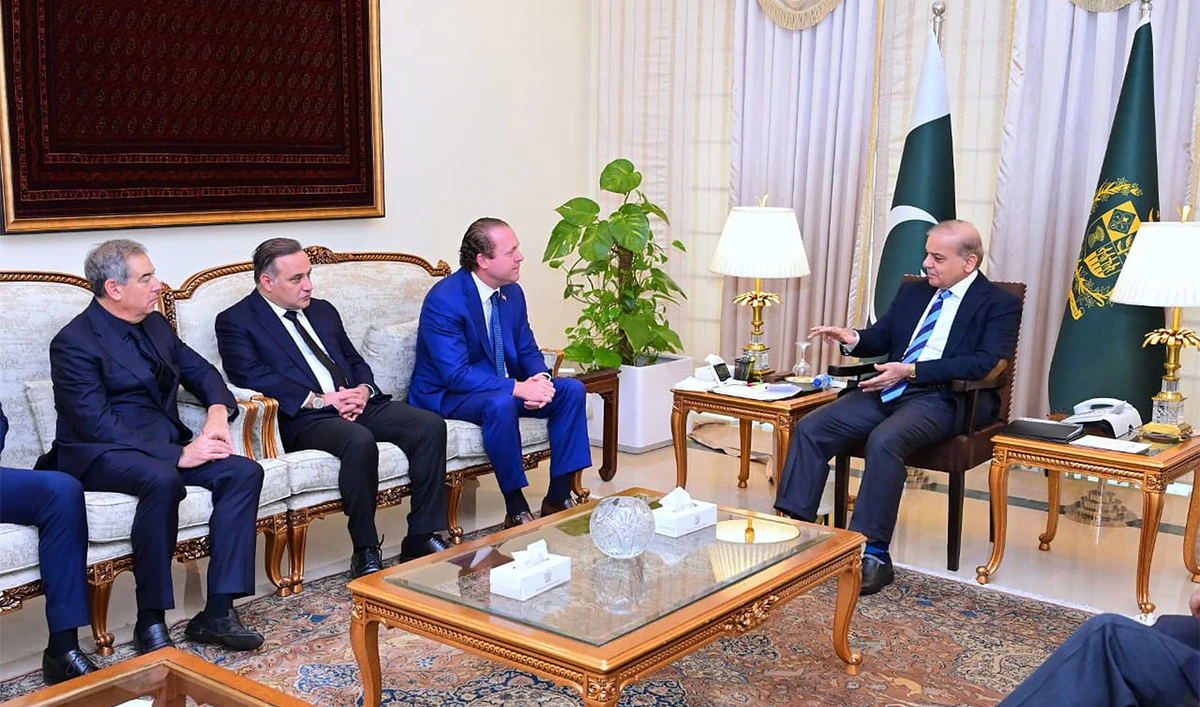
ISLAMABAD: A high-level American business delegation led by a close associate of the family of US President Donald Trump called on Pakistani Prime Minister Shehbaz Sharif on Tuesday, as Islamabad seeks to attract investments to shore up its $350 billion economy.
The delegation, led by Texas hedge fund manager Gentry Beach, arrived for a two-day visit on Monday to explore business opportunities in Pakistan, particularly in sectors like mining and minerals, renewable energy, infrastructure development and technology.
“During the meeting, the Prime Minister reaffirmed the government’s unwavering commitment to facilitating foreign investors by ensuring a conducive business environment, streamlined processes, and robust institutional support,” Sharif’s office said in a statement.
“Highlighting Pakistan’s strategic geographical location, a skilled and youthful workforce, and a rapidly expanding consumer market, the Prime Minister underscored the country’s unique appeal as a global investment destination.”
The statement also quoted Beach as acknowledging the Pakistan government’s “pro-investment policies” and expressing confidence in the nation’s future growth trajectory.
“This high-level engagement reflects the government’s proactive efforts to attract foreign direct investment, foster sustainable economic growth, and generate employment opportunities for the people of Pakistan,” the statement concluded.
Pakistan in 2023 nearly defaulted on the payment of foreign debts when the International Monetary Fund rescued it by agreeing to a $3 billion bailout to Pakistan. Last year, Islamabad secured a new $7 billion loan deal from the IMF. Since then, the country’s economy has started improving with weekly inflation coming down from 27 percent in 2023 to 1.8 percent earlier this month.
Sharif has also vowed to reduce dependence on foreign loans in the coming years and seek more direct investment.
Pakistan’s business and investment landscape poses considerable challenges. Complex and inconsistent regulations, inadequate protection of intellectual property rights, and ever-changing taxation policies are some of the many business climate challenges cited by investors. Security concerns marked by internal and regional conflicts also undermine investor confidence in protection and profitability of their investments. The Pakistani government launched the Special Investment Facilitation Council (SIFC) in June 2023 to attract foreign investment from allies and other nations. Since its creation, the SIFC’s scope has expanded into a wide range of policy areas.
Despite the challenging investment climate, the United States is one of Pakistan’s largest sources of FDI. US companies have profitable operations across a range of sectors, notably franchise operations, fast-moving consumer goods, agribusiness, and financial services. Other sectors attracting US interest include ICT, renewable energy and health care services.
The Karachi-based American Business Council, a local affiliate of the US Chamber of Commerce, has more than 60 US member companies, most of which are Fortune 500 companies and span a wide range of sectors. The Lahore-based American Business Forum has 23 founding members and 22 associate members. The US-Pakistan Business Council, a division of the US Chamber of Commerce, also supports US-based companies that do business with Pakistan.
In February 2023, the United States and Pakistan concluded the ninth meeting under the US–Pakistan Trade and Investment Framework and first ministerial-level meetings since 2016.