


PARIS: France waged a war marked by “extreme violence” during Cameroon’s fight for independence in the late 1950s, historians said in the latest officially commissioned study grappling with Paris’s colonial past released on Tuesday.
The historians found that Paris implemented mass forced displacement, pushed hundreds of thousands of Cameroonians into internment camps and supported brutal militias to squash the central African country’s push for sovereignty.
The historical commission, whose creation was announced by President Emmanuel Macron during a 2022 trip to Yaounde, examined France’s role leading up to when Cameroon gained independence from France on January 1, 1960 and the following years.

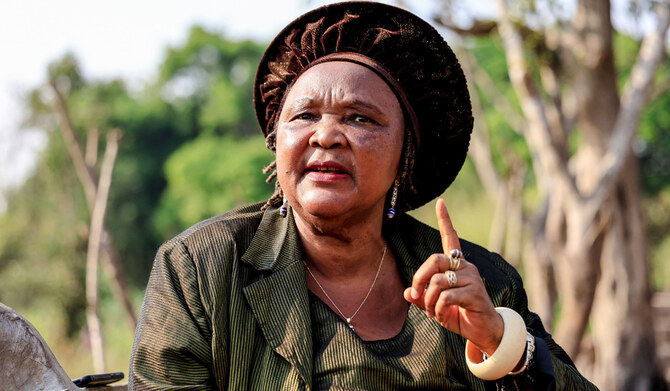
History professor Emmanuel Tchumtchoua poses for a portrait next to a martyrs' wall in the village of Bahouan, in Bafoussam, on January 25, 2025. (AFP)
Composed of both French and Cameroonian historians, the 14-person committee looked into France’s role in the country between 1945 and 1971 based on declassified archives, eyewitness accounts and field surveys.
Most of Cameroon came under French rule in 1918 after its previous colonial ruler, Germany, was defeated during World War I.
But a brutal conflict unfolded when the country began pushing for its independence following World War II, a move France violently repressed, according to the report’s findings.
Between 1956 and 1961, France’s fight against Cameroonian independence claimed “tens of thousands of lives” and left hundreds of thousands displaced, the historians said.
“It is undeniable that this violence was extreme because it violated human rights and the laws of war,” it said.
For many in France, the war in Cameroon went unnoticed because it mainly involved troops from colonies in Africa and was overshadowed by the French fight in Algeria’s 1954-1962 war of independence.
“But this invisibility should not create an illusion. France was indeed waging war in Cameroon,” the report said.
The formerly British Cameroons to the south gained independence from the United Kingdom in 1961 and became part of the newly independent state.
While the study aims to fill France’s “memory gap” on this period, for Cameroonians, “the profound trauma linked to repression remains,” it said.
The report comes as France has seen its influence wane among its former African colonies, which are reevaluating — and sometimes severing — their ties with Paris.
Even after Cameroon gained independence in 1960, Paris remained deeply involved in its governance, working closely with the “authoritarian and autocratic” regime of Ahmadou Ahidjo, who stayed in power until 1982.
France helped draft Cameroon’s post-independence constitution and defense agreements allowed French troops to “maintain order” in the newly independent state.
Ahidjo’s successor, current President Paul Biya, 91, in office since 1982, is only the second president in Cameroon’s history.
Receiving the report in Yaounde on Tuesday, Biya called it a “work of collective therapy” that would encourage the peoples of both countries to better accept their past relationship.
Ahead of its publication, former anti-colonial fighter Mathieu Njassep had told AFP he wanted France to admit to wrongdoing.
“If France does not recognize it was wrong, we won’t be able to forgive it,” said the 86-year-old who fought against Ahidjo’s government from 1960 and was thrown in jail for 14 years for “armed rebellion.”
Macron has taken tentative steps to come to terms with once-taboo aspects of the country’s historical record, though many argue he has not gone far enough.
A 2021 report concluded France bore “overwhelming responsibilities” in the 1994 Rwandan genocide, and a 2020 review examining France’s actions during Algeria’s war of independence called for a “truth commission” and other conciliatory actions.
But Macron has ruled out an official apology for torture and other abuses carried out by French troops in Algeria.
France is now reconfiguring its military presence in Africa after being driven out of three countries in the Sahel governed by juntas hostile to Paris — Mali, Burkina Faso and Niger.
And Chad accused Macron of showing contempt after he said African leaders had “forgotten to say thank you” to France for helping to combat jihadist insurgencies in the Sahel.
Last week Macron said he was committed to “continuing the work of remembrance and truth initiated with Cameroon” after receiving the report.


