PARIS: French President Emmanuel Macron announced Tuesday that the “Mona Lisa” will get its own dedicated room inside the Louvre Museum under a major renovation and expansion of the Paris landmark that will take up to a decade.
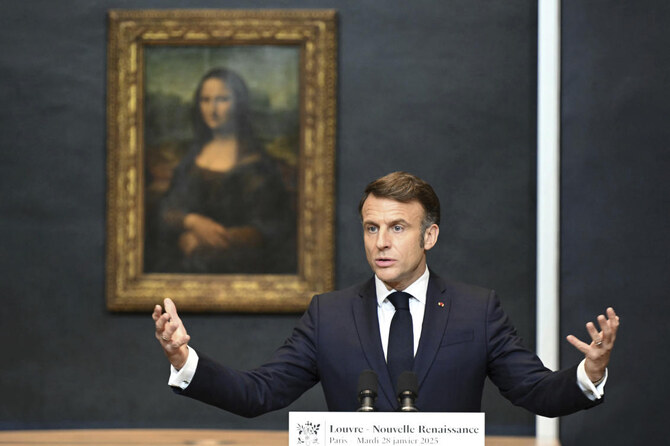
The renovation project, branded “Louvre New Renaissance,” will include a wide new entrance near the Seine River, to be opened by 2031, Macron said in a speech from the room where Leonardo da Vinci’s masterpiece is displayed.
Macron didn’t disclose an exact amount budgeted for the project to modernize the world’s most visited museum, which is plagued with overcrowding and outdated facilities. But it’s estimated to reach up to 800 million euros ($834 million).
The Louvre’s last overhaul dates back to the 1980s, when the iconic glass pyramid was unveiled.
Move designed to make Louvre experience easier
Macron said the expansion of the museum will allow the “Mona Lisa” to be moved to a new, dedicated room accessible to visitors through a special ticket. That will make the visit simpler for those who want to see the painting and ease the experience of other visitors in the rest of the museum, he said.
“Conditions of display, explanation and presentation will be up to what the ‘Mona Lisa’ deserves,” he said.
Leonardo’s masterpiece is now being shown behind protective glass in the museum’s largest room, overcrowded with long, noisy lines of visitors eager to take a selfie with the groundbreaking portrait of the woman with the enigmatic smile. That makes some other paintings in the room by Venetian painters like Titian and Veronese go unnoticed by many.
The museum’s big renovation in the 1980s was designed to receive 4 million annual visitors.
Last year, the Louvre received 8.7 million visitors, more than 75 percent being foreigners mostly from the United States, China and neighboring countries Italy, the UK, Germany and Spain.
Costly and complex overhaul
Macron said that a new entrance for the Louvre will be created near the Seine by 2031, to be financed by ticket sales, patronage and licensing money from the museum’s Abu Dhabi branch.
A design competition will be staged in the coming months, he said. In addition, some new underground rooms will be created to expand the museum.
A French top official said that the cost of the renovation is estimated at 700 to 800 million euros ($730 to 834 million) over the next decade, including half for the creation of the new entrance. The official couldn’t be named in line with the French presidency’s customary practices.
Macron said that ticket prices would be raised for foreign visitors from outside the European Union, up from 22 euros ($23) now. He promised the museum would be safer and more comfortable for both the public and employees.
Comparing the project to Notre Dame’s recent reopening, Macron said that “the redesigned Louvre, restored and expanded, will become the epicenter of art history for our country and beyond.”
Half the Louvre’s budget is being financed by the French government, including the wages of the 2,200 employees.
The other half is provided by private funds including ticket sales, earnings from restaurants, shops and bookings for special events, as well as patrons and other partners.
Water leaks and other damage
The renovation announcement came after Louvre Director Laurence des Cars expressed her concerns in a note to Culture Minister Rachida Dati earlier this month saying that the museum is threatened by “obsolescence.”
According to the document first released by French newspaper Le Parisien, she warned about the gradual degradation of the building because of water leaks, temperature variations and other issues “endangering the preservation of artworks.”
The pyramid that serves at the museum’s entrance, unveiled in 1989 as part of late President François Mitterrand’s project, now appears outdated. The place isn’t properly insulated from the cold and the heat, and it tends to amplify noise, making the space uncomfortable for both the public and the staff, des Cars said.
In addition, the museum suffers from a lack of food options and restroom facilities, she said.


![]()

‘Mona Lisa’ will get its own room under a major renovation of the Louvre
Short Url
https://arab.news/vmq9x
‘Mona Lisa’ will get its own room under a major renovation of the Louvre
- The renovation project, branded “Louvre New Renaissance,” will include a wide new entrance near the Seine River, to be opened by 2031, Macron said
- Macron said the expansion of the museum will allow the “Mona Lisa” to be moved to a new, dedicated room accessible to visitors through a special ticket


Latest updates


© 2026 SAUDI RESEARCH & PUBLISHING COMPANY, All Rights Reserved And subject to Terms of Use Agreement.