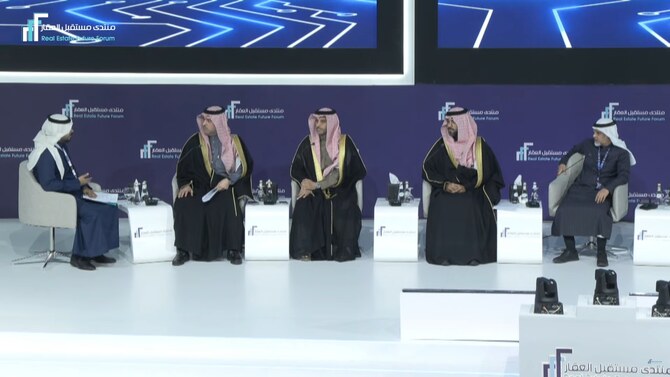

RIYADH: Saudi Arabia is accelerating its real estate and infrastructure development efforts to meet growing demand and improve the quality of life in key regions, including Asir and Makkah, according to top officials.
These initiatives, in line with Vision 2030, aim to boost tourism, attract investments, and improve livability for residents and visitors.
During a panel at the Real Estate Future Forum in Riyadh, Abdullah Al-Jali and Musad Al-Daood, mayors of the Asir region and Makkah, respectively, outlined their municipalities’ strategies to address these objectives.
Al-Jali emphasized the untapped potential in the Asir region’s real estate market, saying: “Currently, 90 percent of the real estate market is concentrated in Riyadh, Jeddah, and other major cities, leaving the remaining regions with just 10 percent of the market share.”
He added: “What we are witnessing today is a growing opportunity driven by the increasing demand for tourism in the Asir region.
“This surge in demand is putting significant pressure on the real estate market, both now and for the future.”
The Asir region mayor stressed the need to attract more investments over the next few years to meet this rising demand.
Highlighting the municipality’s role, Al-Jali underlined its efforts to facilitate infrastructure and real estate development.
“As a municipality, we act as the main enabler for infrastructure development. We provide approvals for real estate investments, construction plans, and land use while also overseeing route clustering and road development,” he explained.
To support the region’s real estate goals, Al-Jali invited investors to explore opportunities in Asir.
“We can facilitate your investment and enable you from the very first phase,” he said, pointing to mixed-use projects in the pipeline and housing developments aimed at both locals and international buyers seeking summer homes.
Al-Jali also addressed broader challenges, such as waste management and visual distortion, calling for greater collaboration.
“Managing visual distortion is not an easy objective to achieve, and Riyadh is currently ahead of us in that regard,” he said.
He urged citizens and stakeholders to support waste management efforts, emphasizing that maintaining public spaces should be treated as a collective responsibility.
Makkah’s mayor Al-Daood highlighted the unique challenges and opportunities facing the holy city, which hosts millions of religious tourists annually.
“We are focused on developing the infrastructure of Holy Makkah and equipping the city with the necessary facilities to support its unique religious significance as it welcomes millions of religious tourists from around the world,” he said.
“We have directives from his royal highness, the crown prince, to combat visual distortion and enhance the cleanliness of the city, particularly in Makkah, to align with our new strategy,” he added.
Al-Daood emphasized the importance of having a framework to meet the demands of Makkah’s 1.5 million annual pilgrims during the peak season.
“We continuously plan ahead to address the growing demand and ensure the effective management of the large masses of visitors. This involves increasing our planning efforts and working closely with our partners and stakeholders,” he explained.
In addition to its religious role, Al-Daood noted that Makkah is home to 2 million residents, necessitating investment in healthcare and entertainment infrastructure.
“With 2 million citizens living in the city, it is essential to provide facilities for entertainment as well. Yes, Makkah has a strong religious identity that prevails, but that does not mean our citizens do not deserve a great quality of life,” he said.