

Experts highlight real estate financing, foreign investment at Saudi forum

Short Url
Updated 28 January 2025
Follow

Experts highlight real estate financing, foreign investment at Saudi forum

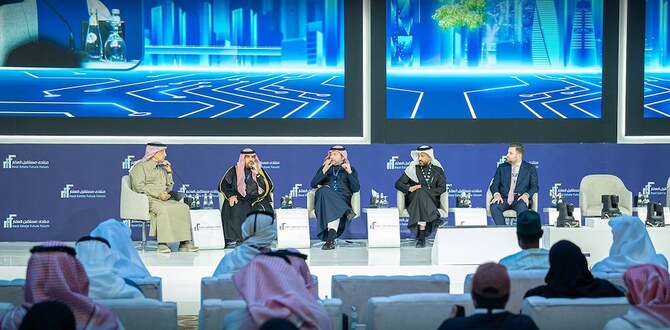
RIYADH: Experts at the Real Estate Future Forum emphasized the evolving landscape of property financing in Saudi Arabia, pointing to strong bank portfolios, public-private partnership opportunities, and a focus on foreign investment.

The Managing Director and Partner at Watheeq Financial Services, Ibrahim Al-Alwan, highlighted the rising significance of property financing for financial institutions: “Today, we see that banks’ portfolios in real estate financing are very high. The process involves regulation, management, and the implementation of effective tools for investment and financing.”

Joe Jabbour, managing director and partner at Boston Consulting Group, underlined the vast potential for PPPs, particularly in utilities, social, and civil infrastructure, facilitated by government offtake agreements.

“I must say that most of the investments that are being structured and are being prepared for the market, have the foreign investors in mind,” Jabbour said. 

On its second day, the forum explores the key trends shaping Saudi Arabia’s real estate sector as it advances toward Vision 2030 goals.

The inaugural day included industry leaders, policymakers, and investors who discussed the Kingdom’s ongoing focus on property development, investment strategies, and tourism expansion.

Governor of Asir Region Prince Turki bin Talal said during a panel that the Public Investment Fund has nine projects in development, with four already launched and five underway in the region. 

The governor also said that Asir has between 6,000 and 8,000 approved and licensed hotel rooms. In line with this momentum, he also announced that the Ministry of Sports has officially recognized Abha’s World Cup bid as the best in the Kingdom.

A key highlight from the first day was the Capital Market Authority’s announcement permitting foreign investment in Saudi-listed companies that own real estate in Makkah and Madinah.

“On behalf of the CMA, we congratulate these companies,” CMA’s Chairman Mohammed El-Kuwaiz said.

The Real Estate Future Forum, taking place from Jan. 27 to 29 at the Four Seasons Hotel in Riyadh, serves as a global platform for shaping the industry’s future. Uniting over 300 speakers from 85 countries, the event explores innovations, sustainability initiatives, and investment strategies under the theme “Future for Humanity: Shaping Dreams into Reality.”

The upcoming event days are set to provide an outlook on integrating advanced technologies into the real estate sector, with panels diving into emerging trends like virtual reality for property marketing, the role of the metaverse in digital real estate, and the use of robotics and 3D printing in construction.


PIF’s Humain invests $3bn in Elon Musk’s xAI prior to SpaceX acquisition

Updated 18 February 2026
Follow

PIF’s Humain invests $3bn in Elon Musk’s xAI prior to SpaceX acquisition

JEDDAH: Humain, an artificial intelligence company owned by Saudi Arabia’s Public Investment Fund, invested $3 billion in Elon Musk’s xAI shortly before the startup was acquired by SpaceX.

As part of xAI’s Series E round, Humain acquired a significant minority stake in the company, which was subsequently converted into shares of SpaceX, according to a press release.

The transaction reflects PIF’s broader push to position Saudi Arabia as a central hub in the global AI ecosystem, as part of its Vision 2030 diversification strategy.

Through Humain, the fund is seeking to combine capital deployment with infrastructure buildout, partnerships with leading technology firms, and domestic capacity development to reduce reliance on oil revenues and expand into advanced industries.

The $3 billion commitment offers potential for long-term capital gains while reinforcing the company’s role as a strategic, scaled investor in transformative technologies.

CEO Tareq Amin said: “This investment reflects Humain’s conviction in transformational AI and our ability to deploy meaningful capital behind exceptional opportunities where long-term vision, technical excellence, and execution converge, xAI’s trajectory, further strengthened by its acquisition by SpaceX, one of the largest technology mergers on record, represents the kind of high-impact platform we seek to support with significant capital.” 

The deal builds on a large-scale collaboration announced in November at the US-Saudi Investment Forum, where Humain and xAI committed to developing over 500 megawatts of next-generation AI data center and computing infrastructure, alongside deploying xAI’s “Grok” models in the Kingdom.

In a post on his X handle, Amin said: “I’m proud to share that Humain has invested $3 billion into xAI’s Series E round, just prior to its historic acquisition by SpaceX. Through this transaction, Humain became a significant minority shareholder in xAI.”

He added: “The investment builds on our previously announced 500MW AI infrastructure partnership with xAI in Saudi Arabia, reinforcing Humain’s role as both a strategic development partner and a scaled global investor in frontier AI.”

He noted that xAI’s trajectory, further strengthened by SpaceX’s acquisition, exemplifies the high-impact platforms Humain aims to support through strategic investments.

Earlier in February, SpaceX completed the acquisition of xAI, reflecting Elon Musk’s strategy to integrate AI with space exploration.

The combined entity, valued at $1.25 trillion, aims to build a vertically integrated innovation ecosystem spanning AI, space launch technology, and satellite internet, as well as direct-to-device communications and real-time information platforms, according to Bloomberg.

Humain, founded in August, consolidates Saudi Arabia’s AI initiatives under a single entity. From the outset, its vision has extended beyond domestic markets, participating across the global AI value chain from infrastructure to applications.

The company represents a strategic initiative by PIF to diversify the Kingdom’s economy and reduce oil dependence by investing in knowledge-based and advanced technologies.