

Pakistan calls on Sudan’s warring parties to engage, work to end humanitarian crisis

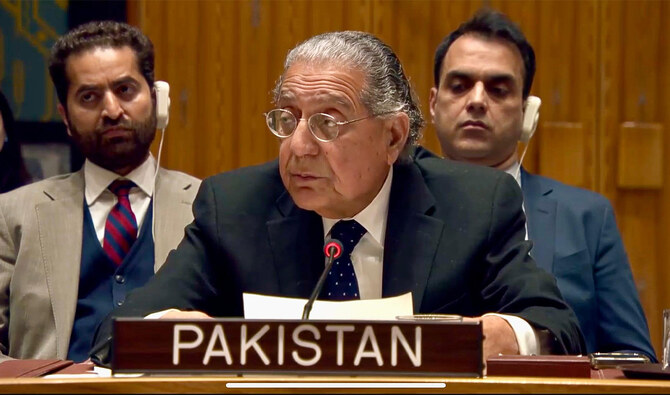
Pakistan’s permanent representative to the United Nations, Ambassador Munir Akram, addresses UN Security Council in New York, US, on January 27, 2025. (@PakistanUN_NY/X)
Short Url
Updated 28 January 2025
Follow

Pakistan calls on Sudan’s warring parties to engage, work to end humanitarian crisis

  • War between Sudan’s army and Rapid Support Forces broke out in 2023 due to disputes over integration of two forces
  • Conflict has displaced more than 12 million people and plunged half the population of nearly 49 million people into hunger

ISLAMABAD: Ambassador Munir Akram, Pakistan’s permanent representative to the United Nations, has called on Sudan’s warring parties to re-engage in negotiations to end a 21-month-long war that has killed tens of thousands, driven millions from their homes and plunged half of the population into hunger.

The war between Sudan’s army and the Rapid Support Forces (RSF) broke out in April 2023 due to disputes over the integration of the two forces. The war has displaced more than 12 million people, while plunging half the population of 49 million people into hunger, for which both the RSF and army are blamed.

“We call on both sides to implement the commitments made under Jeddah declaration on protection of civilians and the facilitation of humanitarian action to meet the emergency needs of the Sudanese people,” Akram said in a speech to the UN Security Council.

The Pakistani envoy spoke after the prosecutor of the International Criminal Court (ICC), Karim Khan, briefed the 15-member council on the deteriorating situation in Sudan’s Darfur region on Monday.

“The blatant violations of international humanitarian law with impunity must stop, and the suffering of the Sudanese people brought to an end,” Akram said. “The Sudanese people have seen unimaginable atrocities during the nearly two years of the recent conflict.”

He extended Pakistan’s condolences to the victims and their families of a RSF drone attack on a Saudi hospital last week in which at least 70 people were killed.

“Pakistan firmly upholds the unity, sovereignty and territorial integrity of Sudan,” Akram added. “We call for an immediate and unconditional ceasefire … The parties need to find a sustainable political resolution through peaceful means. The humanitarian crisis in the country needs to be addressed.”

Akram said although Pakistan was not a party to the Rome Treaty establishing the ICC, it was committed to the objective of accountability for international crimes, whether they were committed in Darfur, Gaza, Afghanistan, or elsewhere.

“The ICC can gain global credibility if it displays full objectivity and impartiality in the cases and persons it decides to investigate and prosecute,” he said. “Some jurisdictions have so far been immune from prosecution for widely reported crimes, including those committed in situations of foreign occupation and intervention.”


Pakistan bank enables Shariah-compliant digital payment facility for passengers at Islamabad airport

Updated 23 February 2026
Follow

Pakistan bank enables Shariah-compliant digital payment facility for passengers at Islamabad airport

  • Pakistan is a cash-dominated market where a significant portion of transactions in the informal sector are made without any taxes, officials say
  • The move comes amid Pakistan’s efforts to introduce a cashless model at airports under which only digital service providers can provide services

KARACHI: Aik, Pakistan’s first Islamic digital bank, has enabled fully digital payments at Islamabad International Airport to offer travelers and passengers secure, Shariah compliant digital transaction facility.

The development comes amid Pakistan’s efforts to introduce a cashless model at airports across the country, under which only digital service providers can provide services to customers.

Aik, a subsidiary of Bank Islami, said it has onboarded merchants across the Islamabad airport and integrated QR code deployments at key touchpoints to allow passengers and visitors to make secure, seamless, and Shariah-compliant digital transactions at all counters, retail outlets, and service points.

It said the implementation complies with the regulations and framework set by the State Bank of Pakistan (SBP) and is a working model for a large-scale adoption of cashless systems in public infrastructure.

“This deployment reflects our commitment to building practical digital infrastructure that improves everyday transactions,” Aik Chief Officer Ashfaque Ahmed said in a statement.

“By enabling a fully cashless environment at a major national gateway, we are supporting efficiency, transparency, and financial inclusion at scale. This is not only a project; it is a foundation for Pakistan’s cashless future.”

Pakistan is a cash-dominated market where a significant portion of transactions, particularly in the informal sector, are conducted in cash. Officials say many of these transactions are aimed at avoiding taxes.

In recent years, the SBP has taken steps to ensure a transition toward a more cashless economy so that transactions are more traceable, reducing chances of tax evasion and corruption.

By digitizing Islamabad airport, aik said it continues to invest in secure and accessible financial solutions that “expand digital participation and support national economic modernization.”