BEIJING/NEW DELHI: India and China have agreed to resume direct air services after nearly five years, India’s foreign ministry said on Monday, signalling a thaw in relations between the neighbors after a deadly 2020 military clash on their disputed Himalayan border.
Both sides will negotiate a framework on the flights in a meeting that will be held at “early date,” the ministry said after a meeting between India’s top diplomat and his Chinese counterpart.
Tensions soured between the two nations after the 2020 clash, following which India made it difficult for Chinese companies to invest in the country, banned hundreds of popular apps and severed passenger routes, although direct cargo flights continued to operate between the countries.
Relations have improved over the past four months with several high-level meetings, including talks between Chinese President Xi Jinping and Indian Prime Minister Narendra Modi in Russia in October.
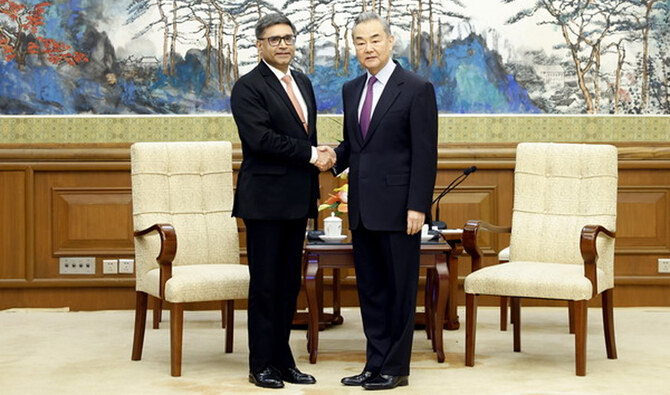
On Monday, Chinese Foreign Minister Wang Yi told Indian Foreign Secretary Vikram Misri in Beijing that the two countries should work in the same direction, explore more substantive measures and commit to mutual understanding.
“Specific concerns in the economic and trade areas were discussed with a view to resolving these issues and promoting long-term policy transparency and predictability,” the Indian foreign ministry statement said in a statement.
Their meeting was the latest between the two Asian powers following a milestone agreement in October seeking to ease friction along their frontier.
Reuters reported in June that China’s government and airlines had asked India’s civil aviation authorities to re-establish direct air links, but New Delhi resisted as the border dispute continued to weigh on ties.
In October, two Indian government sources told Reuters that India would consider reopening the skies and launch fast-tracking visa approvals.
Both nations have also agreed to resume dialogue for functional exchanges step by step and with an early meeting of the India-China Expert Level Mechanism, India’s foreign ministry said.
China and India should commit to “mutual support and mutual achievement” rather than “suspicion” and “alienation,” Wang said during the two officials’ meeting, according to the Chinese foreign ministry’s readout.


![]()

India and China agree to resume air travel after nearly five years
Short Url
https://arab.news/rbv6g
India and China agree to resume air travel after nearly five years
- Tensions soured between the two nations after a 2020 border clash, following which India made it difficult for Chinese companies to invest in the country
- Relations have improved over the past four months with several high-level meetings, including talks between President Xi Jinping and Indian PM Modi in Russia
Latest updates





© 2026 SAUDI RESEARCH & PUBLISHING COMPANY, All Rights Reserved And subject to Terms of Use Agreement.