

Saudi aid provides relief to thousands in Syria, Gaza

1 / 4
These efforts, coordinated with the Syrian Arab Red Crescent, are part of Saudi Arabia’s commitment to alleviating the suffering of the Syrian people. (SPA)
2 / 4
These efforts, coordinated with the Syrian Arab Red Crescent, are part of Saudi Arabia’s commitment to alleviating the suffering of the Syrian people. (SPA)
3 / 4
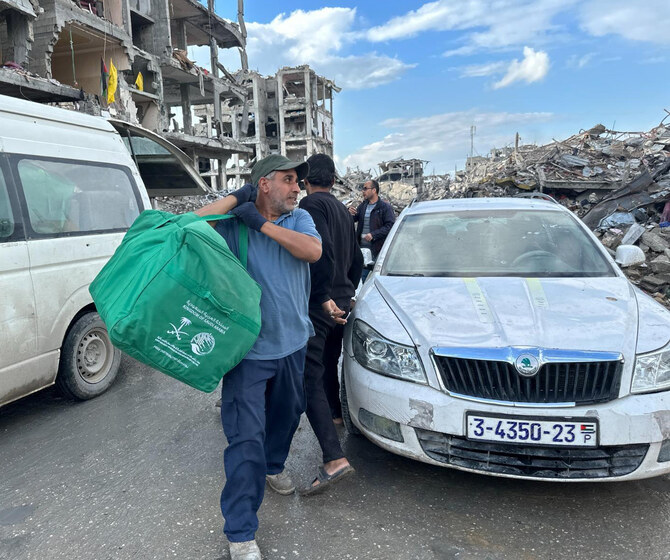
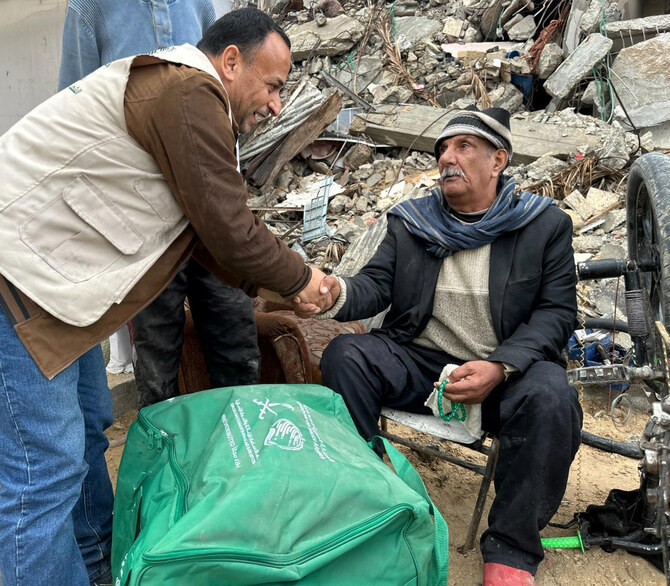
In the northern Gaza Strip, KSrelief continues to provide assistance in Jabalia to support returning residents, alleviate their suffering, and meet essential needs. (SPA)
4 / 4
In the northern Gaza Strip, KSrelief continues to provide assistance in Jabalia to support returning residents, alleviate their suffering, and meet essential needs. (SPA)
Short Url
Updated 27 January 2025
Follow

Saudi aid provides relief to thousands in Syria, Gaza

  • Ongoing support offers food, shelter and medical supplies to those affected by conflict

RIYADH: Saudi aid agency KSrelief has continued to provide aid to the people of Syria as part of various humanitarian missions.

On Monday, a relief plane — the 14th so far — arrived in Damascus from Riyadh, carrying food, shelter and medical supplies for those facing challenging conditions, reported the Saudi Press Agency.

In Harasta town, Rural Damascus governorate, KSrelief distributed 399 bags of flour, blankets and personal care kits, benefiting 532 people.

The Saudi aid agency also distributed shopping vouchers to 56 beneficiaries in Jindires town, Aleppo governorate, enabling them to purchase winter clothing from designated stores.

In Talbiseh town, Homs governorate, KSrelief distributed 327 food baskets, winter kits and personal care kits for 529 people.

These efforts, in coordination with the Syrian Arab Red Crescent, are part of Saudi Arabia’s commitment to alleviating the suffering of the Syrian people.

According to KSrelief, Saudi Arabia’s total aid to Syria from 2011 to the end of 2024 exceeds $856 million.

Meanwhile, in the northern Gaza Strip, the Saudi aid agency is providing support to returning residents in Jabalia.

KSrelief’s executive partner in Gaza, the Saudi Center for Culture and Heritage, has provided essential items such as blankets, mattresses, cooking utensils and more to help families who lost everything due to the widespread destruction.

Since its launch in 2015, KSrelief has implemented 3,306 projects worth almost $7.3 billion in 105 countries, in partnership with 461 local, regional and international organizations.

Its programs include food security, water sanitation, health, education, emergency aid, nutrition, protection, early recovery and telecommunications.


Saudi Arabia looks to become carbon trading hub for Global South

Updated 6 sec ago
Follow

Saudi Arabia looks to become carbon trading hub for Global South

  • Kingdom eyes partnerships with Asian companies

TOKYO: Saudi Arabia is looking to become a carbon trading hub for the Global South and is eyeing partnerships with Asian companies to trade on its exchange, Japan’s Nikkei newspaper has reported.

Saudi Arabia’s Voluntary Carbon Market recently signed a memorandum of understanding with Japanese trading house Marubeni “for collaboration on carbon markets,” and has also linked up with Climate Bridge International, a Singapore-headquartered carbon finance company, as an advisory partner.

Fadi Saadeh, acting CEO of Saudi Arabia’s Voluntary Carbon Market company, said it was important for Saudi Arabia to have a market to trade carbon credits that arise from the phasing out of coal.

A carbon credit represents a tonne of CO2 or CO2-equivalent greenhouse gases reduced or removed by verified projects like reforestation or carbon removal schemes. In the voluntary carbon market, companies can buy the credits to offset their emissions to meet their net-zero goals, while the sellers of the credits can use the funds received to invest in more green projects.

VCM was set up in 2022 by Saudi Arabia’s Public Investment Fund and the Saudi Tadawul Group, the country's exchange operator.

Saadeh said VCM was geographically well located to capture demand from the Global South and could leverage existing relationships and investments that companies like Saudi Aramco have forged over the years.

“In Saudi Arabia three years ago there were zero project developers for carbon credits,” Saadeh said. “Today, because of VCM and the ecosystem around the world, we have more than 25 project developers in Saudi Arabia.” He added that the energy transition would take time.