

Pakistan reaffirms support for Beijing after reports of interior minister attending anti-China event

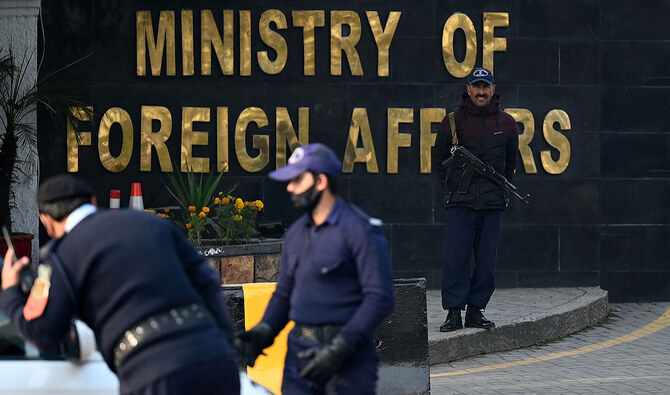
Pakistani police officers stand guard outside the Ministry of Foreign Affairs in Islamabad on January 18, 2024. (AFP/File)
Short Url
Updated 27 January 2025
Follow

Pakistan reaffirms support for Beijing after reports of interior minister attending anti-China event

  • News outlets reported last week Mohsin Naqvi met members of political group opposed to Chinese state 
  • Pakistan’s FO says One-China position “consistent cornerstone” of its foreign policy that remains unchanged

ISLAMABAD: Pakistan’s foreign office spokesperson reiterated support for the One-China Policy on Monday, days after news reports claimed Interior Minister Mohsin Naqvi attended a meeting by a group in Washington opposed to the Chinese state. 

Local and international news outlets reported last week that Naqvi had attended an event in Washington by the New Federal State of China (NFSC), a political movement opposed to the Chinese Communist Party (CCP). The Pakistani interior minister is in the United States to engage American lawmakers on issues of mutual concern, including militancy. 

Naqvi denied the allegations while speaking to reporters on Sunday, describing them as “propaganda.” The minister said he had attended an event by US-based public relations firm Gunster Strategies in Washington, categorically stating that it was not opposed to the Chinese state. 

Pakistan has always backed the One-China Policy, which is the diplomatic acknowledgment of Beijing’s stance that there is only one Chinese government. China uses this policy to form the basis of its ties with other countries regarding the status of Taiwan. 

“Responding to media speculations, the spokesperson categorically rejected baseless and unfounded allegations to target Pakistan-China friendship,” the foreign office spokesperson said. “He reaffirmed Pakistan’s unwavering commitment to the foundational principle of the One-China Policy which is a consistent cornerstone of Pakistan’s foreign policy and remains unchanged.”

The spokesperson described China as Pakistan’s “all-weather strategic partner,” saying their bilateral relations are based on mutual trust, shared values, support on issues of core concern and a commitment to regional and global stability.

China, a major ally and investor in Pakistan, has pledged over $65 billion in investment in road, infrastructure and development projects under the China-Pakistan Economic Corridor (CPEC) project. CPEC is a part of the Belt and Road Initiative, a massive China-led infrastructure project that aims to connect various countries around the globe through trade.


Pakistan invites Uzbek firms to run off-dock terminals at Karachi Port

Updated 10 sec ago
Follow

Pakistan invites Uzbek firms to run off-dock terminals at Karachi Port

  • Pakistan has offered landlocked Central Asian nations access to global sea lanes via its ports
  • Officials in Islamabad seek greater regional cargo flows by modernizing port infrastructure

KARACHI: Pakistan on Thursday invited Uzbek industry and trade stakeholders to consider operating dedicated off-dock terminals at Karachi Port, according to an official statement, as the country looks to expand the use of its maritime infrastructure for regional trade.

The offer was made during a visit by a 13-member delegation from Uzbekistan to the Karachi Port Trust (KPT), where officials briefed them on port infrastructure, terminal operations and logistics-related investment opportunities.

Rear Admiral Shahid Ahmed, the KPT chairman, highlighted ongoing development initiatives, rail and road connectivity and terminal operations.

“In this context, the Chairman invited Uzbek industry and trade stakeholders to consider operating dedicated off dock terminals at Karachi Port to facilitate their import and export operations,” the statement said.

Off-dock terminals are cargo handling and storage facilities located outside a port’s boundaries but connected to it by road or rail to ease congestion and support import and export operations.

The visiting delegation, led by Deputy Minister for Investment, Industry and Trade Gulamov Shokhrukh Khasanovich, also toured private terminals at Karachi Port and was briefed on the use of modern technologies at the facilities.

Pakistan has been offering landlocked Central Asian economies access to global sea lanes through its ports on the Arabian Sea and hopes to position itself as a transshipment hub by strengthening port infrastructure.

Officials say transshipment hubs enable the transfer of cargo from one vessel to another, facilitating regional and international trade and generating revenue.

As part of its port modernization drive, Pakistan has engaged Abu Dhabi Ports Group to upgrade its maritime infrastructure.