

UK team in Pakistan for aviation audit ahead of resumption of PIA flights

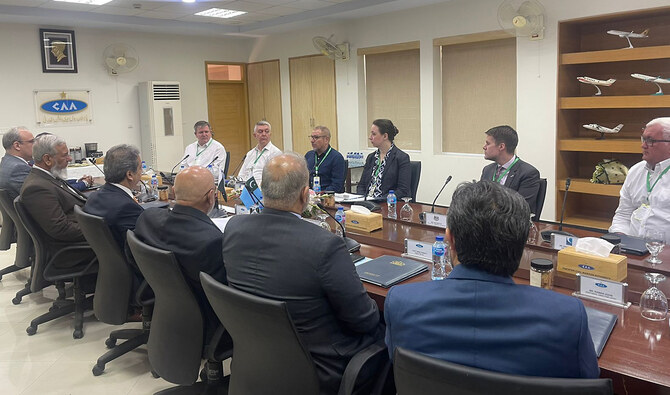
A delegation from the United Kingdom’s Department for Transport and Civil Aviation Authority held a meeting with officials from the Pakistani Civil Aviation Authority in Karachi, Pakistan, on January 27, 2025. (Pakistan Civil Aviation Authority)
Short Url
Updated 27 January 2025
Follow

UK team in Pakistan for aviation audit ahead of resumption of PIA flights

  • European safety agency in November lifted 2020 bar on PIA operating in bloc
  • PIA resumed Europe operations on Jan. 10 with flight to Paris from Islamabad 

KARACHI: A delegation from the United Kingdom’s Department for Transport and Civil Aviation Authority arrived in Pakistan today, Monday, to conduct a safety assessment ahead of the resumption of PIA flight operations between Pakistan and the UK.

The European Union Aviation Safety Agency in November lifted its ban on Pakistan’s national carrier operating in the bloc, a restriction that was placed in 2020 over concerns about the ability of Pakistani authorities and its Civil Aviation Authority (PCAA) to ensure compliance with international aviation standards. The suspension came days after Pakistan launched an investigation into the validity of pilots’ licenses issued in the country following a PIA plane crash that killed 97 people.

On Jan. 10, PIA resumed flights to European destinations with a plane departing for Paris from Islamabad International Airport.

“There will be several high-level meetings between the two sides,” PCAA said in a statement after the UK team’s arrival in Pakistan.

“The discussions will examine aviation safety protocols, review documentation, and evaluate operational procedures. The UK delegation is also scheduled to visit airlines to assess compliance with international standards.”

PCAA said its officials had been engaged for months in technical talks with UK authorities and were “optimistic about the positive outcome of this visit.”

In November EASA said the decision to allow PIA to perform commercial air transport operations to, from and within the EU was based on the “significant efforts” made by the PCAA.

Pakistan had grounded 262 of the country’s 860 pilots, including 141 of PIA’s 434, whose licenses the then aviation minister termed “dubious.” The investigation ultimately did not reveal any major concerns, but the suspension remained in place.

The ban was costing PIA nearly 40 billion Pakistani rupees ($144 million) in revenue annually, according to government records presented in parliament.


Pakistan launches $136 million Ramadan relief package for 12.1 million families

Updated 8 sec ago
Follow

Pakistan launches $136 million Ramadan relief package for 12.1 million families

  • Rs13,000 per family to be transferred via bank accounts, mobile wallets under cashless system
  • Pakistan’s national space agency says the Muslim fasting month is likely to begin from Feb. 19

ISLAMABAD: Prime Minister Shehbaz Sharif on Saturday launched a Rs38 billion ($136 million) Ramadan relief package, pledging direct digital cash transfers of Rs13,000 ($47) each to 12.1 million low-income families across Pakistan.

Pakistan’s national space agency announced a day earlier the Ramadan crescent would likely be visible on Feb. 18, with the first fast expected to fall on Feb. 19, subject to official confirmation.

The government will distribute the relief package through bank accounts and regulated mobile wallet platforms, fully replacing the previous utility store-based subsidy model with a digital payment mechanism overseen by the State Bank of Pakistan.

“This year, Rs38 billion have been allocated ... that will not only be distributed to the rightful people in all four provinces, but also to Gilgit-Baltistan and Azad Kashmir through these wallets and digital bank accounts,” the prime minister said during a ceremony in the federal capital, adding that 12.1 million families would benefit.

The allocation marks a sharp increase from last year’s Rs 20 billion ($72 million) Ramadan program, as the government expands coverage and deepens its shift toward cash-based targeted subsidies.

Officials said Rs28 billion ($101 million) has been earmarked for families not currently receiving support under any federal income assistance program, while an additional Rs10 billion ($36 million) will go to those already registered under existing social protection schemes.

Syed Imran Shah, federal minister for poverty alleviation and social security, said the digital framework would allow transfers to be made in a “safe, effective and easy way,” reducing leakages and preserving beneficiaries’ dignity by eliminating long queues and physical distribution centers.

Amir Ali Ahmed, secretary of the Benazir Income Support Program (BISP), said the 2026 rollout builds on last year’s digital transition, when around two million beneficiaries received payments electronically.

A third-party validation report issued in December 2025 confirmed the transparency and operational effectiveness of the system, he added.

The prime minister said he would personally oversee periodic reviews of the program to ensure timely disbursement.

The government had scrapped the Utility Store-based Ramadan subsidy system last year, arguing that it led to quality concerns, long queues and administrative inefficiencies.

The digital transfer model aims to move toward a targeted subsidy regime aligned with broader efforts to expand financial inclusion and reduce cash-based leakages.