Ronaldo on target again as Al-Nassr win to go 3rd in Saudi Pro League

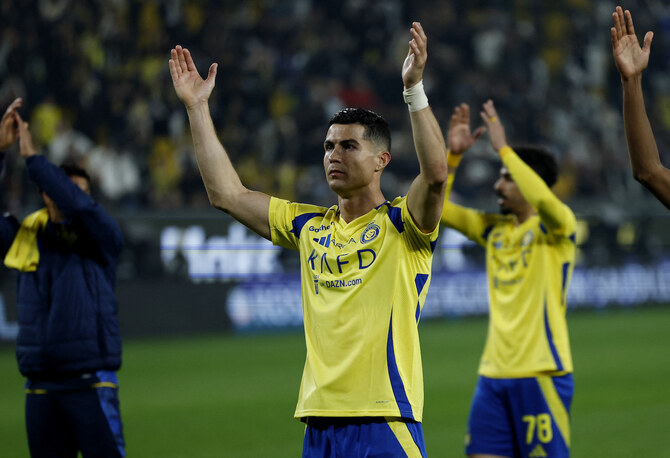
Al-Nassr’s Cristiano Ronaldo celebrates after the Al-Nassr v Al-Fateh match on January 26, 2025. (Reuters)
Short Url
Updated 26 January 2025
Follow

Ronaldo on target again as Al-Nassr win to go 3rd in Saudi Pro League

  • Late strike lifts Portuguese star’s goal tally to 14 — and saves goalkeeper’s blushes

RIYADH: Cristiano Ronaldo’s fine goalscoring form continued in the Saudi Pro League on Sunday as he helped Al-Nassr defeat Al-Fateh 3-1 to move back into third place. 

A late strike made it three goals in two games for the five-time Ballon d’Or winner as he moved clear at the top of the goalscoring standings with 14 for the season so far.

The deadlock was only broken four minutes before the break when Marwane Saadane put into his own net from close range after Angelo drove a low ball across the face of goal. Angelo was the provider of the second just before the hour, swinging over a free-kick for French defender Mohamed Simakan to head home his first goal for Al-Nassr.

At 2-0 the game seemed done and dusted, but with 18 minutes remaining, Al-Fateh, in last place in the standings, reduced the arrears thanks to Mourad Batna, who pounced after goalkeeper Bento spent too long on the ball inside his own area and was caught in possession.

Ronaldo spared Bento’s blushes with three minutes of normal time remaining, just as the visitors were threatening to take a surprising point.

It was so simple. Sadio Mane broke free down the left, passed to the far post, and there was the Portuguese star to sweep home with the minimum of fuss.

Ronaldo had the ball in the back of the net once more deep into injury time, smashing home spectacularly from the right side of the area, only for the strike to be ruled out for offside.

Al-Nassr now have 35 points from 17 games, eight behind Al-Hilal and Al-Ittihad, who have a game in hand. 

Earlier in the day, Al-Ahli made it seven wins from the last eight in the league with a 5-0 thrashing of Al-Riyadh.

Two goals from England striker Ivan Toney and one each from Roberto Firmino, Riyad Mahrez, and Ziyad Al-Johani made the difference as the Jeddah club stay in fifth, three points behind Al-Nassr.


Inside Al-Fateh, Saudi Arabia’s community-driven club

Updated 22 January 2026
Follow

Inside Al-Fateh, Saudi Arabia’s community-driven club

  • Saudi Arabia’s ‘Model Club’ ranks fifth overall in the league’s average attendance, despite sitting in the lower half of the table

AL-HASA: When the world’s top footballers made their way to Saudi Arabia after the arrival of Cristiano Ronaldo, most of the international fan focus was on the top six. The Eastern Province, in particular, saw most media outlets focus on Al-Qadsiah and Al-Ettifaq. Yet between Riyadh and Dammam lies a city called Al-Mubarraz, home of Al-Fateh.

For the international audience, they may have come across the club when Jason Denayer or Cristian Tello joined the club. But for local fans, they were mostly known for their Leicester City-like achievement in 2013.

Against all odds — powered by the duo of Doris Salomo and Elton “Arabia” — Al-Fateh were crowned champions of the Saudi Pro League for the first time in their history, just a few years after securing their maiden promotion to the top tier.

13 years on, Al-Fateh are known for more than their one-off victory. Donning the nickname of “The Model Club”, Al-Fateh have set an example for clubs in Saudi Arabia and the Middle East.

While most clubs rely on big signings or short-term initiatives to attract fans, Al-Fateh have built their model on community values. It comes to no Saudi fan’s surprise that outside the Big Four — Al-Nassr, Al-Hilal, Al-Ahli and Al-Ittihad — Al-Fateh have the highest average attendance in the league with 8,132 fans per game.

The club were the talk of the town after their recent home encounter against Al-Riyadh, where more than 9,000 fans attended. Al-Riyadh have the lowest attendance in the Saudi Pro League and have been lingering near the relegation zone.

All this has come despite limited on-pitch success in recent seasons — a period that has seen Al-Fateh battle relegation rather than trophies.

Why then, are their attendance figures higher than more successful clubs such as Al-Qadsiah, Al-Ettifaq, Al-Khaleej and Al-Taawoun? Al-Fateh have managed to build a community feel around the club — regardless of form or signings — that few, if any, are able to replicate.

Majed Al-Afaliq, Board Member at the club, told Arab News why Al-Fateh are different when it comes to attendances in the league. “Al-Fateh is engaged with its community, the club always has its doors open for the people of Al-Hasa.”

Al-Hasa, the largest governorate in the Eastern Province, is a region known for its success on a sporting level in Saudi Arabia. “Today Al-Fateh hosts more than 1,000 athletes on a daily basis. So all these people, their families and their relatives are directly and indirectly involved with the club. Hence, their attachment to the club grows — because we’re open to the whole community.”

Al-Afaliq spoke openly about the different strategies deployed by clubs to attract a larger audience. “We don’t try to attract fans by bringing in certain players, or because of big signings. We want to engage with our community,” said Al-Afaliq.

An example of this is how the club makes its presence known at community events. “If you look at the majority of social events in Al-Hasa, you’ll find our mascot there, promoting Al-Fateh games.”

This has built a long-running connection for fans with the club. With the Al-Fateh Stadium located right in the heart of Al-Fateh neighborhood in Al-Mubarraz, the stadium is easily accessible for fans.

It isn’t just fans that Al-Fateh are connecting with in the community, but players. “We give opportunities. We believe in our players. For example, we have players in our starting XI that are 17 years old. We often have six to seven players in our starting eleven who are products of Al-Fateh. Who else is doing that in the Saudi Pro League?” Al-Afaliq told Arab News.

An unprecedented rise from the third tier, the largest attendance outside the big four, and an academy that produces the league’s local stars on a yearly basis — all in the space of 18 years — it is no wonder that Al-Fateh have become known as the Model Club in Saudi Arabia.

Al-Afaliq concluded: “Where do we see ourselves 5, 10 years from now? We want to be a special and unique model compared to other clubs. We want to continue improving ourselves when it comes to fan engagement and the matchday experience. I think we have a good shot at doing that.”

In an era defined by star power and spending, Al-Fateh remain proof that community can still fill stadiums.